

ORLANDO–Three CFOs from three different-size credit unions shared some of their budgeting best practices and lessons learned.
Sharing their viewpoints and advice with America’s Credit Unions’ Finance Council’s annual meeting were Brandon Smith, CFO with the $680-million Meridian Trust FCU in Cheyenne, Wyo.; Julie Zink, CFO with the $312-million Marshall Community CU in Marshall, Mich., and Jeff Welch, CFO with the $2.1-billion FORUM Credit Union in Indianapolis.
The session was moderated by Ashley Vandermause, CFO with the $303-million United One CU in Manitowoc, Wis.
Here’s a look at what was discussed:
Vandermause: At what point do you kick off the planning process?
Smith: We try to do the planning before we start the budget process. So, it's important if you don't do it that way that you start with your strategic planning. We usually try to do that it in September. We kick off Sept. 1st, usually with requests for budget and then ask that that be completed by the end of the month so that we can close the third quarter and then just begin with our projections and building out things.
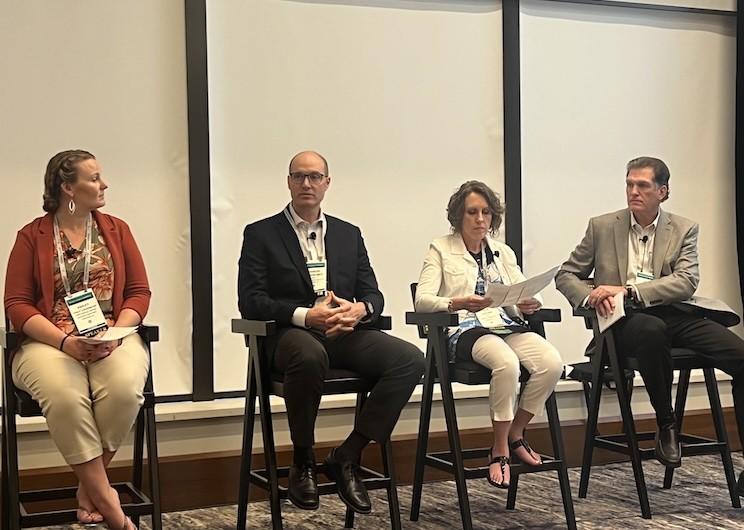
From left: Ashley Vandermause, Brandon Smith, Julie Zink and Jeff Welch.
There's some flexibility depending on what you need there, but that's the general flow.
We then try to take that budget in November to the board meeting. That gives us one more board meeting before we end the year for anything the board may want us to adjust.
Welch: We present our budget and business plan to the board in January. We close out the year and they give us the good grace to make some decisions in January. We update the business plan as to how we’re doing with objectives and initiatives and variances monthly. At mid-year we do a full blown forecast revision. We look at last half of the year and then the full year, as well. That gives us some muscle memory going into September as we start the full process.
In November, we have an internal full draft; we have a second draft in December, before we finally release it in January to our board. It starts really in earnest in September.
Vandermause: What does initial communication look like around budgeting?
Zink: Almost our entire leadership team is included. What we do is we develop a budget workbook of the items that they are responsible for contributing to the budget estimates. We get that out to the leaders, the effective leadership team members and give them a couple of weeks. Usually we do a kickoff meeting, because once a year people don't remember necessarily, especially if they're newer. But everybody, I think, likes to have that refresher. We’ll remind them how it works and give them their timeline. They go to work, they do the inputs.
I also do what I call a strategic budget meeting with my fellow executive leadership team members, so you know all the deposit-related assumptions, all the loan-related assumptions.
I decide the rates, what I think the rate forecast is going to be and how that's going to trickle through to our pricing. But for our loan growth, deposit growth, a lot of our fee income type items, we…discuss it and develop it together to make sure it's all consistent. If you're expecting this kind of loan growth then that should filter through to your loan income. You don't want those to be out of sync with each other. We make sure that all syncs together.
We’re a small credit union so we don't do full departmental budgeting. We really do it more at the GL level. That's not really how I prefer it, but I haven't made that change at this point because that would be a conversion process and a pretty big organizational change.
Vandermause: What about the communication process for you?
Smith: The thing I would highlight is it’s been a little bit of a journey. I have been in three credit unions in a year (including a merger). I have been able to see it differently in all three shops. I inherited a budget at Meridian Trust that was built by Finance.
I think the thing I’ve noticed is in doing it that way, without that involvement, there is less buy in and understanding and alignment with the strategic plan. I think just being open and getting more input—somebody has to own the process and build—but if you get that collaboration you get a better budget.
Vandermause: How do you handle ongoing reporting and variances?
Welch: On a monthly basis there are three big reports we update. Obviously, the financial reports, our business plan, and an organizational scorecard. We have five primary goals and then we have 15 supplemental goals that are kind of tied to those five. I update that on a monthly basis and get that out to our staff via our intranet, and then I usually give a synopsis of how we're doing, if we're missing something, why, can we catch up and what's going on.
I get information from the different departments.
We have internal scorecards and biweekly we have a pricing committee (meeting). Obviously, we don't go through the whole gamut of our products. We also talk about productivity, how are we doing in indirect lending, which is big for us; how are we doing in first mortgages and commercial lending. Are we over or under the goal? Where are we going to be by month-end, by quarter-end, by year-end? What are rates looking like compared to what we had forecast?
We also have loan and deposit production reports weekly and actually daily, so the weekly ones go out to the different departments, to our retail and lending areas. The deposit one goes everywhere across the credit union but especially to our retail delivery team: branches, member services, our call center, because they're producing more of the deposit side.
What were the costs coming in from CD specials? A lot of you probably have CD specials. Are those getting new money? Are we getting old money that's being transferred from money markets or another CD that matured?
Most of the reports go to all the staff and that's via our intranet. Then we're like, ‘Hey what kind of questions do you have?’ and a lot of times it's crickets. But sometimes there's very good questions coming from when there's big positive or a big negative variance.