

ORLANDO–Innovation often fails inside credit unions due to trap questions, zombie projects and from asking the wrong questions, according to one expert, who shared a credit union example of how to improve processes.

Diana Kander addresses the meeting.
Speaking to America’s Credit Unions’ CFO Council meeting here, Diana Kander shared three rules for “staying curious even after success,” which she said is the secret to innovation.
Kander, who arrived in the United States at age eight with her family as refugees from the former Soviet Union who were unable to speak English, before settling in Kansas City, earned a law degree from Georgetown, has been a founder in 10 companies and a New York Times best-selling author.
The one lesson she said she took away from the Soviet Union was that everyone was discouraged from ever asking questions.
Living Testament
“I feel like I’m a testament that no matter how you grew up there is a little spark inside of all of us,” Kander said. “Is there a better way to do it? Yes, there is always a better way to do it.”
But even with a better way, there’s a challenge, Kander told the meeting.
“The more we know, the less we question. When we become an expert we hit the expert plateau,” she said. “Our rate of learning drops, because we have found a way that works. To me, curiosity is the space between what we know and don’t know. And when we show up at work we don’t have any space. We have a to-do list.”
Innovation, Kander said, comes from creating that space.
Three Rules
Kander said there are three rules for staying curious even after success, which she said are the core tenets of her Nonstop Innovation Playbook.
Rule #1. Raise our Standards for a “Yes’
Kander urged credit union leaders need to rethink what gets their time and attention.
“A trap question is, ‘Should I or shouldn’t I?’ But the quality of ideas can be seen on a range of 1-10, most of which are 5s and 6s,” said Kander. “Instead of saying. ‘Should I…?’, the binary question that tricks us into saying yes to terrible ideas, I ask ‘How does this rank 1-10?’”
Having teams participate in the ranking of ideas can lead to a “richness of discussion” around why one idea is a two and another is an eight.
“I have worked with credit unions that have switched their loan approval process from yes/no to ranking 1-10,” Kander said.
Rule #2: Kill the Zombies
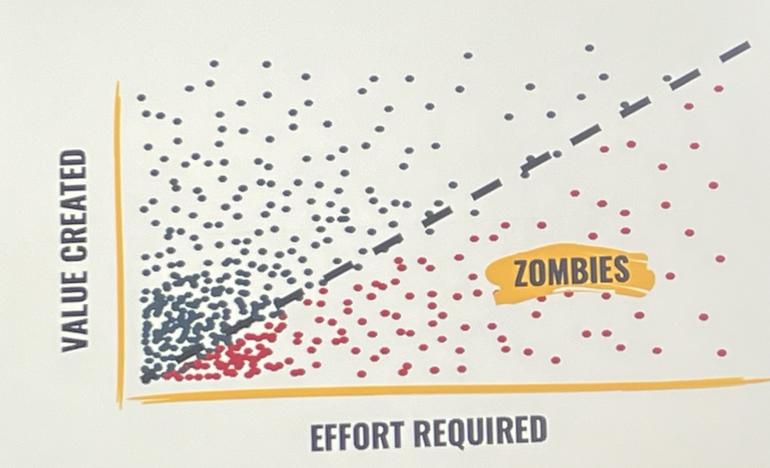
Kander used this value map to help CUs determine whether an idea is a “zombie.”
“We think everything we do at work creates value. I disagree,” said Kander. “Zombies are projects that are alive that don’t die of natural causes. They are processes and meetings that you can classify as zombies. And if we never go looking for them they will continue to pervade our organizations. It is only when we ask what’s not working around here that teams are empowered to say, ‘This isn’t doing what we thought’.”
The king of the zombie-killing companies is Amazon, Kander said. A company that has become a retailing and revenue giant has done so at the same time it has killed numerous Zombie projects, including the Fire phone, Amazon Destination, Amazon Local, Amazon Wallet, Amazon Local Register, Amazon Cloud Player, Amazon Test Drive, Amazon Webpay, and more.
Going ‘Hunting’
“It’s not that Amazon is genius, it’s that Amazon has systemized zombie hunting,” said Kander. “They figure out what’s not working at record speeds. When the zombies are no longer alive, the 8s, 9s and 10s will start to thrive.”
As a CU example, Kander said Vancity Credit Union in Vancouver, Wash. named a director of simplification, who went through 430 policies and procedures and found a way to get rid of 150 of those, while simplifying 150 more. Similar results were had by going through forms inside the credit union.
“Don’t’ ask what should we add, ask what should we stop?” Kander recommended. “That can be the most powerful catalyst for growth.”
Rule #3: Reimagine What’s Possible.
Kander told the meeting’s attendees that when people get so good at their job they often can’t see incremental improvements. To that end, she recommended beginning with a “blank sheet of paper” process.
How to Sign Up For the Best Daily News Email in Credit Unions? (It’s Free!)
Every workday CUToday.info delivers the most comprehensive, freshest daily newsletter with the day’s news headlines, including links to the related articles. The Fresh Today newsletter is the most timely, relevant and widely-read source of news and information in the CU community. And it’s free!
If you haven’t yet signed up for the new email solution on which CUToday.info has partnered with ResponseGenius, you can do so here. Signing up requires less than one minute of your time—and it’s free!
Please note that after signing up you may need to go to your Spam/Junk folder and mark the morning headlines email as safe. CUToday.info does not provide its list of readers and emails to outside parties,
And did we mention it’s free?