

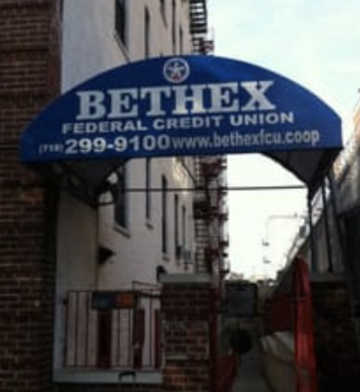
WASHINGTON––The Financial Crimes Enforcement Network (FinCEN) has assessed a $500,000 civil money penalty against the defunct Bethex Federal Credit Union, Bronx, N.Y., for significant violations of anti-money laundering (AML) regulations.
Once among the best known of low-income CUs, the credit union was liquidated by NCUA.
FinCEN’s penalty is a claim against any assets that remain after the completion of Bethex’s liquidation. The penalty will not affect the National Credit Union Share Insurance Fund or any other credit union, FinCEN said.
According to FinCEN, since 2002, Bethex’s AML program maintained internal controls specific for low to moderate-income clientele within its designated field of membership in New York City.
“In 2011, Bethex began providing banking services to many wholesale, commercial money services businesses (MSBs). Many of these MSBs were located in high-risk jurisdictions outside New York and engaged in high-risk activity, including wiring millions of dollars per month to countries at risk for money laundering,” FinCEN said. “When Bethex began to service these MSBs, it did not take steps to update its AML programs. As a result, Bethex was unable to adequately monitor, detect, and report suspicious activity or mitigate the associated risk, leaving the credit union particularly vulnerable to money laundering.”
Among other violations, Bethex failed to timely detect and report suspicious activity to FinCEN and did not file any Suspicious Activity Reports (SARs) from 2008 through 2011. In 2013, as a result of a mandated review of previous transactions, it late-filed 28 SARs. The majority of the suspicious activity involved high-volume, large amount transfers outside of Bethex’s expected customer base by MSBs capable of exploiting Bethex’s AML weaknesses, FinCEN said. Most of those SARs were inadequate and contained short, vague narratives encompassing a broad summary of multiple and unrelated instances of suspicious activity. For example, one SAR covered over $906 million in total aggregate of suspicious transactions, but provided little information useful to law enforcement investigators, FinCEN said.