

MADISON, Wis.–Credit unions have been offered some direction on how to better understand and simulate what their balance sheets might look like moving forward in a “very volatile future,” as well as been given a list of questions to be asking themselves.
During a webinar hosted by the Filene Research Institute, Mike Higgins, Jr., managing partner of Higgins & Associates, walked credit unions through the importance of establishing a “run rate,” or a point of reference as they work to reforecast where they might stand at the end of 2020 and prepare for 2021 as the coronavirus pandemic and its economic fallout sends everyone back to the drawing board.
The webinar was moderated by Filene’s George Hofheimer.
Noting “prior performance does not guarantee future results,” especially now, Higgins said financial institutions are in a “new reality,” and that nothing can be done related to what’s happened in the past.
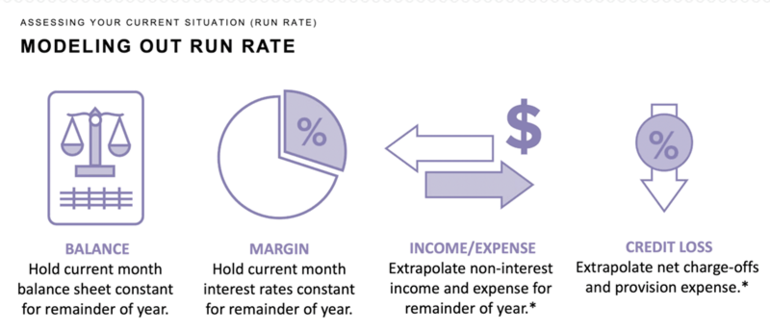
Instead, what CU management teams need to be doing is creating that run rate to better understand “what might happen if nothing changed for the rest of the year.”
Such a status quo modeling is only an “assumption,” Higgins stressed, but it provides the kind of reference a credit union needs to better peer into its balance sheet, provide scenarios to the board, and make better decisions.
Holding Balance Sheet Constant
In creating that run rate a credit union holds the current balance sheet constant for the remainder of the year, including interest rates, expenses, non-interest income, credit losses and provision expense.
Larger institutions with larger finance staffs will be able to get more granular in the data, he said, but the real objective is to create a foundation.
“Things are in a great state of flux right now,” said Higgins. “It’s good to model out the rest of your year so you know where your pain points reside and you can establish expectations with your board. But I’d probably wait until end of May or June before formally reforecasting or rebudgeting for the rest of the year.”
One caveat in setting that run rate, said Higgins, applies to any credit union seeing loan balances jump as the result of Paycheck Protection Program loans from the SBA that will not be reflected later in the year.
Important Step
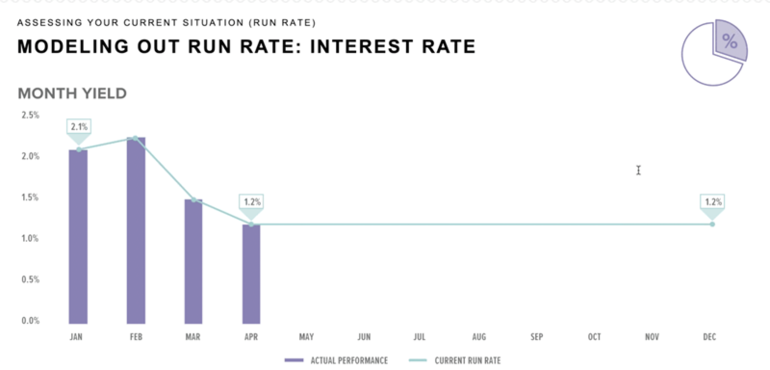
“It’s important to model out interest rates and the investment portfolio,” said Higgins. “The new reality isn’t what was the yield last year or earlier this year, it’s what’s my yield now and for rest of year. We are probably going to see the same thing with deposit costs, as those costs will likely come down, and we will also see a dip-down in loan yield. Holding things steady lets you build that baseline.
“When you bring them all together you get to your new reality on return on assets, and hopefully it’s not a bad reality,” Higgins continued. “This is not a prediction of the future, it just answers where am I now and what will remainder of year look like if nothing changes.”
Minimum Data Set to Model Out
The financial drivers to include in terms of the minimum data set needed for the run rate model, said Higgins, include:
- Loan balance and yield
- Surplus funds balance and yield
- Funding balance and cost
- Non-interest income
- Non-interest expense
- Net charge-offs
- Provision for loan loss expense
Financial Outcomes
The minimum data needed to model out financial outcomes, said Higgins, include:
- Annual net income and ROA
- Ending net worth
- Ending loan loss reserve
- Ending net interest margin
- Ending efficiency ratio
- Ending excess/deficit funds (liquidity)
- Ending ROA
“This is not the average outcomes for the year; it’s where you are going to end the year,” Higgins told the Filene webinar. “I think that’s really important to understand. The key in this modeling is understanding where are you going to end the year, because that’s what you’re going to take into 2021.”
Higgins said this type of modeling aligns with one of his favorite observations about projections, that it’s much better to “be approximately right than absolutely wrong.” Overall, Higgins reminded, the objective is to avoid analysis paralysis and the best way to do that is to think in terms of ranges.
Three Scenarios
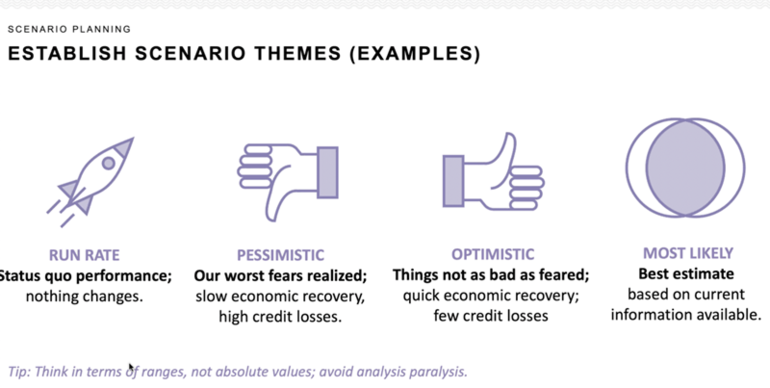
All such planning, he said, should include three different scenarios:
- Pessimistic Scenario, in which the worst fears are realized
- Optimistic Scenario, in which things are not as bad as feared, there is a quick economic recovery and few credit losses
- Best Estimate Scenario, which is based on current information available
“I think it’s important when doing the modeling if you can have some visualization to it, not just the simple rows and columns of numbers,” suggested Higgins, adding that understanding what’s happening is important, but what’s even more important is to understand why something is happening.
Important 2021 Metrics
Going into 2021 expense ratios and operating efficiency are going to be a keys to watch, Higgins said, recommending credit unions find ways to manage the expense-to-ratio relationship.
He reminded that projections may show ROA declining, but that could be the result of setting aside additional funds for loan-loss provisions, which doesn’t show up in the efficiency ratio.
A Meteor Strike
Higgins advised management provide multiple scenarios and models to the board so it can understand what decisions need to be made and why, including identifying all areas of exposure and the options for mitigation.
“This health crisis is a meteor strike from outer space. (A CU’s economic performance) has not been caused by sloppy management. This is something we need to confront,” he said. “Scenario planning will give the credit union board confidence in the management team. You may have to tell the board, ‘We’re going to see this and we might have to temporarily allow this to happen.’ It’s a great discovery exercise.”
Trends and Observations
Higgins also offered these trends and observations and questions to be asking:
- Cash conversions, stimulus checks and PPP are driving up deposit balances. But for how long?
- Fewer transactions are driving down interchange and overdraft/NSF income. How much? “This is such a large portion of most financial institutions’ non-interest income; I would want to get my arms around this for the rest of the year,” said Higgins
- Loan originations are down. What is your consideration? How long will it be impacted? “You might be able to make a little hay with mortgage originations.”
- Elevated expense associated with transition to work from home. Temporary?
- Credit losses. How many? Loan loss reserve—how much to hold? “This is the big $64,000 question. That’s going to be driven dramatically by the kinds of lending you are doing. There are certain types of loan that are going to see higher losses than others.”
- Margin compression is a reality. How to offset? Lower dividend rates? Hold mortgages?
- Liquidity. If members tap out credit cards, credit lines? Has risk basis increased? “How much credit do we have outstanding, versus how much could we have outstanding? What if it’s 30% utilized now but it jumps up to 50% or 60%?”
- Temporary net worth decline due to funding growth. Has risk basis increased?
- Scenario plan now, but revise/update guidance at conclusion of second quarter? Higgins said most of his clients are waiting until the end of Q2 to formally revise their plans.
- Net worth buffer (above 7% or 8%). “Compute how long it would take to fully deplete your net worth, for reassurance and confidence. We are so fortunate in this industry we are required to hold significant reserves.”