

MADISON, Wis.—What makes for a strong diversity, equity and inclusion framework within an organization and what kinds of goals and metrics are needed to make DEI efforts successful at the credit union?
Offering some answers was Filene Research Fellow Dr. Quinetta Roberson who shared findings from Filene’s latest research. She emphasized there is one key step that must be taken is aligning DEI programs with business strategy.
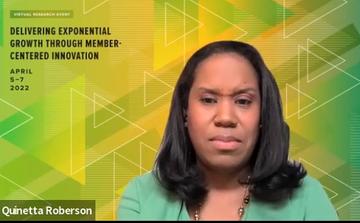
“It’s about how do we bake this into what we do, the business case, right?” said Roberson during day two of Filene’s three-day virtual research event. “Now, that's not the moral imperative, and it also doesn't necessarily capture what employees need. That’s the other part of the story…We have to begin thinking more collaboratively and thinking about how to bake (DEI) into what we do in a way that's both top down and bottom up.”
Roberson, a John A. Hannah distinguished professor of management and psychology at Michigan State University, stressed the importance of having metrics to measure DEI programs.
“How are we going to know that we're doing the right things and that we're making progress? And I love the idea of a balanced scorecard. It's an old concept, but applied to DEI it allows you to take that DEI journey and embed it in all different parts of your organization,” she said
Roberson emphasized that metrics should not simply be thought of as “success metrics.”
“Words matter, and success metrics, I don't think that's necessarily the case,” said Roberson. “It's not necessarily that we've achieved the destination…but we've actually made some kind of change, some positive change, some movement towards whatever the goal is.”
Opportunity To Be Great
Equity metrics, Roberson explained, should ensure everyone within the credit union has the same equality of opportunity.
“Does everyone have the same opportunity to be great?” she said.
To address equity, Roberson recommended credit unions must think about how people move through the organization.
“I remember working with an organization, and they just assumed people in certain roles went from one role to the next role and to the next role,” Roberson recalled. “But what they found was certain groups of employees were off-boarding. They were jumping off this path because of the culture in the other (new) unit. They were saying, 'I don’t want to be in that culture. I don’t want that lifestyle. I don’t like what that entails.' And some people were moving laterally. So, looking at the movement of your people will give you some information about equity.”
Inclusion metrics, Roberson stressed, are about making sure people feel comfortable, safe and a contributing part of the organization.
“Inclusion measures, it’s about do people have that sense of uniqueness and belonging,” she explained. “What value do I bring to the table? Do I feel like I am part of the group? But there's also aspects of psychological safety. Can I disagree? Do I feel comfortable dissenting? Or, do I feel that I'm making a meaningful contribution?”
DEI Leadership
Turning to DEI leadership within an organization, Roberson said much of the effectiveness of the chief diversity office or DEI council depends on the tools and power they are given.
“Whether it is a chief diversity officer or council, they have to have the ability to affect change in that particular organization,” stressed Roberson. “There has to be that power structure, if you will, and probably the resource base—in staff and in budget. They have to be able to drive change. If I'm a chief diversity officer or on the DEI council and we don't have the ear of the CEO, or we don't have a real seat at the table with the other executives, then the DEI effort falls flat.
“I've seen some restructurings where the chief diversity officer reports to the chief HR officer,” continued Roberson. “Now this person has to go through another level of approval. There just really has to be that institutionalization (of DEI) along with commitment to it.”
Perhaps of all of the keys to the effectiveness of DEI programs, suggested Roberson, is tying the tactics and strategies of DEI to the work of the credit union.
“And, it's important to distinguish tactical from strategic—the work the DEI council or chief diversity officer does has to be at that strategic level,” she said. “How does this relate to the credit union’s growth or what we're trying to achieve? It has to be something that is more aligned with the work of the credit union.”