

MADISON, Wis.—Rapid inflation, including skyrocketing gas prices, has created a new period of financial uncertainty that one expert says requires credit unions to listen closely to their members’ needs and “clear out the noise.”
Lisa Servon addresses Filene meeting
“This is an interesting moment to be thinking about financial services, and specifically about how credit unions can help people achieve financial health. We all know the pandemic has been incredibly hard for people,” said Lisa Servon, professor of city planning at the University of Pennsylvania. “It's wreaked havoc on many people's financial lives.”
Servon, a Filene Research Institute fellow who leads the Institute’s Center of Excellence for Consumer Financial Lives in Transition, shared data from the Center that shows people are concerned about financial insecurity, food insecurity, housing payments and more.
“They're really connected to money and financial instability,” said Servon during the first day of Filene’s three-day virtual meeting titled "Delivering Exponential Growth through Member-Centered Innovation." “Financial instability was the new normal before 2020, and COVID has only made it worse. Currently, we're seeing a lot in the news about inflation. And folks are starting to panic about how it will affect their personal finances. It's injected this whole new element of uncertainty into situations that were already bad for so many people.”
Consumers 'Riled Up'
Servon pointed out that in recent weeks as prices have skyrocketed Americans have been getting “riled up.”
“I get that. I really do. But as someone who's really been thinking about and paying attention to financial insecurity for several years, what I don't get is why we're not as riled up about some of the other things that are causing so much financial distress and have been for a long time,” she said.
Servon contended rising gas prices would not be impacting consumers as much as they are if other costs, such as childcare expenses, were not rising quickly, as well.
Servon asked attendees what it means to be member focused in the current financial environment.
“For me, thinking like a social scientist, what it really means is clearing out the noise of the current situation, but paying attention to it for sure,” Servon said. “Also thinking about the broader context of tracking real-time changes in the social and economic environment beyond what you might hear in your member feedback channels and your social media feeds. These things are important but they can also distract us from the bigger picture.”
A member-focused strategy also requires both product and service delivery design that starts with member needs, Servon explained.
“It's not enough to look at what your members do. It’s almost more important to look at the immediate and structural conditions that are motivating and shaping what they do or what they don't or can't do,” Servon said. “Many of you understand that innovation from a jobs to be done perspective can be very effective. But what's even more critical, I would argue, is understanding this notion of jobs to be done in context. And of course, what people say they want to do is often different from what they actually want to do. So, that's where my training comes in and kind of digging underneath that and finding out what's really going on.”
Servon said credit unions must do that, too.
“We think of financial institutions focusing more on what I would call lifecycle kinds of transitions, buying a house, getting married, retirement, those kinds of things,” she explained.
More Realistic Focus
But what might be a more realistic and effective focus today, asserted Servon, is the transition that young adults go through as they become independent from their parents.
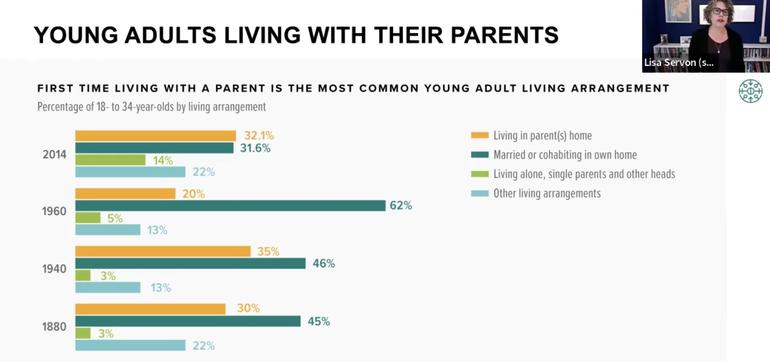
“This is what we call emerging young adults. So, what's different about young adults today than say, when I was a young adult in the mid-80s and early 90s? The first thing we see is that young adults, much more than they used to, are living with their parents,” Servon said. “And you can see the group that's living with their parents has gone up, and certainly from the period of 1960 to 2014. We see many more people who are doing that either staying with their parents, perhaps after high school or returning to their parents’ homes after college. We call that the boomerang generation.”
Servon pointed out that the health crisis has only increased the number of kids returning home.
“Not surprisingly, we see numbers going way up between 2020 and 2021,” she said. “That is definitely a sign of financial insecurity,” Servon said.
Filene data show that young adults who are less educated are more likely to return to live with their parents.
“A full 58% of adults ages 18 to 34 wouldn't be able to afford their lifestyle without assistance from their parents,” she said. “As a social scientist, when I see this figure in particular, what I think about is the parents.”
A Growing Situation
Servon urged credit unions to pay close attention to what is happening with young adults and their aging parents.
“There are issues that are facing not only young adults, but also their parents, whose financial health and ability to retire securely, may be jeopardized by their perceived obligations to their children,” she said.
This is a growing situation more credit unions must recognize and address, Servon added.
“I interviewed scores of people who had taken out payday loans and I heard a lot of stories from people who are going into debt in order to support their grown children or to help take care of grandchildren,” Servon said. “They were really brokenhearted by the fact that their children and grandchildren could not establish their independence as easily as they could, but they were actually taking out these high-cost loans to help be able to afford that. And I think they would have loved some other kind of guidance about maybe how to better meet those challenges.”