

MADISON, Wis.–Credit unions are mistaken if they perceive loans to the unbanked, especially those who have only an Individual Taxpayer Identification Number (ITIN) as ID, as risky money losers, according to organizations that say just the opposite is true.
During a Filene webinar session titled “The Financial Inclusion Challenge,” several people shared their experiences in making so-called ITIN loans, saying the risk can be mitigated, the loans perform, there is good ROI to be had—and all while fulfilling the credit union mission.
In introducing the market, Filene noted a large percentage of America’s minority households are financially vulnerable and underserved by mainstream financial institutions. Nearly half of African American households are unbanked or underbanked, as are 45% of Hispanic households.
George Hofheimer, EVP and chief research and development officer with Filene, said the research organization set out through its incubator process to test a hypothesis: If mainstream FIs offer alternative lending options, they will provide consumers with affordable solutions they may not otherwise have access to and help them get one step closer to financial stability—all while also helping the credit union.
Filene partnered with Point West Credit Union in Portland, Ore., which has been at the “vanguard” of ITIN lending, said Hofheimer, to test its hypothesis in a test that included 13 credit unions over 18 months.
As the chart below illustrates, the results were beneficial to all involved
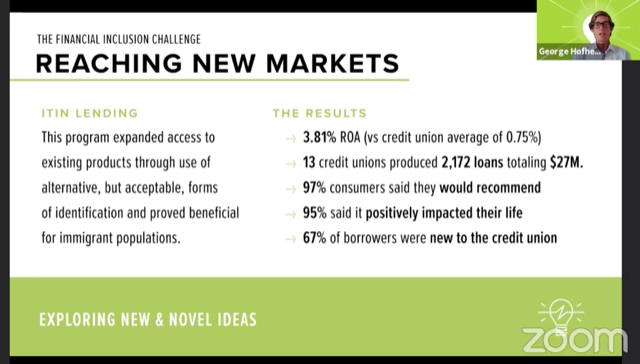
“We found delinquencies and charge-offs were not at the level many thought they would be,” said Hofheimer. “Within the project we clearly saw there was a path to sustainability. We are now in the process of scaling, and have developed a series of Do It Yourself Guides available to everyone.”
Victor Corro
Virtual Q&A
The virtual session included a Q&A with Victor Corro, president and CEO of Iowa-based Coopera, and Aaron Palmer, chief revenue officer at TwinStar Credit Union in Olympia, Wash., which have been involved in the national and local levels, respectively, when it comes to deployment.
Here’s a look at what was discussed:
Hofheimer: What is ITIN lending and why is it important?
Corro: ITIN lending is a tool for inclusion. It is at the core of what we do or should be doing as an industry. We can find those consumers with no access to financial services and find a way to mainstream them and give them a place where they can trust their money.
ITIN is individual tax number issued by the IRS for someone who can’t get a Social Security number. It can be used as an ID to belong to a credit union. It’s kind of the key to opening the door to financial inclusion for many consumers. From there, a credit union must include them in all the products and services they can offer to a consumer. This consumer usually is a person who is working on their immigration status.
For the credit union itself, it’s a way to include more and more folks to fulfill their mission. It’s been tested and it’s been proved that ITIN lending supports ROI, the bottom line of credit unions. It’s in the best interest of the credit union and the consumer.
Hofheimer: TwinStar is on the journey toward implementation. Where are you in the process?
Palmer: We have gone through a number of steps in this process. We are about a $1.6-billion institution in the Pacific Northwest and we do have many Hispanic communities and immigrants and within them many ITIN account-holders.
Eleven years ago we started a program allowing ITIIN-holders to open accounts. About three years ago we had a group of our employees come to us through an innovation committee and they posed a question to senior management: Why do we have members of the community from whom we are willing to accept deposits but we are not willing to lend to them? I can tell you it caused all to pause and ponder our policies and the exclusion we had created, and we started to research what that market looked like and could we identify the right strategy to successfully serve this community with a business case that supported it.
We are in the backyard of Point West, and they have been a very collaborative partner for us and shared as much information as they can.
We came to the conclusion we should expect similar levels of performance as long as proper controls are in place. We are now moving forward Nov. 1 with ITIN lending program, which rather than being special program is part of our normal lending products.
Hofheimer: Two part question: What are the obstacles in implementation, and has there been a renewed interest in the past several months as the environment in which we all live has changed?
Corro: In terms of obstacles, it’s usually the lack of knowledge inside the credit union about the size of the opportunity that exists. That lack of buy-in internally is from those don’t know the market opportunity or know which consumers need us the most. Although there may be good intentions, it doesn’t go anywhere.
This really has to be treated as a strategic initiative. Then we need to know what risk we will have, and then have outreach. It may seem an overwhelming endeavor, but actually it’s not. It’s what credit unions do day in and day out.
In terms of renewed interest, yes, this pandemic has changed the dialogue. That obstacle, the buy-in, has become easier to overcome. More and more
Aaron Palmer
people within the credit union decision-making structure are saying, ‘Yes, we do need to include.’ The pandemic has highlighted inequalities in our society and put them front and center.
Consumers want a safe place to take their money, a safe place to get advice. There is so much uncertainty over the future. Again, credit unions need to be prepared to include and understand new consumer communities. Having ITIN lending is a tool for inclusion.
Hofheimer: Aaron, you are a former i3er, and we teach incubation through i3--how is TwinStar approaching this? Full-on implementation or are you starting small?
Palmer: A lot of the tenets we were taught through i3 and best practices used we are using in this process. One of the lessons we learned along the way is we had to get buy-in from the organization. We identified a need in our community.
Probably our biggest obstacle was the search for perfection probably delayed our implementation. We have people coming in day in and day out asking for this. The reality is we have people who need help today, coming into our lobbies, and we have been saying no. So, we are going to implement at the rate-sheet level.
We have about 1,500 members who are ITIN-holders. We are going to do our best to serve those individuals and use word of mouth. We expect to stub our toe, but we also expect the portfolio to perform. We have members of our team who have the language skills. We will need to build a more robust strategy, but we recognize that the pursuit of trying to build out perfection was leading to delayed implementation. We are going to build small and learn and hopefully expand.
Hofheimer: Do you find boards more uncomfortable? If so, what data have you shared with the board?
Palmer: Our approach has been to break this into two different pieces. First, buy-in around community needs. We took that to board to get buy-in about lending to members of that community. Then we had the conversation about how we want to frame and mitigate the risk. There are concerns about risk and politics in every area, and we are fortunate to have a board that understands our definition of serving the community means being inclusive and serving all communities.
Corro: It really depends on the internal culture we find. If we have a credit union that says it’s business is inclusion, then the buy-in doesn’t take too long. But if the board is uncomfortable, we have to show the market opportunity, the ROI, and show ITIN lending is not the only thing, it’s among the tools we use. It appeals to those who see a connection between the mission of the credit unions and those who would benefit from the products and services. Analytics is very important. The ITIN Lending Guide can help boards understand there is a methodical way to do this and it always shows success.