MADISON, Wis.–The Filene Research Institute has pulled back the curtain on one of its latest Centers of Excellence, in this case the Leadership, Strategy and Governance Center.

Filene has also recently introduced the Credit Union of the Future Center of Excellence, which is being led by Dr. Lamont Black, a professor at DePaul University and a frequent speaker to credit unions on crypto and Blockchain.
The new Center for Leadership, Strategy & Governance is being led by the newest Filene Fellow, Dr. Amy Hillman, a professor in the W.P. Carey School of Management and Entrepreurship at Arizona State University. It has six sponsors: Community Financial (CFCU), Desert Financial CU, Suncoast Credit Union, TruStage, University Credit Union and Visions FCU.
During a webinar introducing both the new Center and Hillman, Christie Kimbell, chief product officer with Filene, said the organization sees both of the new centers as “critical areas in financial services and, in particular, credit unions.”
Inside & Out
“What the Credit Union of the Future talks about is all the things that are happening outside of the credit union and all of the trends and technology and fintechs that are competing with us and that we have to respond to,” explained Kimbell. “This Center of Leadership, Strategy and Governance is focused on is how do you make sure that inside of your credit union you're able to respond and adapt and lead through all of that change and disruption…I read that 50% of the jobs in the future do not currently exist. So, as leaders, as organizations, we have to be ready. We can't predict the future, but we can have more foresight into where the future is taking us and we can make sure we build resilient, flexible organizations that are able to respond.”
What Lies at the Heart
Hillman, who has a deep background in governance issues and who said “reinvention is at the heart of all things strategy, leadership and governance,” shared that she has served on a number of boards, including one she called very functional and another she described as “very dysfunctional.” She has taken lessons from both, she said.
The Purpose
The purpose of Filene’s newest Center of Excellence, according to Hillman, is to understand and share best practices in broad areas of leadership, strategy and governance “because they all go hand in hand.”
“If you have a strategy at your credit union but you don't have the right leadership in place or you don’t have the right governance, that is more of a hindrance for that strategy,” Hillman told the webinar. “You're not going to get anywhere.”
Hillman stressed at several points during her remarks that the new Center will be driven by both the research and input from credit unions.
A Critical Time
Moreover, she said the new Center Is coming at a critical time, noting:
- Financial services faces ecosystem disruption and changing demographics
- Expectations for leaders are shifting
- 40% of CEOs are at retirement age and 80% of CUs have no succession plan
- 90% of leaders say their staff face skills gaps
- Revitalized approaches to leadership and C-suite roles are needed
- Improved change management, skill development and strategy are needed
- Boards must have a renewed focus on strategy and key contributions.
Hillman indicated she has already been made aware of how the lack of succession planning in credit unions has been a driver of mergers, especially at smaller CUs.
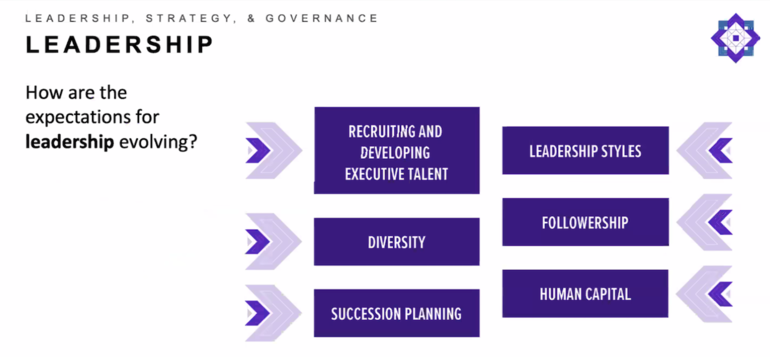
Hillman touched on a number of points related to leadership, including:
- “How do we build diversity into our leadership cadre?”
- “How do we make sure that these emerging leaders who are coming forward are coming forward in the best prepared way possible?” Hillman said that includes capturing the expertise and knowledge of outgoing C-suite leaders.
- “We're going to be talking about change management, because that is, in essence, what leadership is: creating change.”
- “Leadership style is things like emotional intelligence, things like formality and informality, followership versus leadership,” Hillman said. “These are all areas that I think are going to be critically important for the credit union of the future. Followership is different than leadership. We often focus a lot on what it means to be a leader, but we don't often talk about what does it mean to be an effective follower and how to gain followership.”
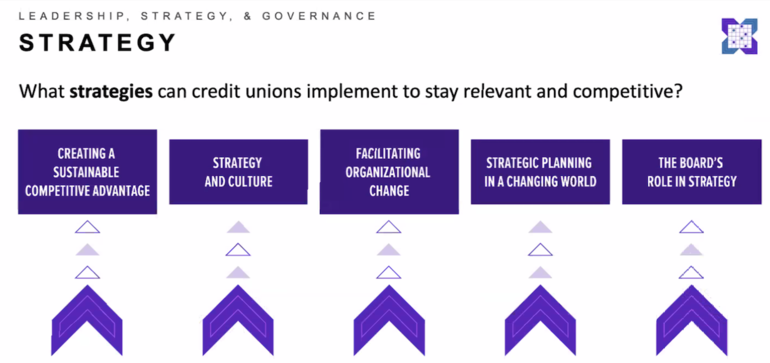
In discussing strategy, Hillman noted:
- “There is an ongoing piece of research that we hope to be publishing soon about the role of culture,” said Hillman, before sharing the old Peter Drucker observation that “culture eats strategy for breakfast.” “Basically, it means that no matter how good your strategy is, if your culture isn't aligned with that strategy you're going to have trouble.”
- “As you think about your role as leaders, culture is going to have to be the question. You have to make sure it's the culture you need, because if it's a culture that happens by accident it might not be the culture that can get you as far as you'd like.”
- “Any adjustment to the strategy is going to require those things as well, and we all know that we are change-resistant as individuals and it is hard to get people to change. The good news is that we have come out of an unprecedented time of challenge and when it comes to organizational change there's nothing like a good crisis to get people motivated to change.”
- Time horizons for strategic planning have gotten considerably shorter.
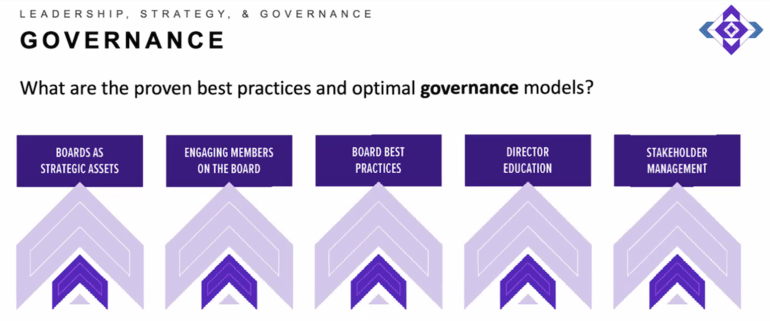
Governance
Among the points made by Hillman related to governance:
- “I've always seen the board of directors as strategic. They are your personal advisors, your resource gatherers, the people that you need to help you achieve your strategy. So, make sure your governance is aligned with where you're trying to go. This can be a real struggle for organizations, particularly membership-based governance organizations like credit unions.”
- “Strategy and leadership are only as effective as their governance structure.”
- “You know the fiduciary responsibilities that boards have, but what we really need to also remember is that compliance-oriented governance is about minimizing the downside risk. But governance can be way more than compliance. It can be the strategic thought-partner. It can be the advocate. It can be the people that actually push you to reimagine the strategy of the firm. We have the expression that ‘Directors are eyes, ears and nose in, and fingers out.’ That is, ‘I should be looking, I should be listening, I should be smelling, but I shouldn't be meddling.’”
- Hillman said the new Center will be examining and sharing best practices for board governance, including how to engage the members of the board.
- “Often, that comes from director education, so each new year your board members actually know what their role is and how they can best be a partner to you,” as well as how the board can “really function in a way that creates the best kind of engagement from stakeholders."