

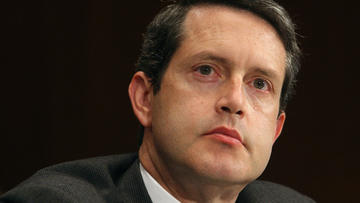
Randal Quarles
WASHINGTON—Federal Reserve Vice Chairman of Supervision Randal Quarles is acknowledging that implications of the Financial Accounting Standards Board's (FASB) current expected credit loss (CECL) standard aren't completely understood, but said the phased-in implementation of the standard should help mitigate issues.
Quarles was responding to a question from House Financial Services Subcommittee Chairman Blaine Luetkemeyer (R-MO), who also voiced concerns about the increased costs smaller financial institutions will incur with the CECL standard. His comments came during a hearing by the Financial Services Committee titled, “Semi-Annual Testimony on the Federal Reserve’s Supervision and Regulation of the Financial System.”
Later during the hearing, Rep. Barry Loudermilk (R-GA), raised additional concerns about the CECL standard making financial institutions less likely to approve certain loans during economic downturns. Quarles reiterated that the Fed is monitoring both immediate and long-term impacts the standard will have on the banking industry.
NAFCU’s Response
Following the hearing, NAFCU said it is continuing to attend meetings and share credit unions' concerns related to CECL implementation in order to obtain more guidance for the industry on the issue.
FASB staff have indicated they are working on certain operational challenges, and FASB is expected to finalize changes – including a delay in the standard's effective date for credit unions – yet this year. FASB is offering a webinar Dec. 14 to update private and not-for-profit organizations on various efforts; see the agenda and register for the webinar here.
Many committee members also asked about efforts to reform the Bank Secrecy Act (BSA)/anti-money laundering (AML) regime, out of which Quarles said he expects to see "material benefits." Rep. Gregory Meeks (D-NY) brought up "banking deserts" and how difficult it can be for small, community banks and credit unions to serve those areas because of compliance costs. He asked specifically about a recent statement from federal depository institution regulators allowing financial institutions to share BSA/AML resources.
"We are very supportive of efforts both to take advantage of the cost reductions that come from using new technologies and reducing the cost in general of effective BSA/AML compliance," Quarles said while also reassuring that the Fed will work to educate financial institutions on their ability to share resources.