

VENICE, Italy–The ability to assess the risks of climate change, particularly when it comes to financial stability, will be dependent upon comparable, globally consistent and reliable disclosures, as well as upon a broader set of high-quality, relevant data, according to the vice chairman of the Federal Reserve.
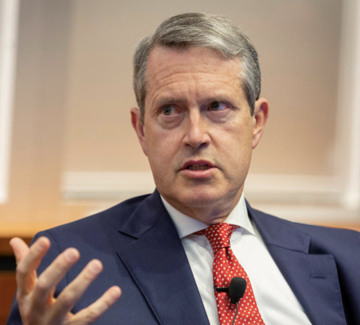
Randal Quarles
Addressing the Venice International Conference on Climate Change, Federal Reserve Vice Chair for Supervision Randal Quarles said it is time establish a “globally consistent baseline standard for climate-related disclosures.”
“Globally consistent and comparable entity-level disclosures by non-financial companies, banks, insurers, and asset managers are increasingly important to market participants and financial authorities as a means of providing information needed to assess and manage risks,” said Quarles, who also serves as chair of the international financial regulators’ group the Financial Stability Board (FSB).
During his remarks Quarles referred to previous work performed by the FSB-sponsored Task Force on Climate-related Financial Disclosures (TCFD), which he said has led to greater recognition of the importance of climate-related financial risk and of “comparable and reliable” disclosure. The TCFD recommendations, noted Quarles, include four core elements for a disclosure framework: governance, strategy, risk management, and metrics and targets.
FSB Survey Findings
Quarles said the FSB had surveyed its members to determine what each was doing to promote disclosures, finding nearly every member of the group had set requirements, guidance, or expectations, or were planning to do so. He said the survey found some diversity in approaches, with some members preferring disclosures that are mandated and others voluntary, and variation in scope.
“However, there is a trend toward an important baseline that focuses on one-way materiality – or the financial risk that climate change could have on a particular entity – based on the TCFD recommendations,” Quarles said. “The majority of our membership are already using the TCFD recommendations as a baseline for their own requirements or guidance.”
According to Quarles, the next step will be for the International Financial Reporting Standards Foundation (IFRS) to develop a set of standards.
“This work holds the promise of providing baseline standards that could inform or be built upon by national authorities as they develop their approaches to climate-related financial disclosure or broader sustainability disclosure,” he said, adding that the FSB encourages IFRS “to press forward as quickly as possible.”
‘Better Information is Needed’
In addition, Quarles said comprehensive, consistent and comparable data for global monitoring and assessing of climate-related financial risks are needed, which he admitted will not be an “easy task.”
“To understand the financial risks, better information is needed on the underlying physical risks, including the sorts of extreme weather events that pose greatest risks to the balance sheets of households, firms, and financial institutions,” he said. “Comparable data is also needed on the nature of jurisdictions’ climate-change targets and progress in meeting them. All this information needs to be related to financial risks – including financial institutions’ exposures to non-financial counterparties.”
Quarles told the meeting improved financial risk data can help financial authorities achieve their financial stability mandates.
“For example, the FSB is exploring how to assess the degree to which climate-related risks might be transferred or amplified by different financial sectors, including the interdependence of banks and insurance firms,” Quarles said. “Climate-related risks vary across jurisdictions, and we need to look at how risks might be amplified by feedback loops with the real economy. Such analysis will contribute to a more comprehensive and global understanding of how to assess climate change and potential effects on the financial system, but those efforts are hampered by a variety of data limitations.”