

MINNEAPOLIS, Minn.–One Fed president said the U.S. economy is going to need a shutdown even more stringent than prior efforts if it is going to defeat the coronavirus.
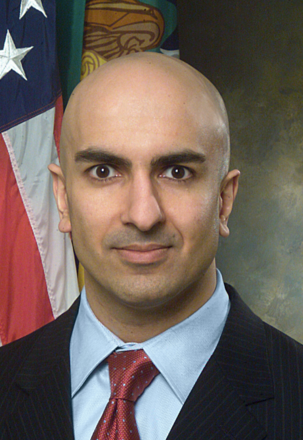
Neel Kashkari
In an op-ed in the New York Times, Minneapolis Federal Reserve President Neel Kashkari joined with Michael T. Osterholm, a professor and director of the Center for Infectious Disease Research and Policy at the University of Minnesota, to argue the government should issue a shelter-in-place order “for everyone but the truly essential workers” for up to six weeks.
According to the Kashkari and Osterholm, the earlier lockdown in March was not sufficiently stringent and has led to the U.S. lagging other stricter nations when it has come to containing Covid-19. The result “could make what we have experienced so far seem like just a warm-up to a greater catastrophe,” they wrote
“To be effective, the lockdown has to be as comprehensive and strict as possible,” Kashkari and Osterholm stated. “If we aren’t willing to take this action, millions more cases with many more deaths are likely before a vaccine might be available. In addition, the economic recovery will be much slower, with far more business failures and high unemployment for the next year or two.”
Insufficient Efforts
Despite the earlier lockdowns and the enormous economic consequences, Kashkari and Osterholm said the efforts were insufficient as the U.S. is still seeing 17 new cases per 100,000 people a day, with more than 160,000 total deaths attributed to the virus.
“Simply, we gave up on our lockdown efforts to control virus transmission well before the virus was under control,” they wrote.
Despite the economic damage done during the initial shutdown, including layoffs, thousands of failed businesses and mental health and education issues, the authors say another lockdown would pave the way for a stronger recovery, the Times noted.
“If we do this aggressively, the testing and tracing capacity we’ve built will support reopening the economy as other countries have done, allow children to go back to school and citizens to vote in person in November. All of this will lead to a stronger, faster economic recovery, moving people from unemployment to work,” the two wrote. “There is no trade-off between health and the economy. Both require aggressively getting control of the virus. History will judge us harshly if we miss this life- and economy-saving opportunity to get it right this time.”