

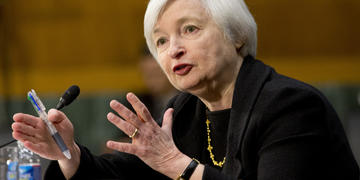
Janet Yellen
WASHINGTON—Federal Reserve Chair Janet Yellen said the Fed would not rule out employing negative interest rates in the event of another economic downturn.
“Negative interest rates are a tool employed by countries in Europe and elsewhere. By some accounts, these policies appear to have provided additional policy accommodation,” said Yellen in response to questions Congressman Brad Sherman (D-CA) submitted for the record after her Feb. 10, 2016, testimony before the House Financial Services Commission. “As I have noted previously, we certainly are trying to learn as much as we can from the experience of other countries. That said, while I would not completely rule out the use of negative interest rates in some future very adverse scenario, policymakers would need to consider a wide range of issues before employing this tool in the United States, including the potential for unintended consequences.”
Yellen responded in a letter to Sherman’s office Thursday. In February, Sherman asked for the Federal Open Market Committee’s plans in the event of another economic downturn, and if the FOMC has determined whether it has legal authority to implement negative interest rates and the following tools:
- Assistance to states, municipalities, and territories in fiscal distress
- An emergency lending program using the Federal Reserve Act Section 14 (12 U.S.C. § 355) authority to make short-term public investments
Sherman also asked under what contingencies would the FOMC consider utilizing the tools, under what circumstances would the FOMC initiate a fourth round of quantitative easing, and under what circumstances would the FOMC formulate a target (e.g., 1.0%) for the five-year Treasury rate?
“The Federal Reserve’s response to economic conditions, including any future financial crisis, very much depends on the circumstances,” wrote Yellen. “It is important to note that there have been many periods of economic downturn coupled with severe strains in financial markets that did not require the use of emergency lending programs, innovative monetary policy tools, or other extraordinary tools. Indeed, prior to the financial crisis in 2007-2009, the Federal Reserve had not utilized its emergency lending authorities since the Great Depression.”
Yellen added that it simply is not possible to predict the circumstances in which it might be appropriate to implement particular policies, such as conducting additional quantitative easing or formulating targets for longer-term rates.
“As the FOMC has noted in recent statements, we expect that the economy will continue to strengthen and that inflation will return to our 2% goal over time,” Yellen said. “Consistent with that outlook, the FOMC has noted that it believes the economic outlook will evolve in way that will warrant a gradual increase in the target federal funds rate. Of course, if the economic outlook evolves in an unexpected way, the Federal Reserve will adjust the stance of policy appropriately to foster progress toward its long-run goals of maximum employment and stable prices.”
Yellen reminded that the policy tools available to the Federal Reserve are provided by statute.
“The Federal Reserve’s authority to purchase obligations issued by municipalities is limited to very specific types of obligations and may be done only in the open market. The Federal Reserve’s authority to provide emergency credit to non-depository institutions is limited to programs with broad-based eligibility aimed at supporting the flow of credit to households and businesses; under these provisions, the Federal Reserve does not have the legal authority to lend to a specific borrower, including a municipality, that is failing or seeking to avoid resolution. More generally, providing assistance to municipalities inherently involves political judgments. As a result, as the Federal Reserve has noted previously, any program designed to provide assistance to municipal governments is a matter for the Congress and the Administration to address,” said Yellen.