

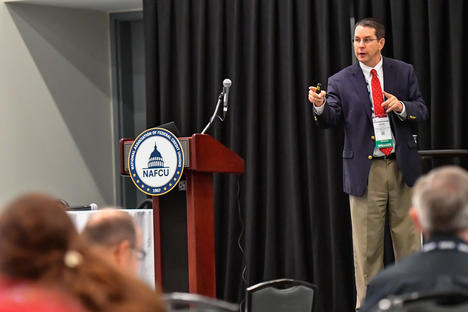
John DeLoach
NASHVILLE–Every interaction between a credit union and its regulator is either a fairy tale or a war story, according to one attorney who said he has been through both and who offered advice for creating more of the former and fewer of the latter.
In remarks to NAFCU’s annual meeting themed “You Had An Exam: Where And When Do You Push Back?” John DeLoach made clear, “Pushing back is always the last step. If you reach that point, in most cases you have not done the preliminary work.”
DeLoach, who is with the Tallahassee, Fla.-based WilliamsGautier, said one big change he has seen in a career working with credit unions is a move away from the long-held standard that a board of directors should put as little as possible in writing. Today, he said, it’s just the opposite.
Around every major decision, DeLoach said a board should document:
- What did we do
- Why did we do it?
- What was the result?
- What was our follow up?
“Where boards get criticized perhaps more than any other area is when you act like mushrooms: you stay in the dark and eat cow manure,” DeLoach told the meeting. “NCUA won’t tolerate that anymore. You don’t need to be in the weeds, but when we put in policies and programs around hot buttons such as BSA and OFAC, you have to be able to answer the questions.”
DeLoach told board members the management teams at their credit unions should read and be familiar with:
- The FCU Act and state laws and regulations
- NCUA Letters to Credit Unions
- NCUA General Counsel opinions
- NCUA examiner guidelines and questionnaires
“The first letter NCUA sends every year is its exam priorities for the coming year,” said DeLoach. “It drives me crazy the number of calls I’ve had from credit unions who say, ‘They sure beat us up on information security!’ Can’t you read. It was number one on their list.”
No Personal Gurantee
The most recent change DeLoach said credit unions must adjust to is NCUA’s removal of personal guarantees with member business loans.
"You all will need a new business lending policy. Has your management team consulted with this guidance?” asked DeLoach.
DeLoach said no credit union should have an adversarial relationship with its examiner, and should take steps in advance to ensure that doesn’t develop.
“What do federal agency people want? They want it to be easy. Have you provided them with the policies? The procedures? Do you have a process to get that into their hands? Are the audits ready and waiting? Are the contingent liabilities letters prepared ahead of time? This request is asked every year. Do you have the responses to the pre-examination questionnaires?”
In the initial meeting and introductions, DeLoach recommended that when it comes to points of contact that the CEO take the lead and that the appropriate individuals be responsible for questions in their area of expertise; that in cases where paper materials are required that they be readily available in the examiner’s workspace, and that the CEO frequently request updates during the examination.
“This is opportunity to correct any misunderstandings,” said DeLoach. “That CEO should be in there all the time.”
Requests For Documentation
DeLoach urged CUs during the examination response to make available all requests for documentation—including any statements from the credit union’s attorney, which is not protected by attorney/client privilege—and legal opinions (“let your lawyer be the heavy”).
“You should always be nice. But you will have examiners who will not be nice and will write crazy things,” said DeLoach. “Do not respond to that. At the end of every day just do a nice memo detailing what was said, especially if an email is sent. Always take the high ground in verbal and written communications.”
When it comes to the post-exam meeting, DeLoach said regulators will often say, “You don’t need everybody present at the post-exam meeting.’” DeLoach recommends against listening.
“Don’t you believe it. You want a show of force with your management team and board, whether there is good news to report or bad news to report. What you want to show is that you are engaged. I like even having the Supervisory Committee there, too, unless they don’t understand their role. Any responses during the meeting on the part of the credit union need to be kept on a high, professional level.”
DeLoach noted that any DOR or LUA that might be issued by an examiner does not need to be immediately signed.
“Those are enforceable contracts. You tell them ‘We need time to reflect on that.’ Once you’re locked in, you’re locked in.”