

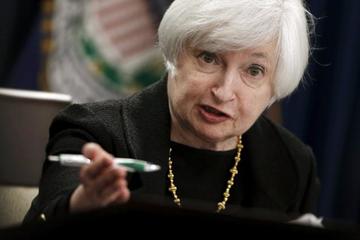
Janet Yellen, Federal Reserve
WASHINGTON—As expected, the Federal Open Market Committee voted yesterday not to raise rates, but again indicated it expects to do so throughout 2016.
Inflation has continued to run below the Committee's 2% longer-run objective, partly reflecting declines in energy prices and in prices of non-energy imports, the FOMC said. It added that market-based measures of inflation compensation declined further; survey-based measures of longer-term inflation expectations are little changed, on balance, in recent months.
“The Committee currently expects that, with gradual adjustments in the stance of monetary policy, economic activity will expand at a moderate pace and labor market indicators will continue to strengthen,” it said in a statement after wrapping up its two-day meeting. “Inflation is expected to remain low in the near term, in part because of the further declines in energy prices, but to rise to 2% over the medium term as the transitory effects of declines in energy and import prices dissipate and the labor market strengthens further. The Committee is closely monitoring global economic and financial developments and is assessing their implications for the labor market and inflation, and for the balance of risks to the outlook.”
Given the economic outlook, the Committee said it decided to maintain the target range for the federal funds rate at 1/4% to 1/2 percent.
“In determining the timing and size of future adjustments to the target range for the federal funds rate, the Committee will assess realized and expected economic conditions relative to its objectives of maximum employment and 2% inflation,” the FOMC said. “The Committee expects that economic conditions will evolve in a manner that will warrant only gradual increases in the federal funds rate; the federal funds rate is likely to remain, for some time, below levels that are expected to prevail in the longer run. However, the actual path of the federal funds rate will depend on the economic outlook as informed by incoming data.”
The Committee added in its statement that it will be maintaining its existing policy of reinvesting principal payments from its holdings of agency debt and agency mortgage-backed securities and of rolling over maturing Treasury securities at auction, and it anticipates doing so until normalization of the level of the federal funds rate is well under way. This policy, by keeping the Committee's holdings of longer-term securities at sizable levels, should help maintain accommodative financial conditions, the FOMC said.
NAFCU Chief Economist Curt Long was among those not surprised by the Fed's decision not to move rates.
"The committee identified low inflation in the near term, resulting in part from the recent drop in oil prices, as well as weakness abroad and in financial markets as the primary risks to its outlook," said Long. "While conditions could certainly improve prior to the committee’s next meeting in March, if these issues persist, it will be difficult for the committee to pull the trigger on a rate hike at that time. As things currently stand, it seems somewhat doubtful that they will be able to squeeze in four rate hikes this year, as they had previously predicted.”