

WASHINGTON–A proposal by the FDIC board would require big banks with large amounts of uninsured deposits to primarily be responsible for a special assessment aimed at covering the costs to the federal bank deposit insurance agency related to uninsured depositors with accounts at two banks that recently failed.
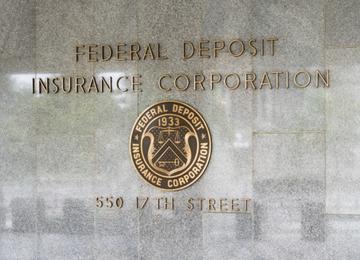
According to the FDIC, the proposed special assessment would affect 113 banking organizations, with those with total assets of more than $50 billion paying in aggregate more than 95% of the special assessment. No banking organizations with total assets under $5 billion would be subject to the special assessment, the FDIC said.
The assessment is in response to the respective failures of Silicon Valley Bank in California and Signature Bank in New York, each of which had significant uninsured deposits, specifically commercial deposits.
As was widely reported, at the time of their failure the FDIC has said it would cover the uninsured depositors at both institutions, citing the “systemic risk exemption” under federal banking law to cover the depositors.
$15-Billion-Plus Cost
The FDIC is estimating approximately $15.8 billion in costs of the failures of SVB and Signature Bank was attributable to the protection of uninsured depositors at the institutions.
Under the FDIC’s plan, the special assessment would be collected at an annual rate of approximately 12.5 basis points over eight quarterly assessment periods. However, the agency said, the special assessment rate is subject to change prior to any final rule depending on any adjustments to the loss estimate, mergers or failures, or amendments to reported estimates of uninsured deposits.
“Assuming that the effects on capital and income of the entire amount of the special assessment would occur in one quarter only, it is estimated to result in an average one-quarter reduction in income of 17.5%,” the regulator/insurer stated.
How Special Assessment Will Work
The FDIC said in a statement the base for the special assessment would be equal to an insured depository institution’s (IDI’s) estimated uninsured deposits reported as of Dec. 31, 2022, the agency said, adjusted to exclude the first $5 billion, applicable either to the IDI, if an IDI is not a subsidiary of a holding company, or at the banking organization level, to the extent that an IDI is part of a holding company with one or more subsidiary IDIs.
Collections would begin with the first quarterly assessment period of 2024 (i.e., Jan. 1 through March 31, 2024, with an invoice payment date of June 28, 2024). The FDIC said it will continue to collect special assessments for an anticipated total of eight quarterly assessment periods.
Congress Talks Expanded Coverage
The plan comes at the same time the House Committee on Financial Services held a hearing at which it appeared receptive to possibly expanding FDIC coverage to more than $250,000 per account.
As CUToday.info reported here, NCUA Chairman Todd Harper recently told credit unions attending a Cooperative Credit Union Association meeting that NCUA is unlikely to assess a premium to shore up the insurance fund anytime soon, and any changes that might be made to FDIC insurance due to what’s taken place in the banking industry will need to be matched by the CU insurance fund.
Feeling the FOMO Fever? CUToday.info Has a Prescription
Are you missing out on the latest news in credit unions? Missing the trends and developments you need to be aware of? We can help. Each morning CUToday.info delivers its daily Fresh Today news update offering the latest headlines and breaking news right to your email, with the easy-to-read headlines format allowing you to click on the stories that interest you most in order to learn more.
And it’s free!
If you haven’t yet signed up for the new email solution on which CUToday.info has partnered with ResponseGenius, you can do so here. Signing up requires less than one minute of your time—and it’s free!
Please note that after signing up you may need to go to your Spam/Junk folder and mark the morning headlines email as safe. CUToday.info does not provide its list of readers and emails to outside parties, and we will not be contacting you to sell you an extended warranty or sending you any links so you may cash in on an inheritance you didn’t know was coming.
And did we mention it’s free?
Please note and/or make your IT department or email administrator aware the emails will be coming from the domains CUTodayinfo.com and CUTodayinfoReply.com