

WASHINGTON–The Federal Deposit Insurance Corporation has released a new large-scale study on the state of the nation’s community banks. Separately, NCUA announced its newest board member, Kyle Hauptman, has been designated vice chairman.
The FDIC’s 2020 Community Banking Study finds community banks played a critical role in providing access to credit in several key areas of the U.S. economy, particularly through lending to support commercial real estate, small businesses and agriculture, the agency said.

The FDIC study further found that, relative to the broader banking sector, community banks continued to report positive financial performance and demonstrated this strength during the COVID-19 pandemic. The 2020 Study also included an examination of the influence of regulation and technology on community banks.
“The FDIC recognizes the critical role community banks play in providing loan and deposit services to customers throughout the United States,” said FDIC Chairman Jelena McWilliams. “By continuing to study community banks, the FDIC can provide support to these institutions and the communities they serve.”
The Key Findings
Among the key findings:
- Structural Changes.Voluntary mergers between unaffiliated institutions were the primary cause of the decline in the number of insured depository institutions between 2012 and 2019: the number of community banks fell from 6,802 to 4,750 and the number of non-community banks dropped from 555 to 427. Community banks acquired more than two-thirds of the community banks that closed during the study period, the FDIC reported.
- Regulation. The scope of regulatory change from 2008 through 2019 underscores that regulatory burden can be challenging for small banks with limited compliance resources. Banks’ regulatory compliance function is likely a factor contributing to scale economies, thereby indirectly affecting some banks’ decisions to enter or exit the industry and the distribution of residential mortgage holdings across banks of different sizes.
- Community Bank Lending. Though community banks tend to be relatively small, their commercial real estate (CRE), small business and agriculture lending far exceed their relative size within the overall banking industry. While community banks account for just 15% of the banking industry’s total loans, they hold 30% of all CRE loans, 36% of small business loans, and 70%of agricultural loans.
In addition, community banks were successful in areas with growing economies and populations while they continued to meet the credit needs of less economically vibrant areas, such as rural counties and areas with declining populations. Community banks have also proven to be resilient in their performance over the last seven years and during the COVID-19 pandemic, the FDIC said.
- Technology. According to the study, several factors drove community banks’ adoption of technology including bank characteristics, the economic and competitive environment, and the attitudes and expectations of bank leadership. Based on FDIC research and survey data from the Conference of State Bank Supervisors, larger community banks and community banks with higher loan-to-asset ratios and higher growth were greater technology adopters. Similarly, community banks that faced greater competition and whose leadership had more optimistic expectations about the future were more likely to adopt technology.
The full study can be found here.
Hauptman Named Vice Chairman
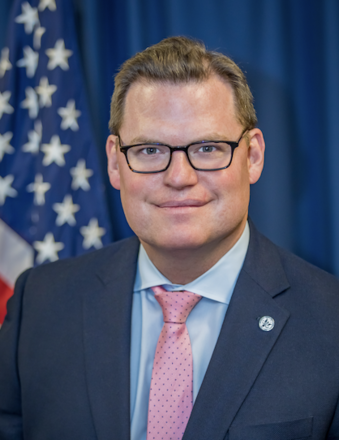
Kyle Hauptman
Separately, NCUA announced Board Member Kyle S. Hauptman is vice chairman of the agency. The title is largely ceremonial.
“I thank President Trump for this honor and the trust he has placed in me,” Hauptman said. “As vice chairman of the NCUA, I look forward to working with credit unions, my fellow board members, and Congress on solutions that provide regulatory relief for the credit union community and expand the use of technology to reach underserved communities. I am committed to the NCUA board’s obligation to protect America’s $1.79 trillion credit union system, which is dedicated to serving those of modest means, and ensuring the safety and soundness of the National Credit Union Share Insurance Fund.”
Trump nominated Hauptman for the NCUA board on June 15. The U.S. Senate Banking, Housing, and Urban Affairs Committee held its confirmation hearing on July 21, and the Senate approved his nomination on Dec. 2. Hauptman took the oath of office on Dec. 14.
Before serving on the NCUA Board, Hauptman was Senator Tom Cotton’s (R-AK) advisor on economic Sen., as well as staff director of the Senate Banking Committee’s Subcommittee on Economic Policy. Before joining Senator Cotton’s office, Hauptman served on President Donald J. Trump’s transition team in 2016.
Previously, he also served asexecutive director of the Main Street Growth Project and SVP at Jefferies & Co. He also worked at Lehman Brothers as a bond trader in New York City and its international offices in Tokyo and Sydney. Hauptman served as a voting member on the U.S. Securities and Exchange Commission Advisory Committee on Small and Emerging Companies from 2016–2017.