

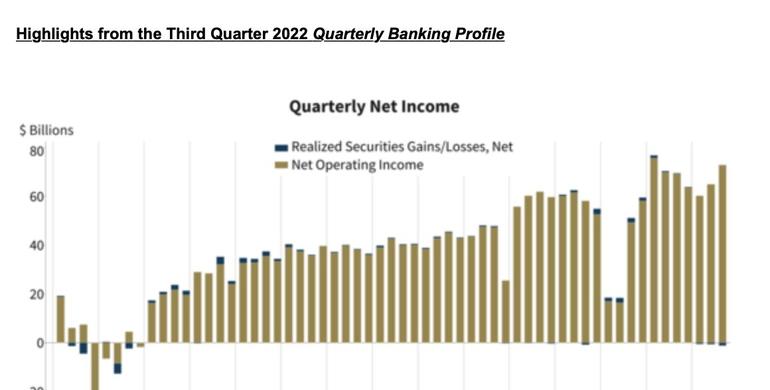
WASHINGTON–The nation’s FDIC-insured banks reported aggregate net income of $71.7 billion in third quarter 2022, an increase of $7.3 billion (11.3%) from Q2.
An increase in net interest income drove the increase in net income, according to the FDIC.
The FDIC’s latest Quarterly Banking Profile just released reported the increase in net interest income more than offset an increase in provisions for credit losses, driving the quarter-over-quarter increase in net income. Nearly three quarters of all banks (73.3%) reported an increase in net income from the prior quarter, while net income also grew $2.2 billion (3.2%) from third quarter 2021, as growth in net interest income exceeded growth in provision expense, the FDIC said.
The banking industry also reported an aggregate return on average assets (ROAA) ratio of 1.21%, up 13 basis points from the ROAA ratio reported in the second quarter but unchanged from the same quarter last year, according to the FDIC.
Performance Metrics
Among the other performance metrics released in the Quarterly Banking Profile:
Net Interest Margin Widened
The net interest margin (NIM) increased 35 basis points from a quarter ago and 58 basis points from the year-ago quarter to 3.14%. The quarter-over-quarter and year-over-year growth were the largest reported increases in the history of the QBP. This is the first time the NIM has been above 3.00% since first quarter 2020. Despite this improvement, the NIM remains below the pre-pandemic average of 3.25%, the FDIC said.
The average yield on earning assets increased 73 basis points from second quarter 2022 to 3.78% due to strong loan growth and rising market interest rates. Average funding costs increased 38 basis points from second quarter 2022 to 0.64%.
Unrealized Losses on Securities Increased
Unrealized losses on securities totaled $689.9 billion in the third quarter, up from $469.7 billion in the second quarter, according to the regulator. Unrealized losses on held-to-maturity securities totaled $368.5 billion in the third quarter, up from $241.8 billion in the second quarter. Unrealized losses on available-for-sale securities totaled $321.5 billion in the third quarter, up from $227.9 billion in the second quarter.
Community Bank Net Income Rose From a Quarter Ago and Year Ago
Community bank quarterly net income for the 4,308 community banks grew $1.0 billion (13.5%) from one quarter ago to $8.5 billion in third quarter 2022.
“Higher net interest income more than offset lower noninterest income and higher noninterest expense. Seventy-four percent of community banks reported higher net income from last quarter,” the FDIC said. “Net income also increased $317.5 million (3.9%) from one year ago because of higher net interest income. Sixty-three% of community banks reported higher net income than one year ago. The community bank pretax ROAA ratio rose 17 basis points from one quarter ago to 1.51%.”
The FDIC added that the average community bank quarterly NIM rose 30 basis points from the prior quarter and 32 basis points from the year-ago quarter to 3.63%.
“Due to the improvement, the NIM is back to the pre-pandemic average of 3.63%. The average yield on earning assets rose 48 basis points quarter over quarter and 49 basis points year over year, while average funding costs rose 18 basis points quarter over quarter and 17 basis points year over year,” the FDIC said. “Quarter-over-quarter growth in net interest income of 9.4% outpaced growth in earning assets of 1.0%.”
Loan Balances Increased from the Previous Quarter and a Year Ago
Total loan and lease balances increased $229.7 billion (2.0%) from the previous quarter. The banking industry reported growth in several loan portfolios during the quarter, including one-to-four family residential loans (up $68.1 billion, or 2.9%) and consumer loans (up $39.4 billion, or 2.0%), according to the FDIC.
Annually, total loan and lease balances increased $1.1 trillion (9.9%), driven by growth in commercial and industrial (C&I) loans (up $259.8 billion, or 11.6%), one-to-four family residential mortgages (up $213.9 billion, or 9.6%), and consumer loans (up $204.1 billion, or 11.4%). The annual increase in loan balances was the largest in the history of the QBP.
Community banks reported a 4.1% increase in loan balances from the previous quarter, and a 12.2% increase from the prior year. Growth in commercial real estate and one-to-four family residential mortgage loans drove the quarterly increase in loan balances for community banks, while growth in commercial real estate loans drove the annual increase, the FDIC reported.
Asset Quality Metrics Were Favorable Overall Despite Growth in Early Delinquencies
According to the FDIC, loans that were 90 days or more past due or in nonaccrual status (i.e., noncurrent loans) continued to decline and the noncurrent rate was down 3 basis points to 0.72% from second quarter 2022.
“The noncurrent rate for total loans is at the lowest level since second quarter 2006. Total net charge-offs increased 6 basis points from a year ago to 0.26%, driven by higher credit card and auto loan net charge offs,” the FDIC said. “Early delinquencies (i.e., loans past due 30-89 days) increased 3 basis points from last quarter and 7 basis points from the year-ago quarter to 0.51%.”
Both the quarterly and annual increases were driven by an increase in past due credit cards, C&I, and auto loans, the FDIC added.
The Reserve Ratio for the Deposit Insurance Fund was Unchanged at 1.26%
The Deposit Insurance Fund (DIF) balance was $125.5 billion on September 30, up $1.0 billion from the end of the second quarter. The reserve ratio was unchanged at 1.26%, as insured deposits rose 0.1%.
Merger Activity Continued in the Third Quarter
Twenty-six institutions merged, three new banks opened, and no banks failed in third quarter, the FDIC said.