ST. PETERSBURG, Fla.–Federal stimulus payments helped to drive strong spending on credit union-issued plastic—with members also checking balances at ATMs—according to new analysis released by PSCU.
PSCU’s Advisors Plus and Data & Analytics newest review of year-over-year weekly performance trends compares the second week of the year, the week ending Jan. 10, 2021, with the week ending Jan. 12, 2020.
“Spending was strong in week two for both credit and debit, with federal stimulus payments fueling record debit card purchase growth,” said Glynn Frechette, SVP, Advisors Plus at PSCU. “Delivery of stimulus payments occurred in a more condensed timeframe this round, resulting in a significant positive impact on consumer spending. ATM transactions also experienced large increases, as consumers conducted balance inquiries to verify receipt of stimulus funds, along with increased deposit activity for those who received paper checks.”
While spending for credit and debit was strong for the second week of January 2021, PSCU said “extraordinary growth in debit purchases” was likely fueled by deposits from the second round of COVID-19 relief funding.
Among the findings:
- Debit card spend was up 37.9% in Week 2 and debit transactions finished up 12.3%. Debit purchases were higher than the four-week average of +21.1% and transactions were higher than the four-week average of +6.1%.
- Credit card spend in week two finished up 3.9%, higher than the four-week average of 2.8%. Transactions finished down 2.8%, in line with the four-week average of -2.1%.
Digital Payments
According to PSCU, consumers continue to show strong adoption of digital payments, including contactless, mobile wallets and Card Not Present (CNP) alternatives, while using less cash.
The company reported:
- Contactless “tap-and-go” transactions via dual interface cards continue to show strong consumer acceptance, with debit showing notable strength. Debit contactless transactions as a percent of Card Present activity on contactless debit cards have more than doubled from around 8.4% in January 2020 to 18.1% in Week 2 of 2021, PSCU said.
- Contactless credit transactions have also more than doubled, growing from 6.5% to 13.2% of card present activity on contactless credit cards in the same timeframe. “We continue to view these results as conservative, as the ratio considers the proportion of contactless activity to all card present transactions, not just those able to be tapped,” PSCU said.
- Mobile wallet transactions and purchases for both credit and debit cards continue to show good growth with Card Present activity, PSCU said. Debit mobile wallet purchases finished week two up 76% year over year, higher than the four-week average of +68.4%. Credit mobile wallet purchases were up 39.8% year over year, lower than the four-week average of +42.4%. The results represent six supported mobile wallets: Apple Pay, Fitbit Pay, Garmin Pay, Google Pay, LG Pay and Samsung Pay. “We continue to see more volume conducted via Card Not Present (CNP) transactions,” PSCU said. “For credit, 58% of purchase volume and 47.8% of transactions were CNP. For debit, 47% of purchase volume and 32.8% of transactions were CNP. Purchase mix has held steady and wsa up eight percentage points year over year for credit and 8.9 percentage points for debit. Transaction mix also remains steady, up 11.7 percentage points for credit and 9.2 percentage points for debit year over year.”
- Overall ATM usage is positive for the first time since March 2020, up +0.5%, PSCU said. Leading the increase for last week were deposits, up 16.9%, and balance inquiries, up 13.7%. Cash withdrawal transactions at the ATM still remain down year over year. For the most recent week, the number of cash withdrawals was down 7.7%, higher than the four-week average of -15.6%.
Merchant Spend
From a merchant category perspective, the start of 2021 continues to show strong results in Goods, Utilities, Service and Grocery Stores, while year-over-year performance for Travel, Gasoline and Restaurants remains depressed, PSCU reported.
- Purchases in the Goods sector posted extraordinary results for Week 2, with debit purchases up 62.8% year over year and credit purchases up 25.8%.
- Utilities spend was up 44.3% year over year for debit and up 14.6% for credit; Service spend was up 44.3% year over year for debit and up 9.5% for credit; Grocery spend was up 24.4% for debit and up 13.5% for credit.
- Travel was down 7% year over year for debit and down 54.3% for credit; Gasoline was down 1.1% for debit and up 20.4% for credit; Restaurants were up 13.1% for debit and down 20.4% for credit.
Regional Spend
PSCU, noting its regional analysis of spend utilizes the segmentation used by the U.S. Bureau of Economic Analysis (BEA) for economic analysis, reported:
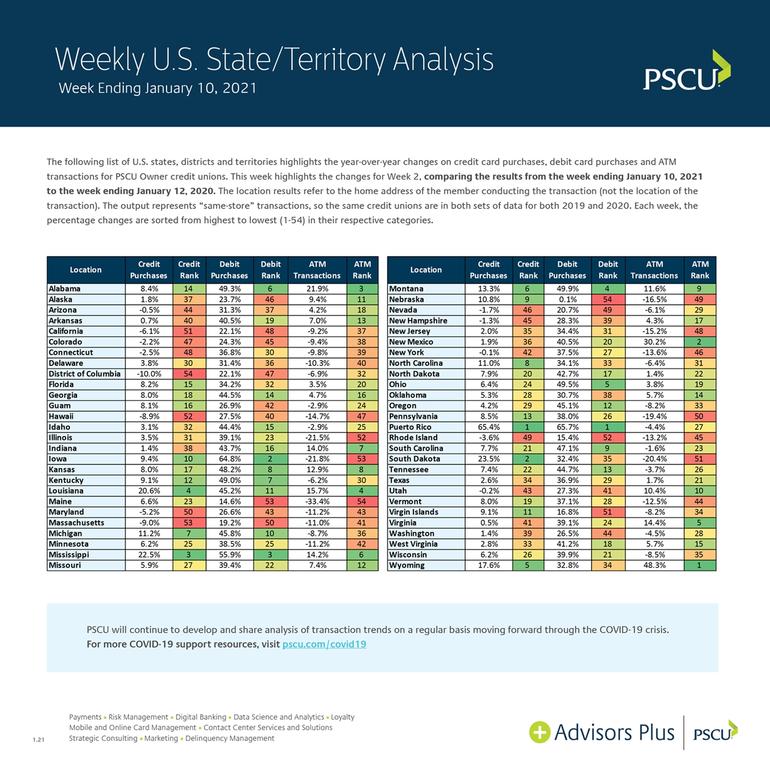
- Overall U.S. spend was up 3.9% for credit purchases. The Plains (+6.8%) and Southeast (+3.2%) finished as the strongest regions for Week 2. Hawaii (-8.9%) and the New England region (-4%) had the lowest credit purchase performance.
- Overall U.S. spend was up 37.9% for debit purchases. The Great Lakes (+43.6%), Plains (+40.4) and Southeast (+40.5%) regions finished as the strongest regions for Week 2. Hawaii (+27.5%) and the Far West (+25.6%) region had the lowest debit purchase performance.
- PSCU noted its Weekly U.S. State/Territory Analysis is available at www.PSCU.com/COVID19, ranking U.S. states and territories by year-over-year performance for debit purchases, credit purchases and ATM transactions.
The Deeper Dive
In its latest analysis, PSCU’s deeper dive looked at U.S. regional performance for all sectors throughout 2020.
Among the findings:
- Consumer purchasing behavior has been greatly affected by COVID-19 since the global health crisis began in March 2020. Throughout the pandemic, there have been regional hot zones and surges in hospitalizations, along with state-level governmental orders to help reduce the spread of the virus. Significant increases in unemployment greatly impacted consumer spending, while spikes occurred when federal stimulus monies were injected into the economy in April 2020 and, most recently, in January 2021.
Ranking each of the U.S. regions for the aggregate COVID-19 pandemic period of Mar. 16 through Jan. 10 (Weeks 12 through 2) using an equal weighting of year-over-year growth for credit purchases, debit purchases and ATM transactions, PSCU said the following regions are listed in order of top performing to most impacted over this 43-week period.
- Southeast – credit purchases down 2.4%, debit purchases up 14.8%, ATM transactions down 11.5%
- Plains – credit purchases down 1.1%, debit purchases up 15.5%, ATM transactions down 19.1%
- Great Lakes – credit purchases down 3.2%, debit purchases up 13.8%, ATM transactions down 17.9%
- Southwest – credit purchases down 3.9%, debit purchases up 11%, ATM transactions down 13.7%
- Rocky Mountain – credit purchases down 5.8%, debit purchases up 8.1%, ATM transactions down 17.5%
- Mideast – credit purchases down 6.4%, debit purchases up 11.3%, ATM transactions down 25.5%
- New England – credit purchases down 9.2%, debit purchases up 9.8%, ATM transactions down 19.4%
- Far West – credit purchases down 6.8%, debit purchases up 7.5%, ATM transactions down 21.8%
- Hawaii – credit purchases down 11.5%, debit purchases up 7.2%, ATM transactions down 27.2%