

WASHINGTON–During testimony before the Senate, NCUA Chairman Todd Harper said the overall health of credit unions is good, but he flagged some threats to that health while also offering an update on other initiatives and closing with a request for several amendments to the Federal Credit Union Act.
As part of the Senate Banking, Housing and Urban Affairs Committee hearing titled, “Oversight of Financial Regulators: Protecting Main Street Not Wall Street,” Harper said the overall financial health of the country’s credit unions is good, but over the past few months the agency has seen growing signs of financial strain on credit union balance sheets and in household budgets.
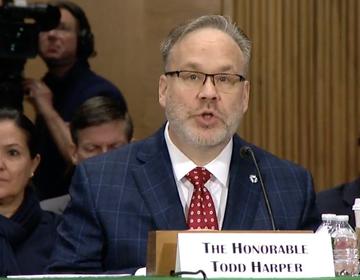
“Over the same period, the NCUA has also seen growing stress within the system because of a rise in interest rates and liquidity risks,” Harper said in his prepared remarks. “In fact, this financial stress is reflected in the increasing number of composite CAMELS code 3, 4, and 5 credit unions. Assets in composite CAMELS code 3 institutions increased sizably in the second quarter, especially among those complex credit unions with more than $500 million in assets. Such increases may well continue in future quarters. We have additionally seen more credit unions fall into the composite CAMELS code 4 and 5 ratings during the second quarter.”
Details on the NCUSIF
Harper further noted:
- Federally insured CUs’ net worth ratio stands at 10.63%.
- Total assets have grown to $2.2 trillion and outstanding loans to more than $1.5 trillion.
- The delinquency rate for loans has risen slightly to 63 basis points, although it remains below historic averages. “Credit cards and automobile loans, however, show increased delinquency levels at 154 and 67 basis points, respectively,” Harper said. “Additionally, net charge-off levels have risen over the last year, returning to pre-pandemic averages.”
- Funding costs for credit unions have increased significantly in the rising interest rate environment.
External Factors Affecting the System
Harper told the Senate external factors affecting the system include:
- Inflation and interest rates are affecting household budgets, which could lead to an increase in credit risk in future quarters.
- Hybrid work environments have placed pressure on commercial real estate lending.
- The rise in interest rates has also increased liquidity and interest rate risks in the credit union system, including at several of the 421 federally insured credit unions with more than $1 billion in assets.
Share Insurance Fund Performance
Harper noted that when it comes to the National CU Share Insurance Fund
- As of June 30, 2023, the Share Insurance Fund insured $1.7 trillion in deposits and shares (92% of total shares)
- As of June 30, 2023, the Share Insurance Fund reported a year-to-date net income of $79 million, a net position of $20.3 billion, and an equity ratio of 1.27%, below the normal operating level of 1.33%.
Other Issues Raised
Other issues raised by Harper during his testimony included:
The Central Liquidity Facility
Harper noted that under NCUA’s regulations, credit unions with assets more than $250 million must have access to a federal emergency liquidity source as part of their contingency funding plans, and that as of September 30, 2023, the CLF had 399 consumer credit union members, providing $19.8 billion in lending capacity.
In December 2022, the CLF had a much greater total membership of 3,673 consumer credit unions with a combined $537 billion in member assets and a lending capacity of $27.5 billion, but membership declined following the expiration of the temporary statutory enhancements enacted during the COVID pandemic.
Harper urged Congress to allow corporate credit unions to purchase capital stock in the CLF to help smaller credit unions access to the facility.
Enhancing Cybersecurity
Harper noted “cybersecurity threats within the financial services industry are high and expected to remain so for the foreseeable future,” and NCUA has deployed its updated, scalable, and risk-focused Information Security Examination (ISE) procedures.
He further pointed out that within the first 30 days of the NCUA’s recently implemented cyber incident reporting rule, the agency received 146 incident reports, more than it had received in total in the previous year. More than 60% of these incident reports involve third-party service providers and CUSOs.
Consumer Financial Protection
Harper said an “important part of the NCUA’s mission” is to examine credit unions with less than $10 billion in assets for compliance with consumer financial protection laws, and that in 2023, the agency’s consumer financial protection supervisory priorities have included overdraft protection, fair lending, residential real estate appraisal bias, and Truth in Lending Act and Fair Credit Reporting Act compliance. The NCUA also prioritized examining credit union compliance with the Flood Disaster Protection Act, including disclosure requirements, Harper added.
Legislative Requests
After offering an overview of several other NCUA initiatives, Harper saidseveral amendments to the Federal Credit Union Act would provide the NCUA with “greater flexibility to effectively regulate the credit union system and protect the Share Insurance Fund in light of an evolving economic environment, a changing marketplace, and technological advancements.”
Those amendments include, according to Harper:
- Central Liquidity Facility Reforms. Harper again urged a statutory change to restore the ability of corporate credit unions to serve as CLF agents on behalf of a subset of their member credit unions.
- Restoration of Third-Party Vendor Authority. Harper reiterated his request NCUA be given oversight ability for third-party vendors to CUs. “If granted third-party vendor authority, the NCUA would implement a risk-based examination program focusing on services that relate to safety and soundness, cybersecurity, Bank Secrecy Act and Anti-Money Laundering Act compliance, consumer financial protection, and areas posing significant financial risk for the Share Insurance Fund,” Harper said.
- Additional Flexibility for Administering the Share Insurance Fund. Harper said NCUA is requesting the amending of the Federal Credit Union Act to remove the 1.50% ceiling for the Share Insurance Fund’s equity ratio from the current statutory definition of “normal operating level,” which he said limits the ability of the board to establish a higher normal operating level for the Share Insurance Fund. “A statutory change should also remove the limitations on assessing Share Insurance Fund premiums when the equity ratio of the Share Insurance Fund is greater than 1.30% and if the premium charged exceeds the amount necessary to restore the equity ratio to 1.30%,” Harper said.
Something to Give Thanks For This Thanksgiving
The biggest, best and freshest news reporting in credit unions remains free! Each morning CUToday.info delivers its daily Fresh Today news update offering the latest headlines and breaking news right to your email, with the easy-to-read headlines format allowing you to click on the stories that interest you most in order to learn more. So stop paying those bank-fee-like subscription prices from other so-called “news” publications!
If you haven’t yet signed up for the new email solution on which CUToday.info has partnered with ResponseGenius, you can do so here. Signing up requires less than one minute of your time—and it’s free!
Please note that after signing up you may need to go to your Spam/Junk folder and mark the morning headlines email as safe. CUToday.info does not provide its list of readers and emails to outside parties, and we will not be contacting you to sell you an extended warranty or sending you any links so you may cash in on an inheritance you didn’t know was coming.
And did we mention it’s free?