

WASHINGTON–As one of four regulators who testified here before a House hearing on oversight, NCUA Chairman Todd Harper largely escaped most of the questions as members of Congress instead pressed banking regulators over the recent failures of several large banks, but he did respond to questions over CRA and NCUA’s recent request for information on climate change.
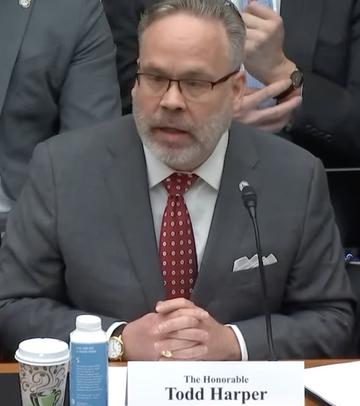
Harper also told Congress that any changes to the FDIC’s deposit insurance coverage must also allow for “parity” by the credit union insurance fund.
In addition to Harper, those testifying included:
- Michael Barr, vice chairman for supervision for the Federal reserve
- Marin Gruenberg, chairman of the FCIC
- Michael Hsu, acting Comptroller of the Currency
Questions Over Climate Change RFI
Rep. Ralph Norman (R-SC) pressed Harper over whether it is appropriate for NCUA to send to credit unions a 38-question request for information (RFI) on climate change, as CUToday.info reported here.
“Our interest is in looking at all appropriate risks to credit unions,” answered Harper.
“But are you comfortable that none of what you are requesting has gone through the congressional review process?” asked Norman.
“The congressional review process does not apply to RFIs. We’ve not adopted a rule,” replied Harper. “We passed this RFI on a 2-1 vote; it was bipartisan, if that is your concern.”
Norman followed by asking, “Do you know what the cost is to a credit union to answer?”
“A credit union can choose not to answer it,” Harper said.
During the hearing, a question was directed to Barr over whether privately insured credit unions will have access to the Fed’s Bank Term Funding Program.
“No,” Barr answered flatly.
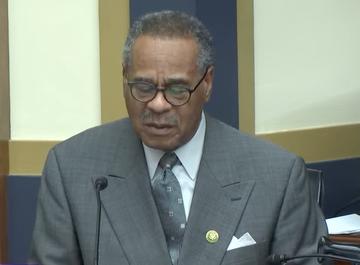
Emanuel Cleaver
Question Over CRA
More than an hour after he had delivered his opening statement to the members of House subcommittees on Financial Institutions and Monetary Policy, Oversight and Investigations, and Housing and Insurance (the text of Harper’s opening statement appears below), the chairman was asked by Rep. Emanuel Cleaver (D-MO) a general question about credit unions and the Community Reinvestment Act.
“CRA does not apply currently to credit unions,” Harper replied.
Cleaver seemed to give up asking any follow-up, saying, “I don’t want to get involved with credit unions. I’ve been around for a while. That’s a headache I can ignore.”
Opening Statement
In his opening statement, Harper focused his oral testimony on what he said have been recent efforts to strengthen the credit union system and, in particular, several key issues.
Overall, Harper testified, the performance of federally insured credit unions remains “stable,” with total loans, assets, insured shares, and deposits all increasing over last year. He noted credit unions’ aggregate net worth ratio also rose to 10.73%, representing a recovery of 73 basis points from its pandemic low.
91% of CU Shares Insured
“What’s more, 91% of total share deposits within the system are insured. That has contributed to stability within the credit union sector in recent months,” said Harper, a reference to the more than 90% of deposits at the failed Silicon Valley Bank that were uninsured.
“The NCUA’s Share Insurance Fund also continues to perform well. Although the fund’s equity ratio is three basis points below the desired operating level, no premiums are expected at this time,” Harper said. “That’s because the system is currently well positioned to handle any dislocation resulting from a moderate recession. Nevertheless, during the last year, we have experienced growing interest rate and liquidity risks within the system — including at several billion-dollar-plus institutions. Aggregate cash positions have declined and are below pre-pandemic levels as well. Further, unrealized losses in securities limit their utility as a source of liquidity.”
Call to Expand the ‘Shock Absorber’
Harper used his testimony to repeat his call that Congress extend the statutory enhancements that were made during the pandemic to NCUA’s Central Liquidity Facility, which he described as a “shock absorber.”
Those enhancements expired on Dec. 31, 2022, with Harper saying more than 3,000 credit unions with less than $250 million in assets lost access to the CLF, contracting the facility’s capacity by almost $10 billion.
“With risks rising within the financial system and at individual credit unions, now is not the time to cut a liquidity lifeline,” Harper said.
Changes in Deposit Coverage
With portions of the hearing addressing potential changes to FDIC deposit insurance coverage beyond the current $250,000 per account threshold, Harper said he would defer to Congress on determining what statutory changes, if any, should be made to deposit insurance coverage levels and account types.
“But, if Congress does act in this area, the NCUA has two requests,” Harper said. “First, we ask Congress to maintain parity between the share insurance coverage provided by the NCUA and the deposit insurance coverage provided by the FDIC.
“Second, because an expansion in coverage will generally increase resolution costs, the NCUA requests greater flexibility for administering the Share Insurance Fund,” he continued. “This flexibility, which would be more in line with the FDIC’s current administrative powers, includes allowing the NCUA board to establish a higher normal operating level and modifying the current limitations on assessing premiums.
“Together, these changes would better enable the NCUA board to build reserves during economic upturns so that sufficient money is available during economic downturns,” Harper said.
Feeling the FOMO Fever? CUToday.info Has a Prescription
Are you missing out on the latest news in credit unions? Missing the trends and developments you need to be aware of? We can help. Each morning CUToday.info delivers its daily Fresh Today news update offering the latest headlines and breaking news right to your email, with the easy-to-read headlines format allowing you to click on the stories that interest you most in order to learn more.
And it’s free!
If you haven’t yet signed up for the new email solution on which CUToday.info has partnered with ResponseGenius, you can do so here. Signing up requires less than one minute of your time—and it’s free!
Please note that after signing up you may need to go to your Spam/Junk folder and mark the morning headlines email as safe. CUToday.info does not provide its list of readers and emails to outside parties, and we will not be contacting you to sell you an extended warranty or sending you any links so you may cash in on an inheritance you didn’t know was coming.
And did we mention it’s free?
Please note and/or make your IT department or email administrator aware the emails will be coming from the domains CUTodayinfo.com and CUTodayinfoReply.com