MADISON, Wis.—How are higher interest rates affecting credit unions?
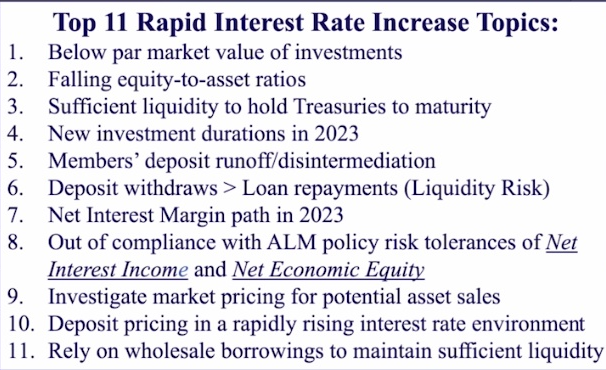
According to TruStage Chief Economist Steve Rick, there are 11 primary ways--including producing a “bank walk” on deposits and forcing changes to ALM policies.

During TruStage’s 2023 Discovery Conference, Rick outlined how the Federal Reserve’s rapid rate increases have credit union CFOs scrambling. Here are some of Rick’s observations:
Below Par Market Value of Investments
“The number one rule of finance is when interest rates go up, bond prices go down. We bought all these investments and maybe some of them are longer term. So, when interest rates went up the investments have fallen from their face value down to a lower market value,” said Rick. “That $1 million investment is now $900,000.”
Falling Equity-to-Asset Ratios
“That means we'll have to record that $100,000 loss in our category called gains and losses on available for sale securities. We're seeing the equity box shrink. From 2021 to 2022 we saw a big decrease in our net-capital-to asset-ratios due to the decrease in capital,” Rick said.
Sufficien Liquidity to Hold Assets to Maturity
“The Federal Reserve is raising interest rates reducing the value of our capital or our equity. Prior to that, if you go from 2019 to 2020, we saw another drop in our equity-to-asset ratio because the assets grew then. This as a denominator effect … do we have sufficient liquidity to hold these treasuries to maturity?” Rick said.
The Uphill Waterfall
“Maybe $1 million (in deposits) is leaving the credit union each month. Alright, that's a problem. If you're ever walking up a mountain and you see a waterfall flowing uphill, you know something really bad is happening,” said Rick. “Well, that's kind of what's happening today. Instead of a bank run we have a bank walk, where money is leaving credit unions and banks slowly.”
New Investment Maturities
“If you're the CFO of the credit union, you're having a hard time today figuring out what investments should you buy. If you think the Fed is going to keep raising interest rates, the old rule of thumb is to ride those interest rates up,” explained Rick. “But if you think the Fed is done raising rates, and if you believe the inverted yield curve is predicting a recession, maybe the Fed's going to start lowering interest rates. What do you do? It's called the recession trade. Basically, you start buying longer-term, maybe five to six to seven year Treasuries to lock in those high rates before they fall. And then, when rates do fall, remember the price of bonds goes up and you'll make a capital gain on those bonds.”
Deposit Withdraws > Loan Repayments
“We’re seeing a deposit runoff now. Credit union savings per member is now $13,604. In April of last year it hit a record high of $14,133. We’ve had about a $500 drop per member. Why is it dropping? Lower-income members are basically draining their savings because they have to, because inflation for many Americans has been higher than their wage growth,” explained Rick. “For middle-income Americans, a lot of us are basically trying to understand things, because maybe we didn't take that trip during 2020-2021 because of COVID-19, or buy those restaurant meals. Well, now we're going out and spending. High-income members are pulling money out because maybe they had $100,000 sitting in their savings account the last 10 years earning nothing, but once interest rates crossed that 5% mark that kind of woke them up.”
Net Interest Margin Path in 2023
“Our loans and investments are repricing into today's higher interest rates. That's nice. But our cost of funds are also going up,” Rick said. “For some credit unions their cost funds is rising faster than the yield on assets, squeezing net interest margins. For other credit unions the yield on assets is going up faster than the cost of funds, increasing their net interest margins.”
Out of Compliance With AML Policy Risk Tolerances
"A lot of credit unions are out of compliance with their own ALM risk policies. For example, we have all these policies that say if interest rates go up 3% we only want our net income to fall by X percent," Rick said. "Or, if interest rates rise 3%, we only want our net equity to fall by X percent. Well, none of us ever thought we'd see a 5% increase in interest rates in a short period. So, either you can change your balance sheet, sell your long-term investments and buy short term, and do things like that. But it's very costly and it's very time consuming. Or, you can just change your policies now.”
The complete top 11 list is below.