

MADISON, Wis.–The ongoing outflow of member deposits has helped push up the credit union loan-to-share ratio, while the pace of membership growth has slowed some compared to a year ago, according to TruStage’s newest Trends Report.
The new analysis is based on credit union performance through September.
Here’s a look at additional detail on how credit unions performed by category:
Total Credit Union Lending
Credit union loan balances rose 0.5% in September, slower than the 1.7% pace reported in September 2022, according to the Trends Report.
Driving overall loan growth was strong growth in adjustable-rate mortgages (1.7%) home equity loans (1.0%), and unsecured personal loans (0.9%).
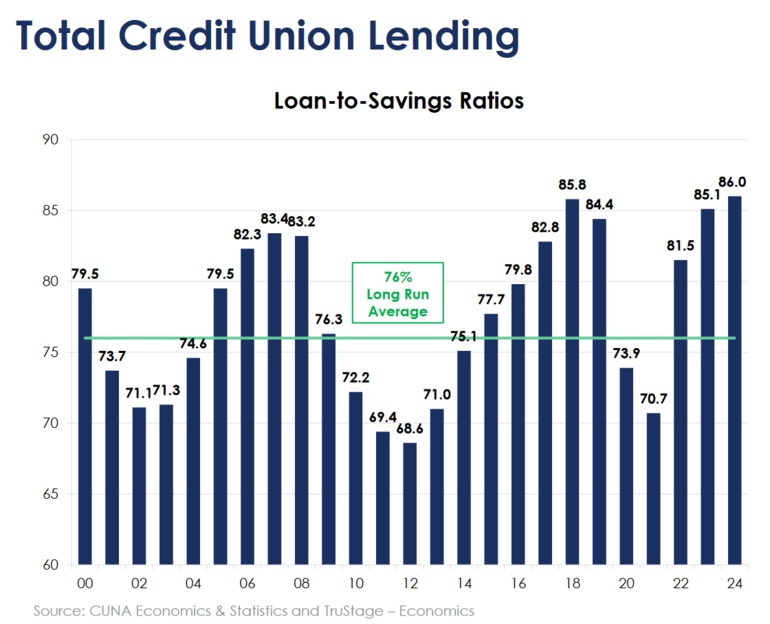
According to the report, the credit union average loan-to-savings ratio rose to 85.1% in September, up from 78.5% in September 2022, due to loan growth (9.2%) exceeding savings deposit growth (0.7%) during the last 12 months.
“Loan-to-savings ratios traditionally peak right before recessions and may contribute to the economic slowdown that follows due to tight liquidity at credit unions reducing their pace of lending and high levels of members’ debt reducing their demand for loans,” wrote Steve Rick, TruStage’s chief economist. “Based on current trends, credit union lending growth is expected to rise 4% in 2024 while savings balances increase only 3%. This is expected to raise the average loan-to-savings ratio to 86% at year’s end of 2024, significantly above the 20-year average of 76%, and the highest ratio since May 1980. This high ratio will cause credit unions to borrow additional wholesale funds, pay higher interest rates on deposits and reduce investment portfolios to keeping lending to their members.”
Consumer Installment Credit
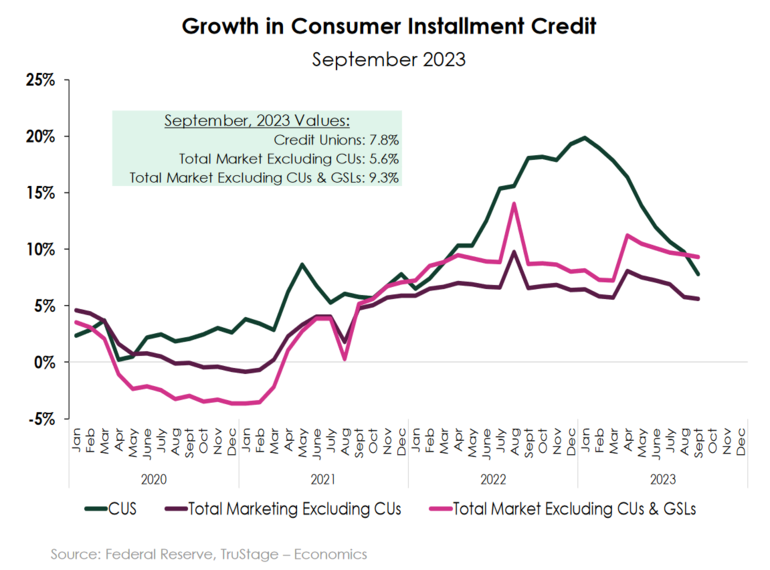
Credit union consumer installment credit loan balances (auto, credit card and other unsecured loans) rose 0.4% in September, slower than the 2.3% rise set in September 2022, the Trends Report analysis shows. During the last 12 months, credit union consumer installment credit grew 7.8%, slightly below the total market excluding credit unions and government student loans (9.3%), the report added.
“According to the Federal Reserve, outstanding consumer credit for all lenders rose a modest $9.9 billion in September, with balances up 5.9% over the last year,” the Trends Report states. “Credit unions now hold 15.6% of all consumer credit, up from the 14.8% reported in September 2022.”
Going forward, Rick forecast that credit unions should expect nonrevolving credit growth to be below its long run trend in 2024 due to satiated consumers’ demand for autos.
“Revolving credit growth will also slow as leisure and travel spending tapers off. If the economy experiences a modest recession in 2024, lenders may tighten lending standards for revolving credit, which includes households’ credit cards and other forms of short-term debt,” the report states. “Higher interest rates will also be a lending headwind in 2024 with the Federal Reserve expected to keep short-term interest rates over 5% for most of the year.”
Vehicle Loans
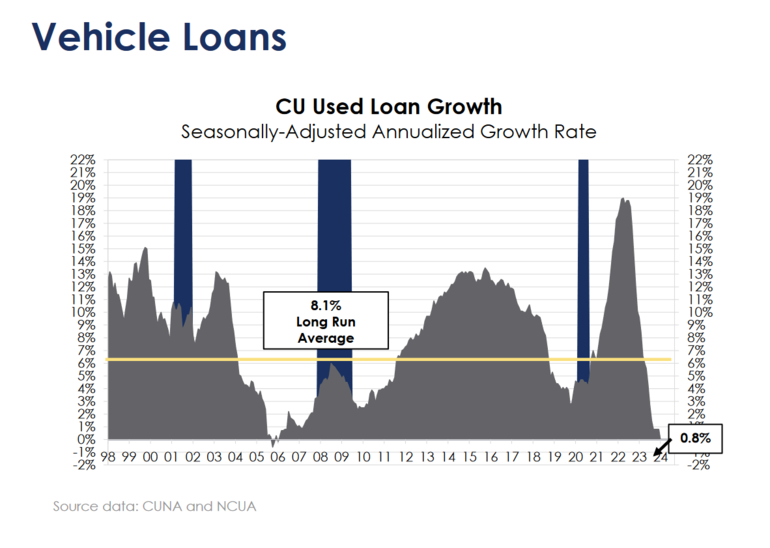
The Trends Report notes that credit union used-auto loan balances grew at a “remarkably low” 0.8% seasonally-adjusted annualized growth rate in September, the slowest pace since 2006 due to higher interest rates, high used car prices, little pent-up demand for used cars, and more new car inventory.
Used car prices rose dramatically over the last couple of years due to a shortage in new car production. But as new car production has ramped up recently, used-car prices fell 7.1% during the last year but are still at elevated levels relative to pre-COVID prices.
“Credit union new-auto loan balances fell at a 1.8% seasonally-adjusted annualized growth rate in September, the slowest pace since the fall of 2020 due to competitive financing offers from competitors,” the report states. “On a monthly basis, credit union new-auto loan balances fell 0.2% in September, still better than the decline of 0.5% reported in September 2022. New-auto loan balances rose 6.1% during the last 12 months while used auto loan balances rose 6.6%.”
Real Estate Information
Credit union fixed-rate first mortgage loan balances grew only 0.3% in September, below the 0.4% pace set in September 2022, according to the Trends Report analysis. “Credit unions sold only 22.1% of their mortgage originations into the secondary market during the first half of this year, down from 38% in the similar period of 2021 and 22.3% in 2022,” the report states. “Adjustable-rate mortgage loan balances rose 1.7% in September, above the -0.7% contraction recorded in September 2022.”
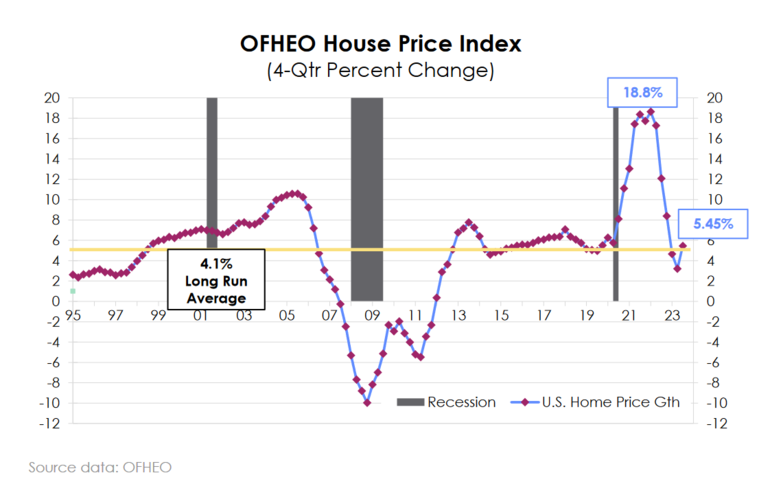
Meanwhile, it further notes that despite the higher interest rates, home prices rose 0.9% in August from July, according to the Core Logic Home Price Index, and increased 2.6 year-over-year.
“Some people are concerned that home prices are overvalued again and creating another home price bubble,” Rick wrote in his analysis. “One way to measure overvaluation is to compare today’s home price-to-income ratio and home price-to-rent ratio to their historical averages. Historically, a house in the U.S. cost around 3 to 3.5 times the median annual household income. During the housing bubble of 2004-2005, the median price for a single-family home cost more than 5.1 times the median annual household income. Today, that ratio stands at 5.2.”
Savings & Assets
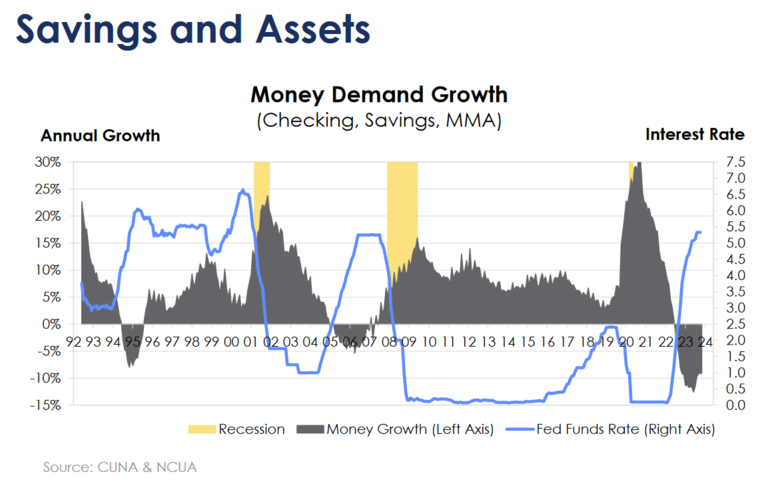
Credit union members’ demand for “money deposits” (i.e., checking, savings and money market accounts) fell at a 9.1% seasonally-adjusted annualized rate in September and has been in negative territory since July of 2022, according to the Trends Report.
“This is a dramatic reversal from the greater than 30% growth rate recorded in the summer of 2020 when COVID-19 stimulus checks were being sent out to millions of Americans,” Rick stated. “Meanwhile, demand for investment type accounts like certificate of deposits are growing at a 55% annualized rate.”
Rick reminded that the rising federal funds interest rate is the major factor causing the decline in money deposits as members withdraw funds from low-yielding savings deposits and place them in higher yielding certificate of deposits or money market mutual funds.
“The figure helps illustrate the strong negative correlation between short-term interest rates and holdings of checking, savings, and money market deposit accounts,” the Trends Report states. “This shift in credit union deposits helped increase credit union cost of funds from 0.36% in the first half of 2022 to1.19% in the first half of this year. This is known as the ‘mix effect.’ But there is also a ‘rate effect’ whereby credit unions are raising their deposit interest rates to prevent deposit runoff or what is known as disintermediation.”
According to the data, savings balances per member have already declined $700, to $13,400 in September from $14,100 in April 2022.
Equity and Other Key Measures
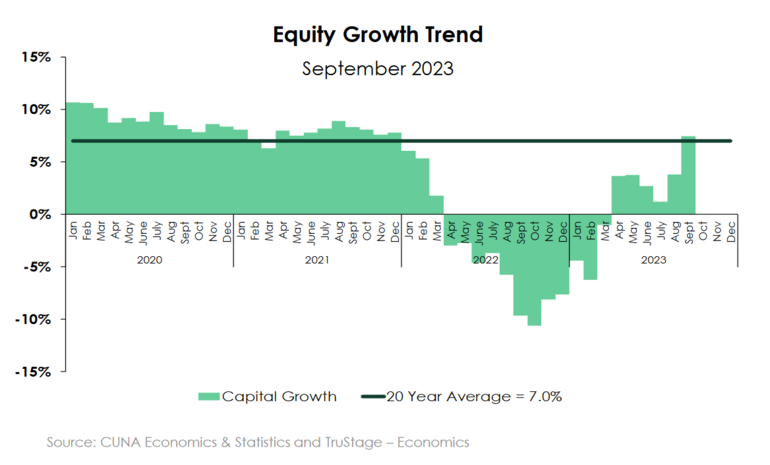
The credit union system’s equity-to-asset ratio fell to 8.9% in September, down from 9.0% in August due to rising interest rates reducing the market value of investments available for sale, the Trends Report analysis shows.
The report further notes that in June of 2023 credit unions classified 74% of their investments as available for sale and therefore were reported at fair value.
“During the last 12 months, the Federal Resave has increased short-term interest rates by the percentage points reducing investment valuations,” analysis continues. “Changes in securities value between accounting periods are included in the equity section of the balance sheet. For example, a one-year 5% Treasury note would decline in value by 2.8% if interest rates rose 3%; a two- year 5% Treasury note would decline by 5.4%, a four-year 5% Treasury note would decline by 9.9% and a nine-year 5% Treasury note would decline in value 18.7%.”
Moreover, Rick wrote, in June credit unions held 18.6% of their surplus funds in the 5–10-year maturity bucket, up from 18.3% one year earlier.
“Despite this equity headwind, credit union equity levels grew 7.5% during the last 12 months due to credit union net income adding to their undivided earnings account,” the analysis observes. “This equity growth rate is also known as the return-on-equity ratio and is one of the most important credit union financial ratios. For the last two years, the return-on-equity ratio has been running below the 7% average recorded over the last 20 years. Equity growth began its downward trajectory when interest rates began heading up in March 2022.”
Numbers of Credit Unions
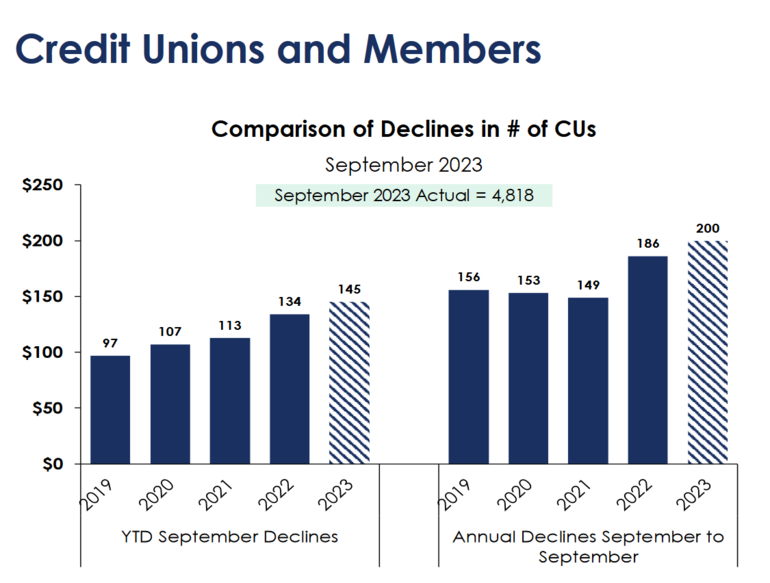
As of September 2023, the report notes that CUNA estimates 4,818 credit unions were in operation, down 200 from September 2022. Year-to-date, the number of credit unions fell by 145, slightly faster than the 134-decrease reported in the first nine months of 2022.
The Trends Report further states that NCUA’s Insurance Report of Activity showed 39 mergers were approved in the third quarter (down from 59 in the third quarter of 2022), with an average asset size of $24 million. The average asset size of the continuing credit union was $709 million.
Expect mergers to accelerate into 2024 due to the ongoing liquidity crisis and smaller credit unions wishing to expand the services offered to their member, the report states.
Credit Union Membership
Meanwhile, the TruStage Trends Report shows credit unions added more than 3.5 million memberships in the first nine months of 2023, below the 4.7 million added in the similar time period of 2022.
“Modest demand for credit was the major driver for the pickup in memberships,” according to the report. “Also driving the increase in memberships was the 2.2 million new jobs added in the U.S. during the last nine months, which was significantly below the 3.9 million added during the same period in 2022.”
Your Best Holiday Shopping Offer is Here!
The biggest, best and freshest news reporting in credit unions remains free! Each morning CUToday.info delivers its daily Fresh Today news update offering the latest headlines and breaking news right to your email, with the easy-to-read headlines format allowing you to click on the stories that interest you most in order to learn more. So stop paying those bank-fee-like subscription prices from other so-called “news” publications!
If you haven’t yet signed up for the new email solution on which CUToday.info has partnered with ResponseGenius, you can do so here. Signing up requires less than one minute of your time—and it’s free!
Please note that after signing up you may need to go to your Spam/Junk folder and mark the morning headlines email as safe. CUToday.info does not provide its list of readers and emails to outside parties, and we will not be contacting you to sell you an extended warranty or sending you any links so you may cash in on an inheritance you didn’t know was coming.
And did we mention it’s free?