

NEW YORK–Credit unions have seen record high levels of deposit inflows as the result of the pandemic, affecting loan-to-share ratios, margins and even the share insurance fund—but the inflows could be even stronger.
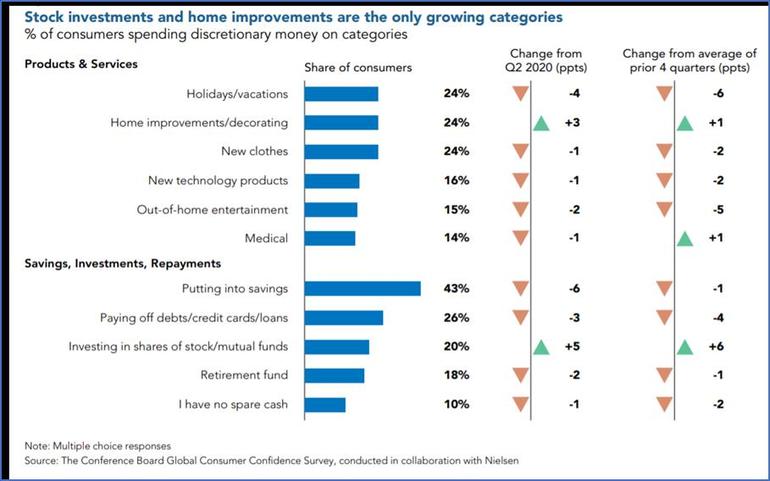
That’s one conclusion to be drawn from new data showing an increasing number of Americans have been pouring discretionary funds into stock and mutual funds.
One new report shows during Q4 2020, 20% of consumers surveyed invested in shares of stocks or mutual funds, up from 16% in Q2. The same survey, from The Conference Board, found record-low interest rates have resulted in just 43% of consumers putting money into savings in Q4, down from 49% in Q2.
The findings are included in the report, US Consumer Dynamics Report: Q4 2020, which is the first in a new quarterly series drawn from The Conference Board Global Consumer Confidence Survey. Overall, the Q4 survey confirmed that pandemic-related forces—including more time at home, reduced opportunities to spend, and enhanced fiscal support from the government—continue to be the chief factors shaping consumer behavior in the United States, noted The Conference Board.
‘A Broader Story’
“The booms and busts of a few unlikely ‘meme stocks’ have grabbed recent headlines, but the rise of individual investors tells a broader story about spending habits during COVID-19,” said Denise Dahlhoff, senior researcher at The Conference Board. “Trends like low interest rates and declining debt concerns—alongside below-normal spending on vacations and out-of-home entertainment due to pandemic restrictions—have left a portion of Americans with more disposable income and fewer ways to spend it. Stocks, which continue to yield strong returns, have become an increasingly attractive option for these consumers.”
Key Findings
Among the key findings in the new report:
- The proportion of U.S. consumers spending discretionary money on stocks and home improvements rose in Q4 2020—and shrank in every other category.
- Consumers’ share of spending on essentials fell in Q4, fueled by historic declines in the relative cost of housing.
- In Q4 2020, the share of US consumers’ budget devoted to housing costs fell to 18%, a record low and down 3.5 percentage points compared to Q2 2020. Plummeting rental rates in city centers, rent abatements and cuts, temporary rent and mortgage non-payments, and historically low mortgage rates all drove the decline, the Conference Board said.
- With the housing savings, total spending on essential goods and services (including food/beverage at home, routine transportation, education, and medical) fell −4.1 percentage points in Q4 2020 compared to Q2.
- Consumers shifted their spending, in large part, to discretionary products (+3.8 percentage points)—including electronics and, especially, apparel.
Other Findings
The survey also found:
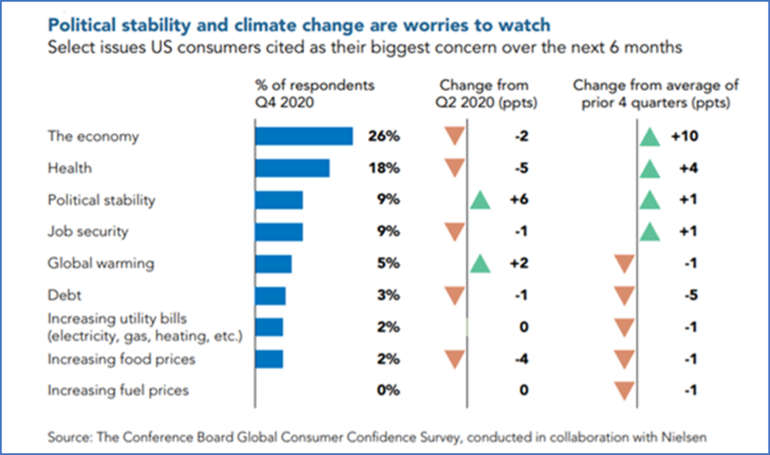
- In the aftermath of a highly contentious election, 9% of consumers in Q4 2020 named political stability their top worry for the next 6 months, up from just 3% in Q2.
- 5% of consumers in Q4 named global warming their top worry.
- Unsurprisingly, more than half of U.S. consumers continue to name the economy (26%), health (18%), or job security (9%) as their top concern for the months ahead. Notably, however, focus on all three areas was lower in Q4 compared to Q2, in the early months of the COVID-19 crisis.