

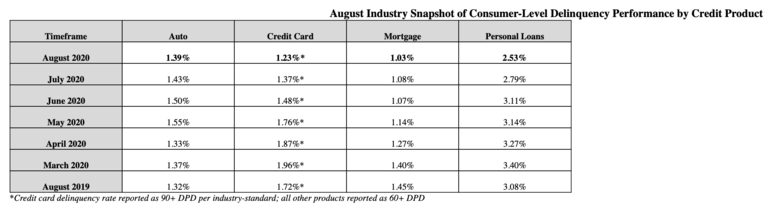
CHICAGO–Serious delinquency rates in August improved once more across all consumer credit segments even as the number of people in accommodation programs dropped for the second consecutive month, but there could be “potential challenges in the near future,” according to a new report from TransUnion.
During August TransUnion reported serious consumer-level delinquency rates improved across all credit products, including auto loans, credit cards, mortgages, and personal loans. Since the start of the pandemic in March 2020, consumer performance has been mostly positive with continued month-over-month improvements for many of these products, TransUnion added.
“A significant percentage of consumers utilized financial accommodations to defer or freeze payments during the early stages of the pandemic. As the first wave of consumers exit accommodation and a period of excess liquidity, they are returning to their debt obligations and continuing to perform,” said Matt Komos, vice president of research and consulting at TransUnion. “Consumers who still remain in hardship could be more likely to face income losses and thus have more difficulty exiting these programs than consumers who may have entered into hardship programs as a precautionary measure.”
‘Hardship’ Decline
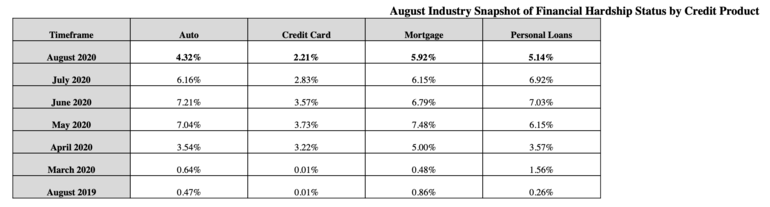
According to TransUnion, its August Monthly Industry Snapshot Report found the percentage of accounts in “financial hardship” continued a downward month-over-month trajectory for auto loans, credit cards, mortgages, and personal loans from the months of July to August.
TransUnion’s financial hardship data includes all accommodations on file at month’s end and includes any accounts that were in accommodation prior to the COVID-19 pandemic.
“Across all credit products, the percentage of accounts in financial hardship during the month of August 2020 dipped to pre-May levels, TransUnion said. “Accommodation programs provided consumers with payment flexibility and added liquidity during the course of the pandemic. However, as the number of consumers leveraging such programs decreases and government relief funds are not expected to renew, many consumers may find themselves at an inflection point.”
Potential Challenges
While serious delinquency rates continued to decline in August, TransUnion reported it observed some negative movement in 30-day delinquency rates. This metric, which may serve as an early indication that an account will default and potentially be charged off, increased slightly in August 2020 for the two largest payments in the consumer wallet – auto and mortgage, the company said.
“This uptick for both products could signify that consumers are starting to roll forward on deferred payments as they come off of hardship programs. However, it’s still much too early to tell. It could simply be ‘sloppy’ payment behavior where consumers miss an occasional payment or are late by a few days or weeks, though their intention is still to make the payment,” added Komos.
TransUnion said “close attention” is being paid to delinquency levels in its latest Financial Hardship Survey from the week of August 24th found that COVID-19 continues to financially impact consumers. While the percentage of financially impacted Americans dipped to 52% – the lowest level since the ongoing survey series began in March – the concern among impacted consumers regarding their ability to pay bills and loans remains high (75%), TransUnion stated.
Card Balances Decline
According to the survey, about one-third of impacted consumers are turning to savings to pay bills or loans and 13% cited they plan to open new credit cards. Despite these concerns, data from the monthly snapshot found that consumers are continuing to make payments as the average credit card balance per consumer dropped to $5,127 in August, compared to $5,686 the previous year.
In addition, the Average Excess Payment (AEP), the average amount consumers are paying over their respective minimum payments, increased to $330 in August 2020, though similar to what was observed at the same time last year ($300), TransUnion said.
“Many consumers have continued to make payments even when enrolled in financial accommodation plans. The real litmus test in regard to consumer credit health will become apparent in the coming months when these safeguards begin to expire and consumers have less payment flexibility,” said Komos.