

MADISON, Wis.–The newest deep dive into credit union performance shows auto delinquencies are on the rise and further “headwinds” could be ahead, home prices could decline by as much as 10% over the next two years, and a drop in member savings balances was the biggest seen in history, according to TruStage’s newest Trends Report.
The report, authored by the company’s chief economist, Steve Risk, also shows Credit union membership growth “significantly” slowed in the first quarter of 2023 compared with one year.
The May Trends Report is based on CU performance through March. Here’s a look at how credit unions performed by category:
Total Credit Union Lending
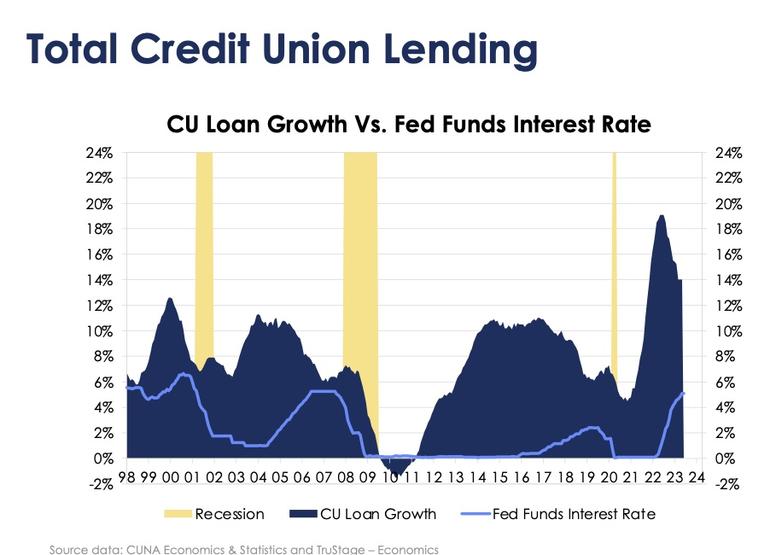
Credit union loan balances rose 0.8% in March, below the 1.7% reported in March 2022, and 17.4% during the last 12 months, the TruStage analysis noted.
“March is historically the third-weakest loan growth month of the year, with seasonal factors typically shaving off 0.24 percentage points from the underlying trend growth rate,” the Trends Report states. “The lending season for credit unions begins in earnest in April and continues through August.”
Driving overall loan growth was strong growth in adjust-rate first mortgages (3.1%), used-auto loans (0.6%) and fixed-rate first mortgages (0.5%). Home equity loan growth accelerated recently with March posting growth of 1.7% and year-over-year growth of 40.4%,” the report said.
“Credit union annualized and seasonally- adjusted loan growth is currently running at 14%, significantly above its long run average of 7%,” the report forecasts. “Expect credit union loan balances to rise 8% in 2023 and then slow to 7% in 2024 as the Fed Funds interest rate remains at 5.08% for the remainder of 2023 and then declining in the first half of 2024.”
Consumer Installment Credit
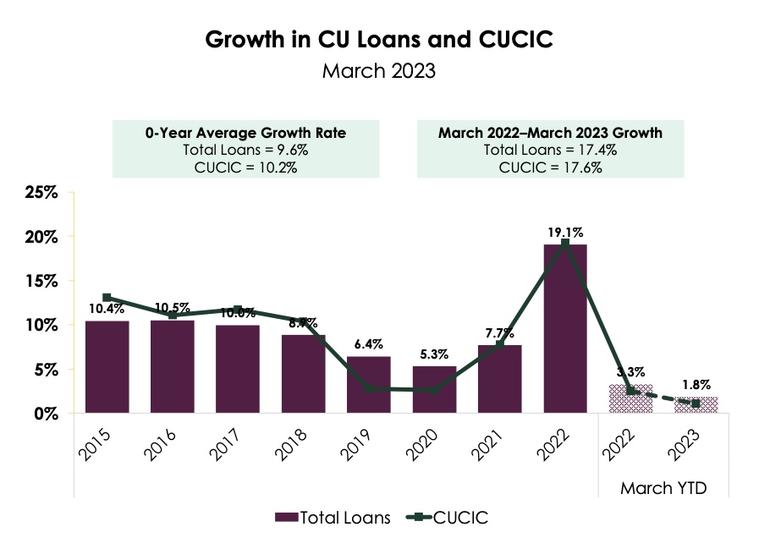
Credit union consumer installment credit balances (auto, credit card and other unsecured loans) rose 0.4% in March, but below the 1.7% pace set in March 2022, due to strong growth in used-auto lending (0.6%), the Trends Report analysis shows.
Over the last year, credit union credit card loan balances rose a strong 14.5%, above the 30-year long run pace of 7%, “due to higher inflation and members spending more on travel and leisure as the pandemic loosened its grip on consumer behavior,” according to the Trends Report.
The analysis shows credit union consumer installment credit grew 1.1% year to date, significantly below the 2.5% pace set in the first quarter of 2022. Credit union consumer installment credit grew 17.6% during the last year, which is significantly above the 7.4% for the total market excluding credit unions and government student loans, the report adds.
“This disparity in credit union and bank loan growth rates has led to credit unions now holding 15.6% of the total consumer loan market, up from 13.6% one year ago,” wrote Rick in the Trends Report. “Very competitive loan pricing by credit unions is driving this loan growth disparity.”
Vehicle Loans
Credit union new-auto loan balances rose 0.4% in March; a “big drop compared to the 1.3% jump in March 2022,” the Trend Report states.
New-auto loan balances are up 20.9% from one year ago and used-auto loan balances are up 16.6%.
“The new-auto buying and lending season begins in May and runs through October,” the Trends Report explains. “On a seasonally-adjusted annualized growth rate basis, new-auto loan balances rose 14.1% in March, as loan originations exceeded loan payoffs.”
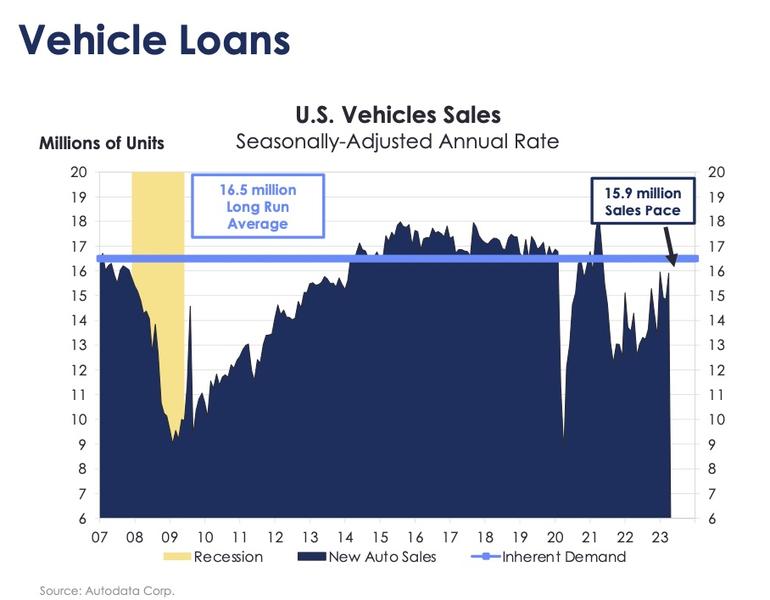
The report notes vehicle sales fell to 14.8 million in March but then rebounded to 15.9 million in April at a seasonally-adjusted annualized sales rate, but still below the 16.5 million long run average.
“Auto delinquency rates are on the rise for young borrowers due to the end of the moratorium on student debt payments,” according to the analysis. “Headwinds to auto sales include rising interest rates, credit contraction and the possibility of a recession and job losses in the fourth quarter of 2023.”
Real Estate Information
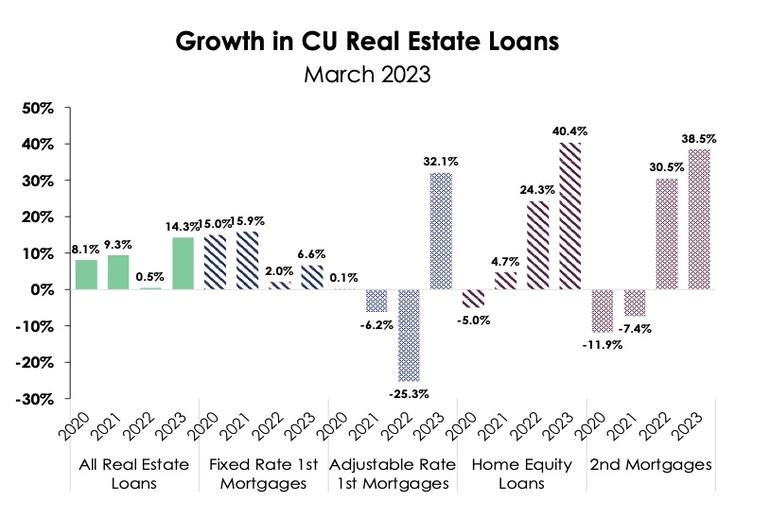
The new analysis shows credit union fixed-rate first mortgage loan balances rose 0.5% in March, above the -2.3% decrease reported in March 2022, as mortgage interest rates began to rise. Credit union fixed-rate first mortgage loan balances rose 6.6% over the last 12 months (see Figure below), above the 5% pace set for the similar time period last year, according to the Trends Report, while home equity loan balances rose 40.4% due to strong home price appreciation over the last few years, while second mortgage balances rose by 38.5% over the last year as members decided to lock in interest rates before they rose further.
“U.S. home prices rose due to a slight improvement in affordability as mortgage rates fell slightly in February and a limited supply of homes collided with steady demand,” the report states. “The shortage of new homes is due to homebuilders not producing enough new inventories to satisfy demand during the last 12 years. The sharp rise in mortgage interest rates over the last 14 months could lower home prices 5-10% during the next two years.”
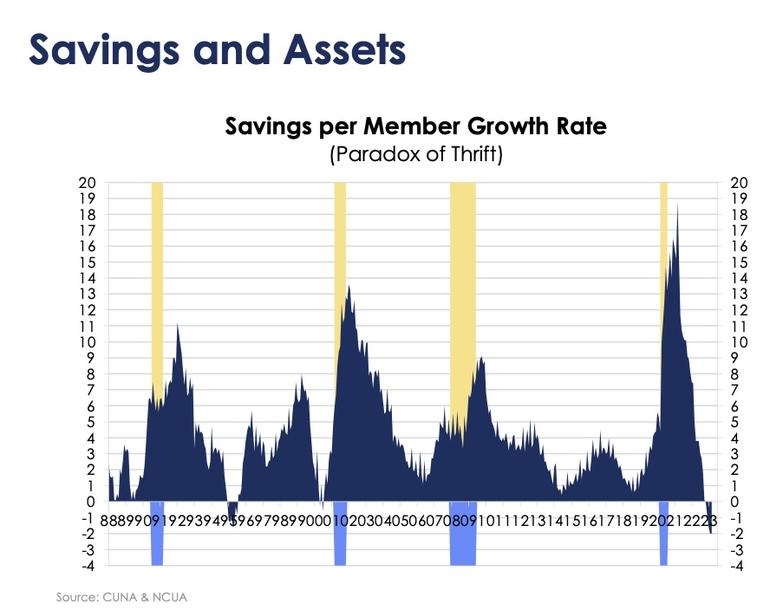
Savings & Assets
Credit union savings balances rose 1.6% in March, below the 1.9% gain reported in March 2022.
“Seasonal factors like tax refunds and bonuses typically get deposited in credit union members’ share draft in March, which increased 5.0%,” according to the Trends Report. “March’s seasonal factors typically add 1.2 percentage points to the underlying savings trend growth, making it the second biggest month of the year for credit union savings growth.
“Nevertheless, many credit unions are experiencing disintermediation as members withdraw deposits. Per member savings balances fell 2.0% during the last year, significantly below its long run average of 5.5%.”
According to the Trends Report, the average credit union member had $13,818 in total savings deposits in March 2023, down from $14,104 in March 2022.
“This $286 drop in savings balances per member is the biggest in credit union history,” the Trends Report states, citing two reasons:
- Middle income members are withdrawing savings to spend on services like hotels, airfares and restaurants now that the COVID-19 pandemic is coming to an end.
- Some high-income members are withdrawing some of their large balance deposits in search of higher yields.
“This disintermediation of deposits is a big concern for credit unions and the economy in general as falling deposits could lead to a credit contraction and slower economic growth,” the analysis notes.
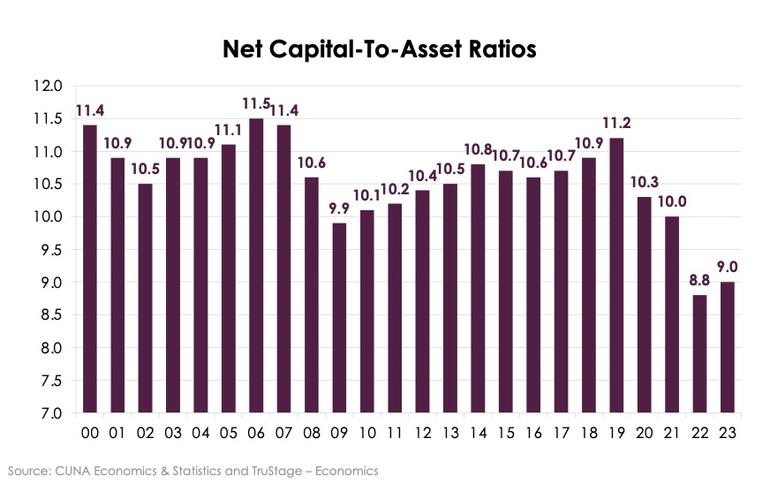
Capital & Other Key Measures
Through March, the credit union average capital-to asset ratio rose to 9.0% in March 2023, up from 8.8% at the end of 2022.
In the first quarter of this year, credit union capital rose 4.3% while assets only grew 2.2%, which increased the capital ratio 0.2 percentage points and 2.3%, which is the approximate difference between the numerator and denominator growth rates, according to the report.
The analysis notes that during the first quarter of 2023, the dollar amount of credit union equity rose $8.3 billion, from $193.2 billion in December 2022 to $201.5 billion in March 2023. During the last 12 months, credit unions have taken on more interest rate risk by increasing their percentage of investments in maturities greater than one year from 52% to 57% today, the report adds.
Meanwhile, the new data show credit union loan delinquency rate (loans two or more months delinquent as a percent of total loans outstanding) rose to 0.65% in March, up from 0.61% in December 2022, and up from 0.42% in March 2022.
“With the unemployment rate expected to slowly rise and approach 4.5% over the next year, we can expect the credit union loan delinquency rate to rise slowly to its long run natural delinquency rate of 0.75%,” the report forecasts.
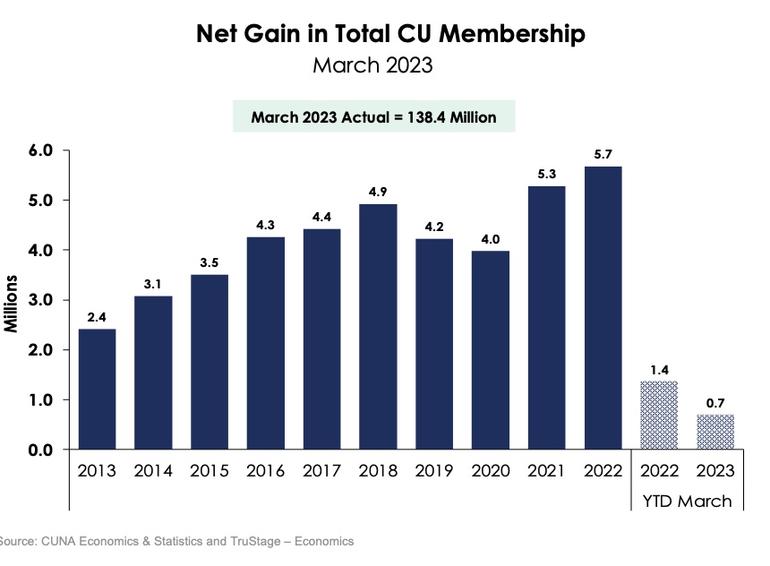
Credit Unions & Members
Credit union membership growth slowed in the first quarter of 2023, adding 0.7 million new memberships, significantly slower than the 1.4 million added in the first quarter of 2022.
According to the Trends report, on a growth rate basis, memberships are up 3.8% in the year ending in March 2023, below the 4.1% pace set in the year ending in March 2022.
The report explains the membership growth slowdown was partially driven by the 0.885 million jobs gained in the first quarter, according to the Bureau of Labor Statistics, which is significantly below the 1.682 million jobs gained in the first quarter of 2022.
“Credit unions should expect membership growth around 3% in 2023, and a similar 3% membership growth is forecasted for 2024,” according to the Trends Report forecast. “Most of the membership growth is taking place at credit unions with assets greater than $1 billion due to organic growth and mergers. These large credit unions reported membership growth in the 6.3% range. Credit union with assets in the range of $250-999 million reported membership growth of around 2.5% for the last two years. Credit unions with less than $100 million in assets lost memberships during the last two years.”