

MADISON, Wis.–For the first time in seven years, consumer loans grew at a slower pace than other lenders during October, while CUs added a modest 158,000 new members, in October, or 0.13%, slower than the 227,000 new members during October 2018.
Those figures and others are indicative of changing trends in credit unions released as part of CUNA Mutual’s latest Trends Report, which shows data through October of 2019.
Among some of the other topline findings and projections:
- CUNA Mutual expects new auto sales to decline 3-4% in 2020, which will “weigh on credit union new-auto lending growth in 2020, which is already in negative territory.”
- Total mortgage lending is expected to decline by 10% in 2020.
- Deposit growth is expected to remain strong in 2020, and possibly exceed 9%.
Here’s a look at how credit unions performed by category through November, according to the CUNA Mutual analysis:
Total Credit Union Lending
Credit union loan balances rose 0.6% in October, the same as the 0.6% pace reported in October 2018. Driving overall loan growth was strong growth in adjustable rate first mortgages (1.3%), fixed rate first mortgages (1.2%) and unsecured personal loans (1.3%), the Trends Report stated.
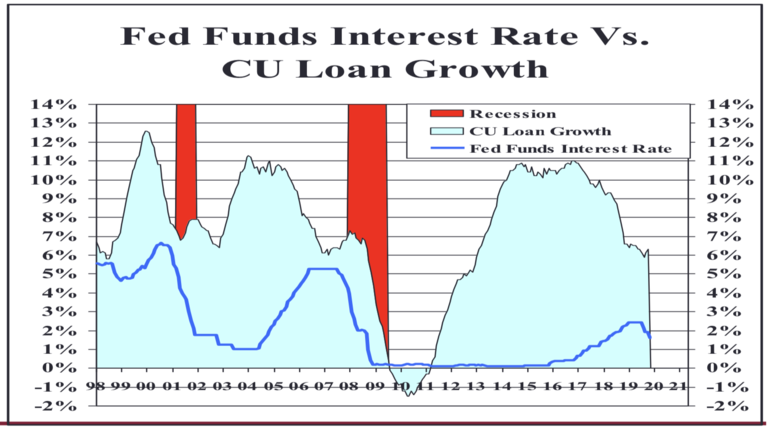
CUNA Mutual’s economists additionally examined how rising short-term interest rates affect credit union loan growth, as can be seen in the chart, which shows the relationship between credit union annualized loan growth numbers and the Fed Funds interest rate for the past 22 years.
“Periods of rising Fed Funds interest rates (1999-2000, 2004-2006 and 2016-2018) have a downward pull on overall credit union loan growth,” CUNA Mutual said. “This is, of course, the goal of tighter monetary policy, which is to slow the rate of credit creation from above trend growth to something closer to normal. Credit union loan balances grow on average 7.2% per year over the long run, and credit union loan balances are rising slightly more than 6% today. The recent decline in the Fed Funds rate will help to buoy loan growth in 2020, which will help offset other factors pushing loan growth lower.”

Credit Union Consumer Installment Credit
Credit union consumer installment credit balances (auto, credit card and other unsecured loans) reported no growth in October, less than the 4.2% increase set in October 2018, due to a deceleration in new and used auto lending. During the last 12 months, credit union consumer installment credit grew only 3.3%, which is below the rest of the market excluding credit unions, which increased 5%, CUNA Mutual said.
“This is the first time in seven years that credit union consumer loans grew at a slower pace than other lenders,” CUNA Mutual said. “For all lenders, outstanding consumer credit rose a strong $18.9 billion in October, according to the Federal Reserve, and above the $16 billion average monthly growth reported during the last 12 months.”
CUNA Mutual forecast the decrease in the Fed Funds interest rate will decrease credit card interest rates in the near term and, to a lesser extent, auto loan rates. “This will lower credit union yield on assets and net income in 2020,” the analysis states.

Vehicle Loans
Credit union new auto loan balances fell 0.7% in October, slower than the 0.7% gain set in October 2018, and increased only 0.9% during the last year, the Trends Report states. On a seasonally-adjusted annualized basis, new auto loan balances fell 3.5% in October, down from the 7.2% pace reported in October 2018.
“The number of new auto loans as a percent of members in offering credit unions – the penetration rate – rose to 6.2%, up from 6.1% last year and 4.2% in 2012,” according to the analysis,
CUNA Mutual is cautioning credit unions to expect new auto sales to decline 3-4% in 2020 due to slowing U.S. economic growth, car prices rising faster than wages and the elimination of pent-up demand for new vehicles. This will weigh on credit union new-auto lending growth in 2020, which is already in negative territory, the report adds.

Real Estate Secured Lending – First Mortgages and Other Real Estate
Credit union real estate lending was “firing on all four cylinders during the first 10 months of 2019 due to the 114 basis point drop in mortgage interest rates and the improving economy,” the Trends Report states.
“Adjustable-rate first mortgage loan balances grew a strong 1.3% in October, but below the rapid 3.4% pace set in October 2018. Second mortgage loan balances rose 1.3% in October, above the 0.1% increase recorded in October 2018,” CUNA Mutual said. “Expect purchase mortgage lending to increase only 1-2% in 2020 due to rising incomes, falling consumer confidence and modest job growth. However, expect refinance mortgage lending to drop 20-25% as long-term interest rates rise from around 3.7% today for a 30-year mortgage to over 4% in 2020. Thus, total mortgage lending is expected to decline by 10% in 2020.”
CUNA Mutual said home equity lending balances rose a modest 0.3% in October, down from the 2.5% reported in October 2018.
“Home equity loan balance growth will recover in 2020 as the mortgage refinance boom comes to an end and home prices continue to rise,” according to the Trends Report.
Surplus Funds (Cash + Investments)
Credit union surplus funds rose in October by $3 billion due to a $9.6 billion surge in deposit growth outpacing a $7 billion increase in loans. Borrowing rose $1.1 billion as some credit unions took advantage of a risk-free riskless arbitrage opportunity between the FHLBs and the Federal Reserve, according to the Trends Report.
Credit union surplus funds as a percent of assets rose to 24.3% in October, up from 23.5% in October 2018, to reach $383.4 billion. We expect the credit union liquidity position to increase in 2020 as deposit growth outpaces loan growth.
Moving forward, CUNA Mutual stated, “With the Federal Reserve now paying 1.55% on required and excess reserve balances held at the Fed, and the 3-year Treasury rate trading at only 1.61%, many credit unions will park excess funds in their Fed reserve account to maintain liquidity.”

Savings and Assets
Credit union savings balances rose in October by 0.7%, greater than the -0.2% decline in October 2018. Savings balances grew at an 9.7% seasonally-adjusted annualized growth rate in October, above the 5.8% reported one year earlier, the Trends Report states.
“We expect credit union deposit growth to remain strong in 2020, possibly climbing over 9%, if the economy enters a ‘growth recession’ with GDP increasing only 1%,” CUNA Mutual forecast.

Capital and Other Key Measures
Credit union capital balances grew 12.2% in the year ending in October, significantly above the 7% average set over the last 20 years.
Credit Unions and Members
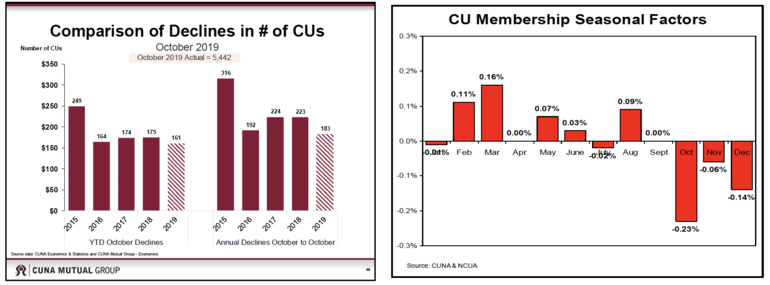
As of October 2019, CUNA Mutual said estimates by CUNA are that 5,442 credit unions were in operation, down 183 from October 2018. Year-to-date the number of credit unions fell by 161, slightly less than the 175 reported in the first 10 months of 2018.
Looking forward, CUNA Mutual said CU consolidation and concentration is expected to continue at its long run pace in 2020.
“Since 1980, the number of credit unions has declined by roughly 3.5% each year. If we apply this exponential ‘decay’ rate to the current number of credit unions, 5,442, we should expect another 190 credit unions to exit the financial system in 2020,” CUNA Mutual said. “If we forecast out a little further, according to the laws of exponential decay, there will only be 2,669 credit unions in 20 years, half as many as there are today. Fortunately, credit union assets follow an average annual exponential growth of 7%. This means the time that it takes for credit union assets to double (currently $1.578 trillion) is only 10 years.”
CU Membership
Credit union memberships grew by a modest 158,000 in October, or 0.13%, slower than the 227,000 new members, or 0.19%, added in October 2018. Year-to-date credit unions added 3.2 million new members, slower than the 4.3 million members added during the similar period in 2018, the Trends Report stated.
Total credit union memberships reached 121.7 million in October, 3.2% more than October 2018 and the slowest pace since the summer of 2015. Expect membership growth to slow to 2.5% in 2020 as loan growth slows to 5.5%, CUNA Mutual said.