

COLORADO SPRINGS, Colo.–NCUA Chairman Todd Harper covered a variety of issues and agency priorities for attendees at the Defense Credit Union Council meeting here, including issues he has identified in the past as well as new issues, such as AI.
As he has done in other remarks, Harper pointed to the failures of a number of well-known banks, such as Silicon Valley Bank, to emphasize the need to be attuned to safety and soundness concerns.
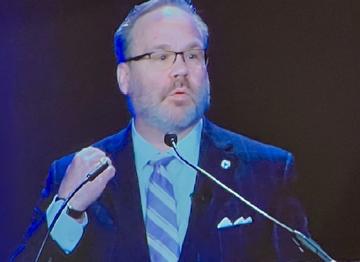
Todd Harper speaks at DCUC meeting.
“The recent turmoil within the banking system is also a reminder — for us all — of the need to carefully manage capital, interest rate, liquidity, and credit risks,” said Harper.
Harper noted NCUA has:
- Highlighted each of those risks as areas of focus in its supervisory priorities.
- When examining credit unions, the NCUA has been forward-looking, risk focused, and ready to act expeditiously, if needed.
- Updated its guidance on how examiners work with credit unions exposed to the market risk of rising interest rates. “By increasing clarity and flexibility, these changes to the supervisory framework for interest rate risk are a win for both examiners and credit unions,” Harper said.
The Good News
The good news, according to Harper, “is that the credit union system — overall — remains well positioned at this time to handle economic disruptions like a moderate recession. What’s more, the NCUA is well positioned, through the supervisory process, to address issues that may arise from broader market concerns about liquidity in the financial services sector.”
The Issues Covered
Among the other issues touched on by Harper:
Interest Rate Risk, Liquidity Risk, and CLF
“Changes in inflation, the interest rate environment, and broader economic conditions over the last year call for extra vigilance,” said Harper. “In fact, a credit union’s ability to manage interest rate risk will remain a crucial factor in its performance going forward.”
Proposed Rule on Charitable Donation Accounts
Harper cited the most recent NCUA board meeting at which he said it took an “important step to facilitate the work of defense credit unions.”
His reference was to its new proposal for which the comment period has just ended on charitable donation accounts, which adds veterans’ organizations, as defined in the Internal Revenue Code, to the definition of a “qualified charity” that a federal credit union may contribute to using a charitable donation account.
“Your credit unions have fields of membership that specialize in serving military branches, military bases, veterans, and defense-related organizations,” Harper said. “With this proposed rule change, the NCUA would allow you to better support your members and fulfill your missions. That’s good for veterans, good for military families, good for credit union members, good for credit unions, and good for our country.”
The comment period ended last week.
Cybersecurity Risk
Harper noted NCUA has begun implementing its new Information Security Examination procedures for credit unions to prepare for, withstand, and recover from cybersecurity attacks.
He also reminded that NCUA’s new Cyber Incident Notification Rule goes into effect in September.
“With their close connection to the branches of the U.S. military and the federal government, defense credit unions are on the frontlines of the cyber warfare waged by foreign adversaries and their allies,” Harper said. “That’s why each of us — the NCUA, state supervisory authorities, vendors, and defense credit unions — has a responsibility to protect our systems, improve our ability to recover from incidents, educate our teams, share information, and report and address potential vulnerabilities.”
Harper repeated his call for NCUA oversight of third-party vendors to credit unions.
Artificial Intelligence
Harper said discussion of AI is imperative.
“…Artificial intelligence, like every new technology, offers both promise and peril. Our role is to maximize and deliver on the former while identifying and mitigating the risks of the latter,” said Harper. “Some of the pitfalls in relying on artificial intelligence to make important, even life-changing decisions have already come to light.”
As an example, Harper pointed out that in 1995 Fannie Mae and Freddie Mac launched automated underwriting software that “promised to make the home loan approval process more efficient by using AI to assess the likelihood of a borrower defaulting on a loan. This technology was promised to be color blind, but it has unfortunately fallen far short of that goal. A 2021 report by The Markup found mortgage lending algorithms in the U.S. were 80% more likely to reject Black applicants, 50% more likely to reject Asian and Pacific Islander applicants, 40% more likely to reject Latino applicants, and 70% more likely to reject Native American applicants compared to similar white applicants. Those numbers are startling and should absolutely cause concern.”
Reminder on ECOA
As CUToday.info reported, Harper also reminded that last week the agency issued an NCUA Express email message reminding credit unions of their obligation to comply with Equal Credit Opportunity Act nondiscrimination requirements in their use of automated underwriting systems.
How to Get the Daily CU News Headlines In Your Inbox Each Day, For Free!
The biggest, best and freshest news reporting in credit unions remains free in ’23! Each morning CUToday.info delivers its daily Fresh Today news update offering the latest headlines and breaking news right to your email, with the easy-to-read headlines format allowing you to click on the stories that interest you most in order to learn more.
If you haven’t yet signed up for the new email solution on which CUToday.info has partnered with ResponseGenius, you can do so here. Signing up requires less than one minute of your time—and it’s free!
Please note that after signing up you may need to go to your Spam/Junk folder and mark the morning headlines email as safe. CUToday.info does not provide its list of readers and emails to outside parties, and we will not be contacting you to sell you an extended warranty or sending you any links so you may cash in on an inheritance you didn’t know was coming.
And did we mention it’s free?
Please note and/or make your IT department or email administrator aware the emails will be coming from the domains CUTodayinfo.com and CUTodayinfoReply.com.