

COLORADO SPRINGS, Colo.–Any credit union exec attending a conference doesn’t need to look far to understand why embedded finance has become embedded in life and critical to CUs’ futures.
Abbie Rodriguez, SVP-lender experience with TruStage, pointed out that on her own trip to the Defense CU Council’s annual meeting included buying airline tickets online, receiving offers to buy trip protection in the digital app, offers to finance the travel costs, using her Starbucks app at the airport to purchase coffee, using the Uber app to pay for travel, finding dinner using Google maps and then being able to pay for dinner thorough the app, and more.

From left, Abbie Rodriguez and Kevin Polinsky.
“Embedded finance just continues to expand in its use-cases,” said Rodriguez.
Rodriguez was joined in her remarks by Kevin Polinsky, service director-technology with TruStage, who pointed to other examples of how providers are enabling the experiences consumers want, including Walmart’s effort to create a super app and Apple Card’s new high-yielding savings account.
Competition of the Future
“We talk about the competition of the future, and Walmart is (looking) to capture more and more of the finance opportunities,” said Polinsky, who spoke of a broader issue he called the “Amazon-ification” of the marketplace.
Why has it gained so much traction? Polinsky cited five factors at which Amazon excels:
- Mobility
- 24/7 response
- Easy and simple. “The historical premise of member service is important, but or and more it’s about what is simple and easy,” said Polinsky
- No waiting
- Instant decisions
The Challenges
Rodriguez outlines the challenges consumers face, including:
- Consumers want easier access to financial solutions
- CUs are experiencing competition from online retailers
- Lenders are too remote from the online buying experience
- Borrowers continue to be presented finance options withing he purchase event.
She noted retailers and other providers are redefining the consumer experience, and credit unions must recognize that in a broader sense. That includes embedding financing options “right where consumers are.”
Rodriguez said TruStage likes to think about the question of when credit unions are not present at a decision point, who will be?
“Retailers are all about this. They are leaning into this in spades. They continue their war on friction. How do I keep the consumer right here in this experience without clicking away?”
The ‘Microwave Culture’
Behind everything, stressed Rodriguez, is the need for transactions to be fast, easy and simple, a reality she called the “microwave culture.”
As an example, she noted there are 100-million Apple Pay users in the U.S., including herself, saying she considers herself inconvenienced when she has to reach into her purse to use a plastic card rather than being able to pay using her phone.
“This is the underlying trend that underpins embedded finance,” Rodriguez added, noting indirect lending is a form of embedded finance at point of sale with which many CUs are familiar.
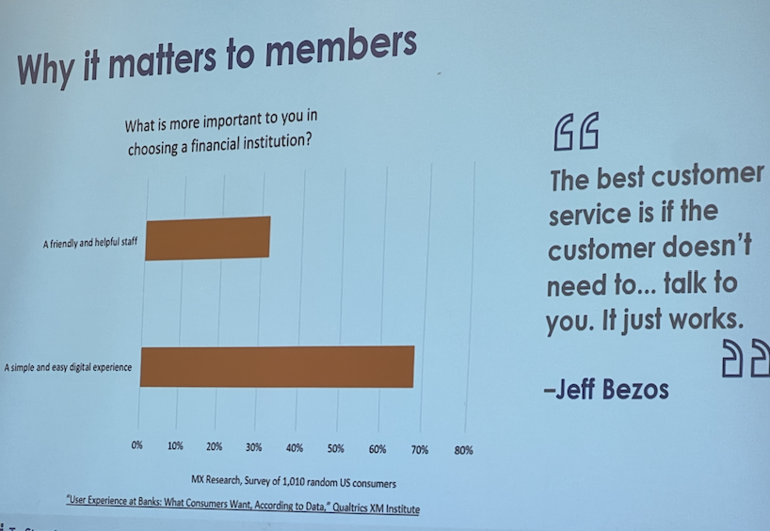
Credit unions should understand that in this new landscape the process can actually mean “interacting with members less,” said Rodriguez, suggesting being more than three clicks and more than 90 seconds away may make the credit union “too remote” for the member.
The Concept
Embedded finance is all about providing services to consumers at the point of need, said Polinsky.
According to Polinsky, TruStage is focused around three key areas of embedded finance: financing, payment services and insurance services.
“It’s about when the consumer is in the buying journey, how do you provide them with all the relevant components with the right things at the right time,” he said.
What does all this look like and mean to credit unions?
The consumer benefits, Polinsky told the meeting, include convenience, a seamless experience (meaning no “stepping out” of the buying experience) and personalization. The latter is all about tailored recommendations and offers based on consumers’ specific needs and financial behavior.
“Personalization is becoming more and more impactful,” he said.
The CU Benefits
The benefits to credit unions from embedded finance include, according to Rodriguez:
- Increase in member satisfaction
- Revenue growth
- More data
The piece we haven’t talked a lot about is the opportunity around data,” said Rodriguez. “When you partner it can give you a different view into that consumer experience and you can collect different data you may not have today. This goes back to personalization. It allows us to think about what are the next steps for the consumer so we can continue to engage them and drive a stickier relationship.”
Starbucks, for example, knows its app user’s buying history, location and more, she added.
The Data Point Worth Noting
The data point credit unions should be watching, according to Rodriguez, it is that 78% of U.S. adults prefer to bank via a mobile app or website. She noted that a majority of adults check their balances weekly or, in some cases, daily, which she said is good news for the credit union if it captures those opportunities.
CUs Recognized
Separately, during the meeting the first Department of Defense Credit Union of the Year Awards were presented. The Department of the Air Force recognized both Wright-Patt Credit Union in Ohio and Air Force Federal Credit Union at Joint Base San Antonio.