

NAPLES, Fla.–Pointing to all the change that has occurred since he last spoke to a Defense Credit Union Council meeting in 2019, NCUA Board member Rodney Hood said he remains “even more optimistic” that the issues he highlighted two years ago will be addressed in a positive way.
Hood noted that at that earlier meeting he had spoken of the importance of things like diversity, equity, and inclusion, especially financial inclusion.
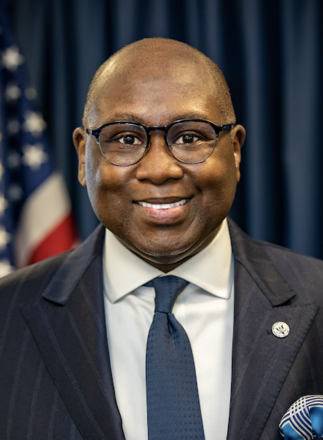
Rodney Hood
“Toward the end of 2020, I started speaking to the leadership team at the NCUA and our employees about the silver linings of the COVID-19 pandemic,” Hood said. “At that point the first vaccines were becoming available, and while we still had a long way to go – and still do have a long way to go – it was becoming possible to think about the future with more clarity and confidence. So, we wanted to pinpoint some of the lessons learned from that hard experience.”
Among those silver linings, according to Hood, is what he termed a “global stress test” he said he believes will go a “long way toward helping us to strengthen not only the credit union industry and the larger financial services industry, but also our communities and our larger society.”
Hood saluted the DCUC-member credit unions for a “job well done,” saying the response to the COVID crisis has demanded courage, creativity, and resilience, and a “fair amount of improvisational risk-taking in a climate of deep uncertainty, to keep the system running.”
To support the point, Hood cited credit union statistics showing that over the last 18 months federally insured credit unions reported net income growth of $11.3 billion, an increase of 134.9% over the year ending in the first quarter of 2021, and insured shares and deposits rose $286 billion, or 22.4%, to $1.56 trillion over the same period.
‘What’s Next?’
“So, the question is, what’s next?” asked Hood. “How do we build upon these successes and keep up the progress? How do we continue to enhance the resilience of the industry in the face of risk and uncertainty? I would suggest that, first, a continued focus on regulatory reform, and second, a continued commitment to working toward a more diverse and inclusive economy, are essential.”
Looking to the issues of diversity, inclusion, and financial inclusion, Hood said those are the “priorities where I believe credit unions are already making a difference, and can continue to do so.”
Offering a “progress report” on DEI, Hood said NCUA, including while he was chairman, has “walked the walk” and made “solid progress,” with 41.5% of the agency’s new hires in 2020 being people of color.
“In addition, 2020 was the year that we achieved gender parity in our senior executive staff for the first time,” Hood told the meeting. “Moreover, roughly a third of the NCUA’s total reportable contracting dollars in 2020 were awarded to minority-owned or women-owned enterprises. I’m proud of those achievements within the agency, and pleased that my success, Todd Harper, shares that commitment to diversity and is working to continue the progress.”
Defense CUs & Diversity
Hood praised DCUC for also leading on the issue, reflecting its diverse membership base, and defense CU executives for participating in the African-American CU Coalition’s Cross-Cultural Exchange Program.
“And when we talk about diversity, equity, and inclusion, I also emphasize that we’re not talking simply about race, ethnicity, and gender, though those are critically important,” Hood said. “I also urge people to think more broadly about diversity and inclusion, especially when it comes to our efforts at increasing financial inclusion in our society. Are we doing all we can to help Americans with disabilities or differently abled gain access to the financial system? What about older Americans who may need more protection from financial predators? What about people in under-served areas, whether rural or urban, who lack ready access to affordable financial services and products?”
Credit Unions & Fintech
Meanwhile, Hood also said he continues to encourage credit unions to look more closely at the opportunities for innovative financial technology solutions to bolster financial inclusion.
“To me, this is truly the most exciting and interesting potential that these technologies present,” said Hood.