

COLORADO SPRINGS, Colo.–Two-thirds of employees do not trust their immediate supervisor. Fifty percent would rather trust a stranger. But 92% of employees will trust each other. That’s why workplace “cohesion” is so critical to retaining talent, one person told credit unions here.
Speaking to the Defense CU Council’s annual meeting, Dr. Troy Hall, author of the book “Cohesion Culture,” said organizations all have “trust issues.”
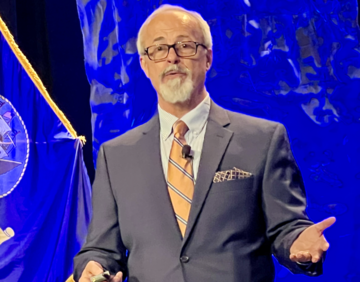
Troy Hall speaking to DCUC Annual Conference.
“Workplace cohesion is an opportunity for us to look at what is happening in our shops and make a difference,” said Hall. “Culture is paramount. It is the interaction between employees that makes it work.”
Hall said money and resources both need to be allocated to the budget specifically for culture. He added, however, it goes beyond just budget.
“It's important that the employee voice can be heard at that table,” he advised, before adding, “The objectives and goals need to be at the similar level that you would have if you were talking about your financial situation--safety and soundness, growth, loan production and deposit-gathering.
“Culture has to be a key objective,” Hall continued. “There must be education and development around the area of culture.”
After urging his audience to think of one word that explains their own credit union’s culture, Hall added, “Workplace cohesion is about infusing cohesion into the culture, not replacing it.
Three Strategic Elements
According to Hall, there are three strategic elements fundamental to workplace and cultural cohesion: belonging, value, and commitment.
“When those three things are present you are also building DEI, so you get a two-fer,” Hall added.
Hall told the meeting that for employees, belonging is about feeling included and believing one is part of something greater than they ever thought possible. “For people to be included they have to express their whole self, not just their work self,” he said.
Value
Value, according to Hall, has to do with having purposeful and meaningful work. For the employee, it’s about saying, “If what I do matters, I have value.”
Respect, Hall said, is about understanding what it really means when it comes to treating employees.
“Culture is built on how you treat people, not the treats you give them. It’s that relationship we have,” Hall said. “We don’t get to purposeful and meaningful work until we feel we belong. It really connects when we feel included. You have to think about collaboration. It’s not cooperation, it’s collaboration. To have collaboration you need two things: You need to look at each other and agree you need each other. And you have to understand that you trust people. We should be able to trust them to do their jobs. If you are in a work environment and you do not believe you need the other people who are there and you are not willing to trust them, you will not have collaboration--you may have cooperation.”
A Causal Relationship
Cohesion, said Hall, is a causal relationship and is based on focusing on others in organizations.
“I'm just going to clarify a little simple thing when it comes to what our responsibility is in this industry,” Hall said. “Regardless of what your brand promises, regardless of your clever taglines and the colors you use, we have one and only one purpose and that is to improve the financial conditions of the people we serve.”

Belonging
Hall said belonging needs to be thought of from the standpoint of not just the credit union and the member, but also the employee.
“It’s motivation, it's influence and it's enabling. This is probably the only time you'll actually be able to use the word ‘enabling’ in a very positive way,” he said. “What we're creating is transformation. We are focusing on the success of others and that happens when we stimulate individuals toward their desired goals…It’s the only purpose. It's about molding the thinking of individuals. It is making sure we've got people lined up.”
Hall said his experience has shown what happens when people aren’t lined up.
“I've worked in a $3-billion organization. I've had up to 350 people reporting into my structure and I will tell you if you don't tell people things, they will make stuff up that is pretty crazy.”
Creating Fair Play
Hall urged organizations to recalibrate and create “fair play,” observing that:
- People are looking for flexible work hours and locations. “You get to decide if you are going to have a remote workplace. But stop calling it ‘work from home.’ It’s demeaning. It’s not the nature of what we are really doing. We called it that during the pandemic. What we are seeing today is we have more remote work than ever. It is important that you keep that in mind.”
- Autonomy and initiative. “The workforce is looking for that. They want to know what their job is. They want purposeful, meaningful work, but that won’t happen if the individual doesn’t understand their level of autonomy and what level of initiative you want them to provide. “We measure people not by whether they are in the seat but by the quality of the work they are doing,” Hall continued. “Today’s workers aren’t looking for one size fits all. They are looking for inclusiveness. If you don’t get the money right it will be an issue, but money isn’t everything. The number-one driver of people to leave an organization is they were not included. They had a disconnect with their supervisors. This is the area where you can have the most impact in retaining talent.”
- Readiness. “Individuals want to be ready for their next opportunity for growth, for development, for advancement. Seventy-one percent of employees are looking for advancement.”
The Real Goal
Hall said the process of attempting to make employees happy and satisfied is “exhausting.”
“Stop focusing on that. It’s not your job to make employees happy or satisfied,” Hall said. “What is important is that you are aligning people to the culture of your organization and that you are creating cohesion. Cohesion builds performance through engagement. When it is present you have helpful, active, vested, eager employees. You should focus on, ‘How do I get my employees to be more engaged in what you are doing?’ And that means focusing on belonging.”