

MADISON, Wis.–Credit unions closed 2023 with 15.2% of the consumer loan market, up from 14% one year earlier and marking the highest percentage on record, according to TruStage’s new Trends Report data.
The February report, which is based on data through December of 2023, shows the lending growth came in the same year membership in credit unions grew at its slowest pace since 2020.
Here's how credit unions performed by category, according to the Trends Report analysis:
Total Credit Union Lending
Credit union loan balances rose 0.3% in December, less than a third of the 1% pace reported in December 2022, according to the Trends Report.
“Driving overall loan growth was strong growth in adjustable-rate mortgages (3.7%), credit card loans (2.0%), and second mortgages (1.6%),” the report states. “December credit card seasonal factors – such as holiday shopping – typically add 3.1 percentage points to the underlying credit card trend loan growth.”
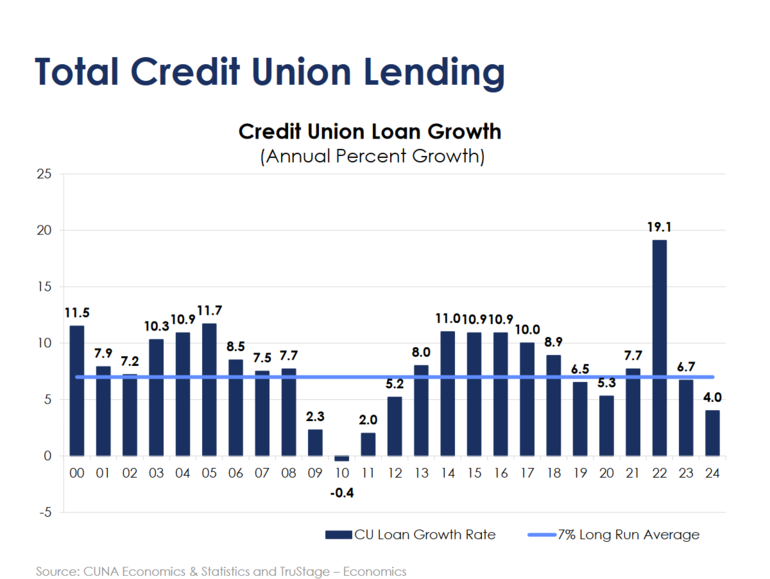
The analysis further shows credit union loan balances rose 6.7% in 2023, down from the 19.1% reported in 2022 and below the 7% long-run average for two reasons.
“First, the Federal Reserve raised short-term interest rates another 1.25 percentage points in 2023, which increased consumer and mortgage loan interest rates, and therefore reduced members’ demand for loans,” the Trends Report states. “Second, tight liquidity, especially among larger credit unions, has reduced their ability to keep making loans.”
Credit unions now hold 15.2% of the consumer loan market, up from 14.7% one year ago and is the highest percentage on record, according to the TruStage analysis.
“Expect credit union loan growth to slow to 4% in 2024 as many large credit unions focus on building liquidity,” the report predicts. “Credit unions with ample lending capacity, however, will see faster loan growth as other lenders face similar liquidity challenges and even greater concerns around capital and loan performance.”
Consumer Installment Credit
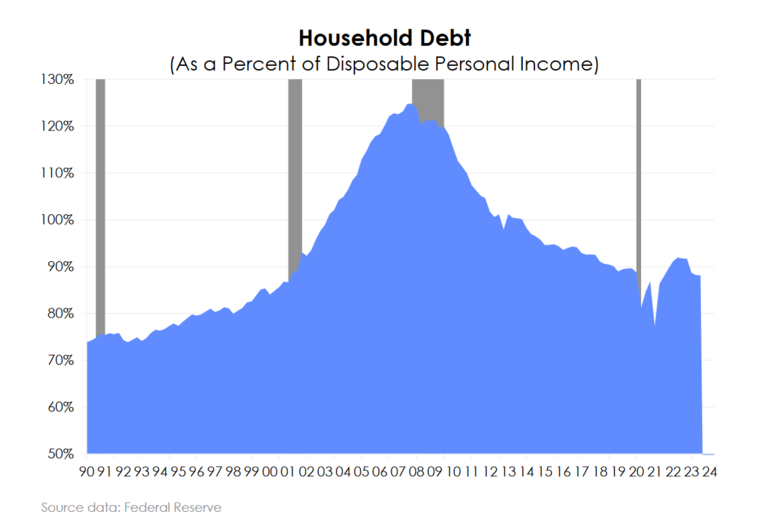
The great deleveraging of the U.S. consumer balance sheet that began in 2008, then reversed course in 2022, has resumed in 2023 as household debt grew slower than disposable personal income, the Trends Report states.
“Household debt burdens, as measured by residential mortgages and consumer credit as a percentage of disposable personal income, fell to 88.1% in the third quarter of 2023, down from 91.7% in the third quarter of 2022, according to the Federal Reserve’s Flow of Funds report,” the analysis explains. “A strong labor market, fast rising wages and higher interest rates were the primary factors bringing down the debt-to-income ratio.”
The report further notes that debt-to-income ratios are back to the levels seen in the first quarter of 2001, before the housing and debt boom of 2002-2007.
“Falling debt burdens during the last 15 years have improved household balance sheets. Household net worth has also surged since 2009 due to rapidly rising stock and home prices,” the report says. “Expect household debt-to-income ratios to fall slowly for the next few years as income growth barely exceeds debt growth. We expect the supply and demand for credit to decrease this year as lending institutions tighten their lending standards thereby reducing the supply of credit and higher market interest rates reduce the demand for credit. Tighter lending standards will reduce credit card and other forms of short-term debt the most.”
Vehicle Loans
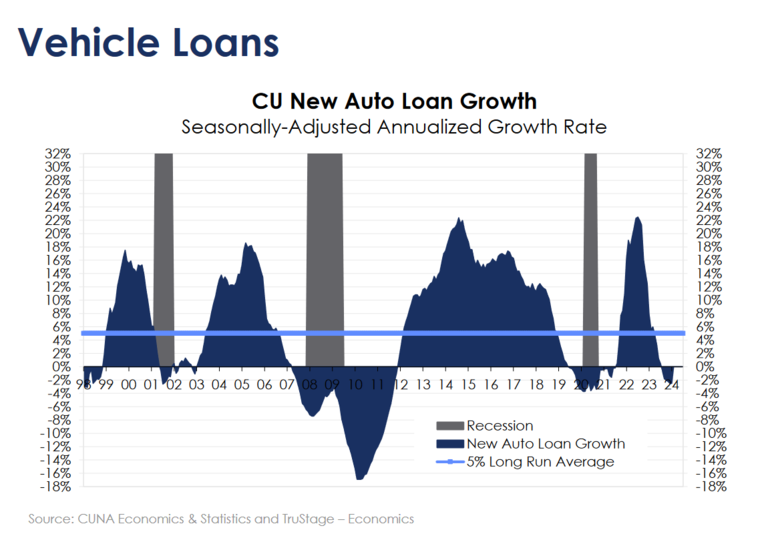
Credit union new auto loan balances fell 0.3% in December, significantly below the 1.7% gain set in December 2022, and only rose 1.2% for the full year, which is the slowest pace since 2021, the Trends Report analysis shows.
“On a seasonally-adjusted annualized basis, new auto loan balances fell 2.5% in December
due to high lending interest rates, tight liquidity pressures causing some credit unions to pull back from lending, increased vehicle incentives by manufactures, and tighter lending standards reducing the availability of credit,” the report says.
It further notes new vehicle sales rose 3.7% in December from November to a 16.1 million seasonally-adjusted annualized sales rate and were up 17.1% from the pace set one year earlier. Sales improved due to greater vehicle inventories making it easier to buy a new vehicle, a resilient U.S. economy boosting consumer confidence, and a tight labor market creating 3.1 million new jobs and a 4.5% increase in average wages, the report adds.
‘Less Equity’
“Despite the improved new auto market in 2023, sales are still below the assumed market equilibrium of 17 million car sales due primarily to persistently high new car transaction prices. Moreover, declining used-vehicle values are leaving consumers with less equity from their trade-ins making the purchase of a new vehicle out of reach for many consumers,” the report states. “For 2024, we expect auto sales to rise from 15.5 million in 2023 to 16.3 million. This 5.2% increase is due to improvement in new-vehicle affordability, steady growth in inventory levels, a relatively healthy labor market and the prospect of declining interest rates reducing the lending costs of a new vehicle.”
Real Estate Information
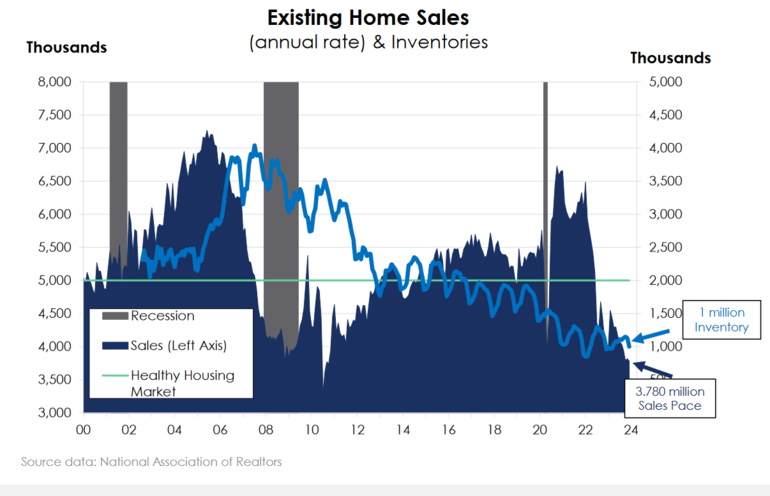
The housing market closed 2023 on a weaker note as existing home sales fell 1% to a 3.78 million seasonally-adjusted annual rate in December from November and fell 6% from December 2022, the Trends Report observes.
“High mortgage interest rates and high home prices appeared to weigh on sales along with limited homes available for sale. Currently the month’s supply of homes on the market has plummeted to 3.2 months, below the six months considered a balanced housing market,” the report notes. “Meanwhile home prices are still rising due to the tight housing market. Median single-family home prices fell 1% in December due to seasonal factors but rose 4% during the last year according to the National Association of Realtors, which is at the 4% long run average. Housing demand is expected to remain below its long-term trend of five million annual home sales during the next year due to unaffordability issues related to high home prices and high interest rates.”
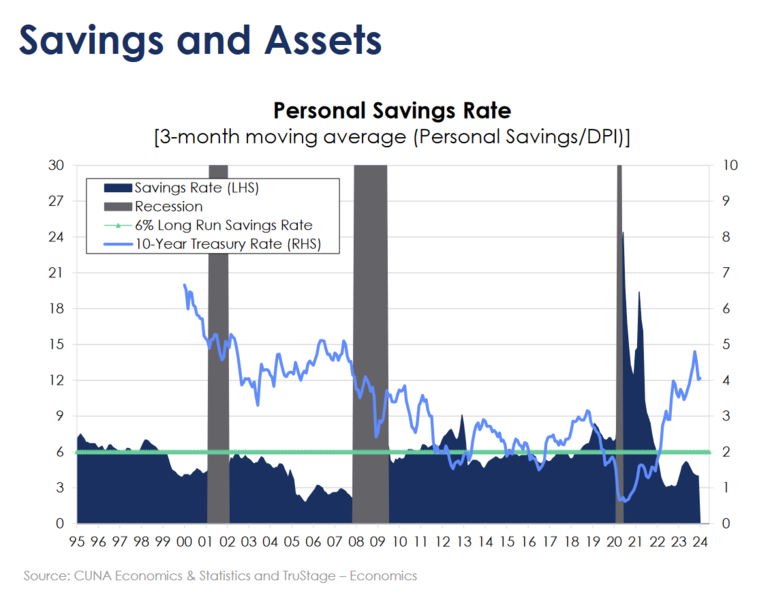
Savings & Assets
According to the new Trends Report analysis, the personal savings rate (personal savings divided by disposable personal income) averaged 4.5% in 2022, below the 6% long run average, which has created a headwind for credit union deposit growth, the report states. During December 2023, consumers saved 3.7% of their disposable income, up from the 3.4% reported in December 2022.
“Today's low savings rate comes on the heels of the high savings rates reported during the COVID-19 pandemic in 2020-2021 when consumers spent less on leisure and hospitality and received three rounds of government stimulus checks,” according to the Trends Report analysis. “Consumers typically used 80% of their stimulus payments to either pay down debt or to build up their precautionary savings balances. Expect the personal savings rate to rise to 6% later in 2024, due to members’ having exhausted their excess savings built up during the pandemic.”
Decline in Personal Savings
The drop in the personal savings rate is one factor pushing up long-term interest rates recently, the analysis continues.
“The figure shown in the chart reveals how the jump in the savings rate in 2020-2021 helped lower the 10-year Treasury note interest rate,” the Trends Report states. “Financial institutions used the surge in savings deposits to purchase additional government debt. This increased the price of bonds and reduced the interest rates on those bonds. The recent drop in the savings rate slowed the growth in credit union deposits and therefore the funds available to purchase additional government debt which raises interest rates.”
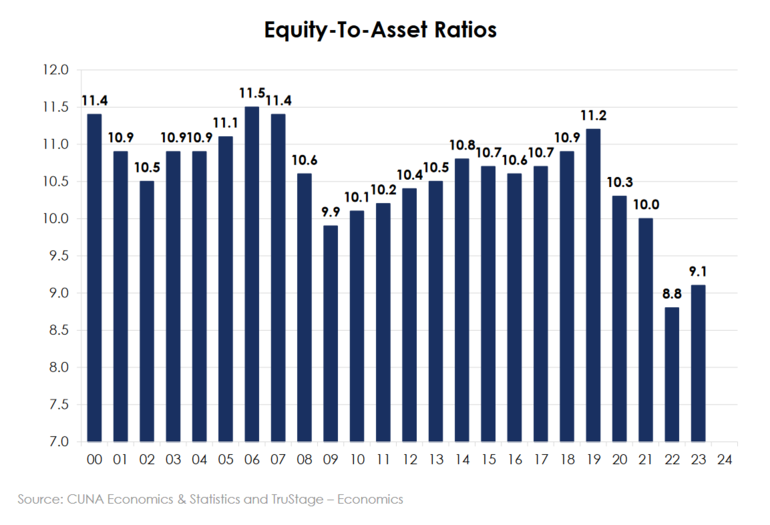
Equity and Other Key Measures
The credit union movement’s equity-to-asset ratio ended 2023 at 9.1%, up from the 8.8% reported at year-end 2022, as net income outweighed losses on the market value of available-for- sale investments, according to the Trends Report.
“Credit union equity (Other Reserves + Undivided Earnings + Unrealized Gains/Losses on Available for Sale Securities) rose $15.5 billion in 2023 due to losses on securities (-$0.7 billion) being outweighed by net income ($16.2 billion),” the report explains. “The numerator of this ratio (equity) rose 8% in 2023, while the denominator (assets) rose only 4.1%. The net effect was a 3.4% rise in the ratio from 8.8% to 9.1%.”
The Trends Report further notes credit union earnings as measured by return-on-asset ratios came in at 0.72% in 2023, down from 0.88% in 2022 and below the 1% long run average. The decline was due primarily to higher provision for loan losses and operating expenses rising faster than assets.
‘An Important Measure’
“Credit unions reported a return-on-equity (a.k.a. equity growth rate) number of 8% in 2023, above the 7.4% 30-year average. The return on equity ratio is an important measure of credit union financial performance because it is considered the speed limit for asset growth in the long run,” the analysis says. “Credit union equity growth could improve in 2023 if the Federal Reserve lowers interest rates later in the year and therefore boosts the market value of available-for-sale investments and reduces the competitive pressure on deposit pricing.
“However, we are forecast return-on-asset ratios falling to 0.5% this year due to falling net interest margins, low fee income and a rise in loan loss expense,” the analysis adds.
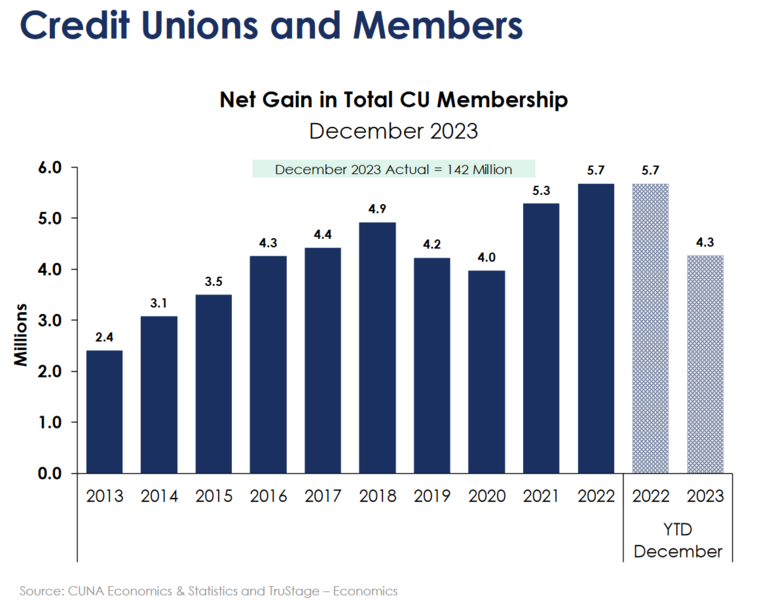
Credit Unions & Members
According to the new data, credit unions added 191,000 memberships in December, less than the 399,000 reported during December 2022. Credit unions added 4.3 million memberships for all of 2023, the slowest pace since 2020.
“This membership slowdown is due in large part to the slowdown in credit union lending,” the report states. “Membership growth is also driven by job growth. In 2023, the economy gained 3.1 million jobs, according to the Bureau of Labor Statistics, down from 4.5 million in 2022, but 41% more than the 2.2 million jobs the economy typically added annually during 2010-2019. For 2024, expect a weaker labor market with an expected 2 million additional jobs being added to the workplace.”
The Forecast
The Trends Report projected that as credit union membership growth is expected to be 3.3% in 2024 and 2.5% in 2025, below the recent five-year average of 4.7%, due to a decrease in the demand for credit by the American consumer.
Now With Free Shipping! The CUToday.info Daily News Email Keeps Getting Better!
The biggest, best and freshest news reporting in credit unions remains free, and now has an added bonus---free shipping to your email address! That’s right. Each morning CUToday.info delivers its daily Fresh Today news update offering the latest headlines and breaking news right to your email, with the easy-to-read headlines format allowing you to click on the stories that interest you most in order to learn more. So stop paying those bank-fee-like subscription prices from other so-called “news” publications!
If you haven’t yet signed up for the new email solution on which CUToday.info has partnered with ResponseGenius, you can do so here. Signing up requires less than one minute of your time—and it’s free!
Please note that after signing up you may need to go to your Spam/Junk folder and mark the morning headlines email as safe. CUToday.info does not provide its list of readers and emails to outside parties, and we will not be contacting you to sell you an extended warranty or sending you any links so you may cash in on an inheritance you didn’t know was coming.
And did we mention it’s free?