

NEW YORK – The cost of the average out-of-network ATM withdrawal has reached a new record high of $4.72, according to the latest Bankrate.com Checking Account and ATM Fee Study.
Overdraft fees have also increased, the survey has found.
The study, which has surveyed non-interest and interest accounts and their associated fees for more than 20 years, found the all-in fee, which includes the ATM surcharge as well as the penalty that banks charge their own customers to make out-of-network withdrawals, has increased 33% over the last decade, Bankrate.com reported.
“Banks are charging non-customers more than ever to use their ATMs,” Bankrate.com reported. “The average ATM surcharge increased two percent to a new record of $3.09, the 15th consecutive year establishing a new record. The average surcharge has increased in 20 of the past 21 years.”
The Good News
According to Bankrate.com, the good news is the fee charged by the accountholder's own bank for using another institution’s ATM has decreased 2% from $1.66 to $1.63, moving lower for the second year in a row. In fact, the number of banks and accounts allowing free out-of-network withdrawals is at a record high, although this still represents less than one-third of accounts (32%), Bankrate.com said.
“While large banks have extensive ATM networks, many smaller banks and credit unions belong to nationwide fee-free alliances that may have significantly more ATMs available than even the ATM networks of big banks,” said Bankrate.com Chief Financial Analyst Greg McBride, in a statement. “One other option to withdraw money for free is to get cash-back at the point of sale when using a debit card. Banks don’t charge for that and very few merchants do either.”
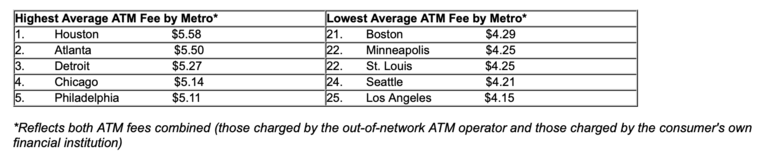
Bankrate.com said its survey found ATM fees vary by region. Houston has the highest average out-of-network ATM fee of the 25 major metro areas examined in the study ($5.58), while Los Angeles has the lowest ($4.15).
Overdraft Fees Increase
The study found overdraft fees have also increased for the 19th time in 21 years. The current average cost for non-sufficient funds (NSF) sits at $33.36, just shy of the record of $33.38 set in 2017. The most common fee remains $35 for the 11th year in a row, Bankrate.com said.
McBride said those consumers who occasionally overdraft might want to consider some of the fintechs and neobanks that are offering accounts that do not charge overdrafts and are worth considering.”
Bankrtate.com said its study found overdraft fees continue to vary by metro area. For the third straight year, consumers in Philadelphia are paying the highest average overdraft fee ($35.50), while Cincinnati’s fees are the most lenient compared to the rest of the major metros ($30.95), the company said.

Checking Account Pricing
Ninety-nine percent of non-interest checking accounts are either free by default or can become free, according to Bankrate.com. Among non-interest accounts, 42% are free without stipulation, the highest since 2011, and 43% will waive the monthly fee ($5.61, on average) based solely on direct deposit.
“On the other hand, just 7% of interest checking accounts are free by default,” said Bankrate.com. “While 73% will waive the service fee ($15.05, on average) with a minimum balance requirement – either across accounts or within the checking account itself – the average threshold is a hefty $7,123, up nearly 13% from last year. Unlike non-interest accounts, just 18% of interest accounts will waive the fee with direct deposit alone. Interest earnings on checking accounts remain negligible, with yields averaging just .06%.”
Bankrate.com said its findings are based on a study of a total 10 banks and thrifts in each of 25 large U.S. markets; one interest and one non-interest account, as well as their associated ATM and debit card fee policies were surveyed from 244 institutions offering checking accounts; 238 interest and 237 non-interest accounts were surveyed.