

MADISON, Wis.–The effects of the coronavirus pandemic upon credit unions is readily apparent in the latest Trends Report released by CUNA Mutual, which finds auto loan balances as part of the overall portfolio at their lowest point in five years, credit card balances seeing their “biggest drop in history,” and which further projects loan delinquencies to double by the end of this year.
The one bright spot in the July Trends Report, which includes data through May of this year: mortgage lending.
Meanwhile, new membership growth has also slowed considerably to a pace not seen since the days before 2011’s Bank Transfer Day.
The overarching issue for credit unions, of course, is the economy, with CUNA Mutual’s economists now forecasting the economy will contract at a 35% annualized pace in the second quarter, with the unemployment rate remaining over 8% during 2021 and deflationary pressures keeping the inflation rate around 1% during the next 18 months. The 10-year Treasury interest rate will remain below 1.5% until 2022 due to low inflation expectations and massive quantitative easing by central banks around the world, the Trends Report states.
Here’s a look at how credit unions performed by category.
Total Credit Union Lending
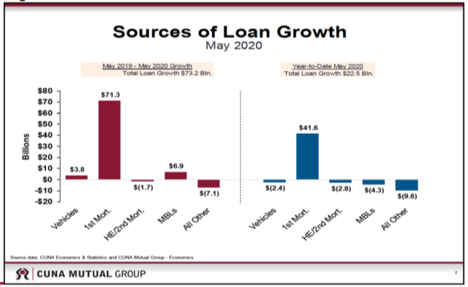
Credit union loan balances rose 1% in May, faster than the 0.6% pace reported in May 2019 and 6.8% during the last 12 months due to record setting first mortgage loan originations, the Trends Report states, adding every loan category reported negative growth rates except fixed-rate first mortgage loan balances which rose 2% and used-auto loan balances which rose 0.6%.
First mortgage lending has made up all of loan growth over the last five months. Vehicle loan balances fell $2.4 billion and home equity/second mortgage loan balances fell $2.8 billion. Auto loan balances now make up only 32.8% of all credit union loan balances, the lowest in five years. Higher yielding unsecured and credit card loan balances made up 9.2% of all loan balances in May, the lowest in credit union history, the Trends Report states.
Credit Union Consumer Installment Credit (CUCIC)
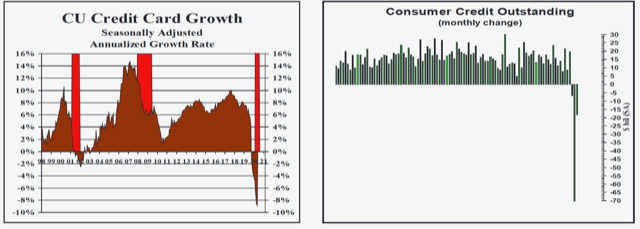
Credit union credit card loan balances fell 1.4% during May, below the 0.8% rise in May 2019, as the effects of COVID-19 economic lockdown were still in full force, according to the Trends Report. On a seasonally adjusted annual rate, credit card balances fell 8.9%, the biggest drop in history.
“Expect consumer credit to contract as long as the economy remains at least partially shut down. Revolving credit balances (which include credit card spending) will continue to decline because of the large number of people who have lost their jobs in the last four months,” CUNA Mutual’s economists said. “Moreover, supply side constraints will reduce credit creation as credit quality begins to deteriorate and lenders move quickly to tighten their lending standards.”
Vehicle Loans
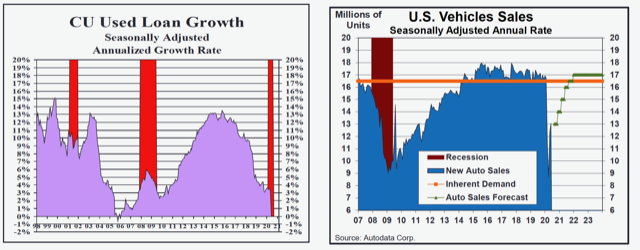
Credit union used-auto loan balances rose 0.6% in May, above the 0.5% gain reported in May 2019. On a seasonally adjusted annual rate, new auto loan balances rose only 3.3% in May, down from 3.9% in May 2019. Used-auto loan balances were the only consumer loan category to post an increase in May, according to the Trends Report, which noted used-auto loan interest rates have not changed much over the last year, while new-auto loan interest rates fell 43 basis points.
The report cautions credit unions to not expect auto sales to return to its long run average of 16.5 million sales pace until the end of 2021 due to high unemployment, cautious consumers and an all-time low in the number of miles driven per licensed driver.
Real Estate Secured Lending – First Mortgages and Other Real Estate
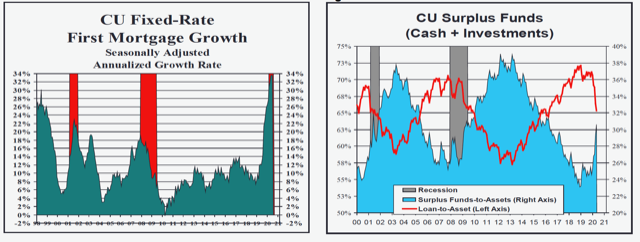
Credit union fixed-rate first mortgage loan balances rose 2% in May, above the 1.2% increase reported in May 2020, due to historically low mortgage interest rates, according to the Trends Report. Credit union fixed-rate first mortgage loan balances rose 33.6% at a seasonally adjusted annual rate in May, the fastest in credit union history.
“However, adjustable-rate first mortgage balances fell 0.3% in April as members preferred fixed-rate loans. Fixed-rate first mortgages now make up 34.3% of all credit union loan balances, up from 29.6% last May and the highest in credit union history,” the Report observes. “This raises concerns for interest rate risk if and when market interest rates rise.”
Surplus Funds (Cash + Investments)
According to the Trends Report, credit union surplus funds as a percent of assets rose to 30.6% in May, up from 25.5% last May, as credit unions’ deposits grew faster than loans. During the last year, credit unions added $73 billion in loans to their balance sheets and $149 billion in investments.
“These assets were funded by $199 billion in new savings deposits and $15 billion in additional capital (net income),” the Report states. “Credit unions reduced total borrowed funds by $3 billion.”
Other findings, according to CUNA Mutual:
- Credit union yield-on-asset ratios fell 13 basis points over the last year to fall to 3.81% in the first quarter of 2020.
- The “mix effect,” the shift in the mix of credit union assets from higher-yielding loans to low-yielding investments, subtracted three basis points from credit union yield-on-asset ratios. In addition, the “rate effect” subtracted 10 basis points from yield-on- asset ratios due to the yield on investments falling from 2.28% in the first quarter of 2019 to 1.49% in the first quarter of 2020.
- Credit union cost of funds rose 4 basis points during the last year to reach 0.86%. Net interest margins therefore fell a total of 17 basis points, from 3.12% to 2.95%.
Savings and Assets
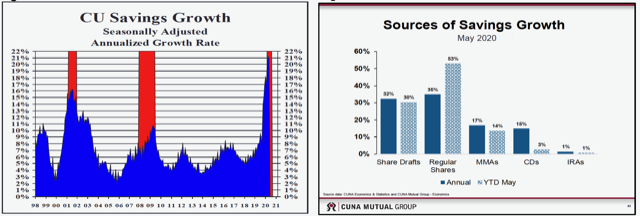
Credit union savings balances grew at a 21% seasonally-adjusted, annualized growth rate in May, the fastest pace since August 1986 which was during the height of the savings-and-loan crisis, the Report states.
Regular share accounts obtained 53% of all new savings flowing into credit unions during the first five months of 2020, up from 35% during the last 12 months. Thirty percent of all new savings flowed into share draft accounts, similar to what was reported during the last 12 months.
Capital and Other Key Measures
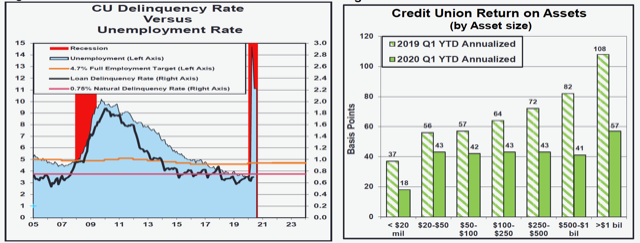
The credit union loan delinquency rate (loans two or more months delinquent as a percent of total loans outstanding) rose to 0.7% in May, up from 0.69% in April and from 0.6% in May 2019.
“Delinquency rates are still below the 0.75% long run natural delinquency rate, even though the unemployment rate was 13.3% in May, due to credit union offering loan payment extensions to their members facing financial difficulties,” CUNA Mutual’s analysis states. “Expect loan delinquency rates to double to 1.5% by the end of the year due to double digit unemployment rates, loan payment extensions plans coming to an end, delinquency rates history of rising during the second half of the year and much slower loan growth than the growth of delinquent loans.”
Credit union return-on-assets ratios fell to 0.53% in the first quarter of 2020, down from 0.95% in Q1 2019, due mainly to rising provision for loan loss ratios (10 basis points) and falling net interest margins (17 basis points). The disparity between small and large credit unions’ return-on-asset ratios narrowed significantly over the last year, according to the Report.
Number of Credit Unions
As of May 2020, CUNA estimates 5,369 credit unions were in operation, 37 fewer than April and 179 less than May 2019. During the first five months of 2020, approximately 91 credit unions ceased to exist because of mergers, purchase and assumptions or liquidation. This rate is faster than the 55 reported during the similar time period in 2019.
The Trends Report states most of the recent mergers were either an acquisition merger (where the assets of the merged credit union were 10%-50% of the acquirer credit union) or an absorption merger (where the assets of the merged credit union were less than 10% of the acquirer credit union).
“Our 2020 forecast estimates an average annual decline of 160 credit unions through 2021, bringing the total number of credit unions to around 5,065 by the end of 2021,” the report states. “The annual contraction rate of the credit union marketplace rose to 3.2% in the year ending in May 2020, up from 2.6% in the calendar year 2019. During the last 40 years, the annual credit union marketplace contraction rate has averaged 3.5%, with little variance over time. Expect the contraction rate to rise above 3.5% once the current economic crisis ends.”
Credit Union Membership
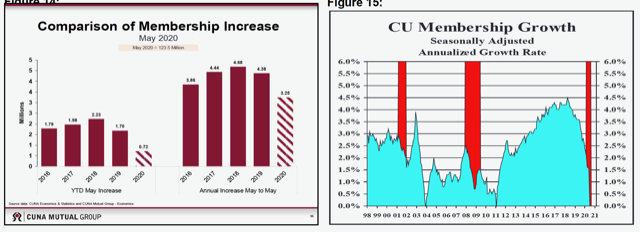
Credit union memberships grew 241,000 in May, or 0.2%, down from May 2019 when the movement added 278,000 memberships at an increase of 0.23%, CUNA Mutual said. The membership gain year-to-date slowed to 720,000, down from 1,700,000 for the similar period in 2019.
“Slower loan growth, closed credit union branches due to the pandemic and less job creation are three factors weighing on credit union membership growth,” the Report states. “Credit union memberships grew at a 1.3% seasonally-adjusted, annualized growth rate in May, significantly slower than the record-setting pace of the last few years. The current pace is now below the strong pace that began after Bank Transfer Day on November 5, 2011. Expect credit union memberships to grow 1.5% in 2020 and then increase to 2% during 2021 and 2022.”