HOBOKEN, N.J.–When it comes to financial goals, which are the top priorities for everyday consumers?
A new survey by LendEDU offers some answers, along with additional insights around how long people think it will take them to reach those goals, if ever.
Consumers were further asked if there was anything that could derail the targets they have set.
Some of the questions asked, along with the responses, are below.
What Are Primary Goals?
Out of the following options, what financial goal is the most important for you to achieve or is your number one priority?
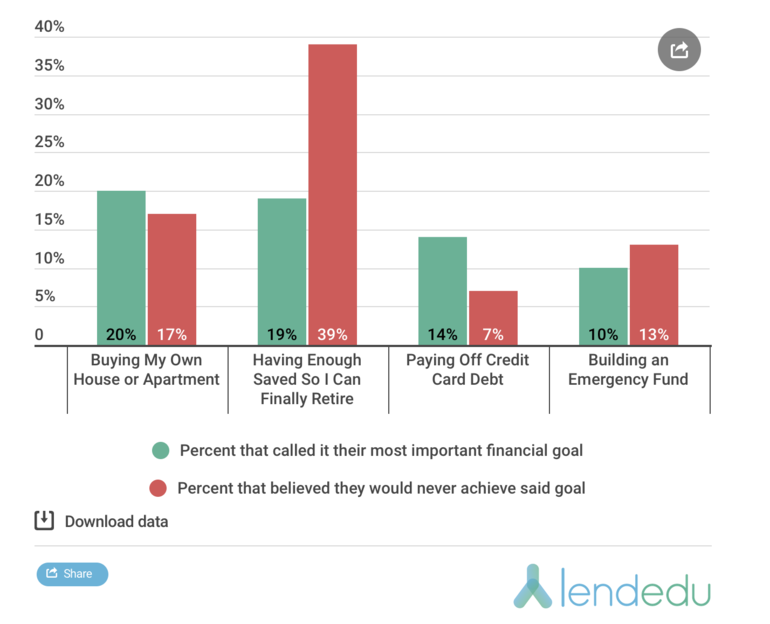
- 20% of respondents answered “Buying my own house or apartment”
- 19% of respondents answered “Having enough saved so I can finally retire”
- 14% of respondents answered “Paying off credit card debt”
- 10% of respondents answered “Building an emergency fund”
- 7% of respondents answered “Paying off my student loan debt”
Realistically, how long do you think it will take you to complete the goal that you answered Question 1 with?
- 47% of respondents answered “1 to 5 years”
- 17% of respondents answered “6 to 10 years”
- 16% of respondents answered “Within 1 year”
- 8% of respondents answered “11 to 15 years”
- 3% of respondents answered “More than 20 years”
- 2% of respondents answered “16 to 20 years”
LendEDU found 7% of respondents answered, “Realistically, I don’t think I will ever be able to attain the goal I answered question 1 with.”
Asked only to those who answered Question 2 with, “Realistically, I don’t think I will ever be able to attain the goal I answered Question 1 with.”), Why do you think you will be unable to attain your most important financial goal?
- 20% of respondents answered “My expenses are simply too high and I have no discretionary income to use on other things”
- 14% of respondents answered “I have too much debt to payoff”
- 7% of respondents answered “I am stuck in a low-paying job/industry”
- 6% of respondents answered “In general, my consumer confidence is simply too low”
- 1% of respondents answered “I do not have enough/good enough credit”
- 52% of respondents answered “Another reason not listed”
Why So Long?
Asked only to those who answered Question 2 with either “16 to 20 years” or “More than 20 years”: Why do you think it will take you roughly 20 years or more to attain your most important financial goal?
- 19% of respondents answered “Payments toward my debt command most of my income at the moment”
- 37% of respondents answered “My expenses are too high right now and I do not make enough money at this point to use on other things”
- 11% of respondents answered “I do not have enough/good enough credit”
- 11% of respondents answered “My job doesn’t pay well enough and will take a while for me to get a significant raise or promotion”
- 3% of respondents answered “My consumer confidence is simply too low right now”
- 19% of respondents answered “Another reason not listed”
What Could Happen?
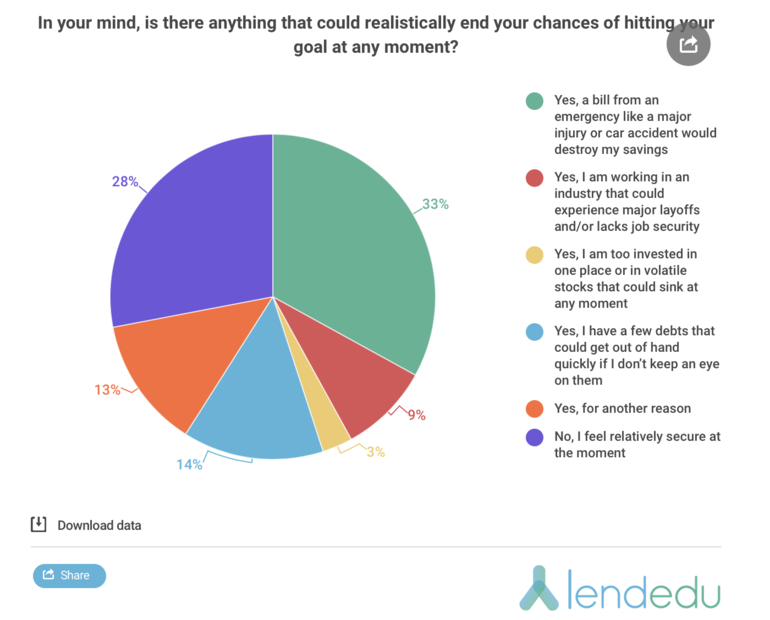
Asked only to those who answered Question 2 with any answer besides the last one in which they said they would not hit their financial goal: “In your mind, is there anything that could realistically end your chances of hitting your goal at any moment?”
- 33% of respondents answered, “Yes, a bill from an emergency like a major injury or car accident would destroy my savings”
- 28% of respondents answered, “No, I feel relatively secure at the moment”
- 14% of respondents answered, “Yes, I have a few debts that could get out of hand quickly if I don’t keep an eye on them”
- 13% of respondents answered, “Yes, for another reason”
- 9% of respondents answered, “Yes, I am working in an industry that could experience major layoffs and/or lacks job security”
- 3% of respondents answered “Yes, I am too invested in one place or in volatile stocks that could sink at any moment”
Do you believe that politics play a role, positive or negative, in your ability to hit your financial goals?
- 53% of respondents answered “Yes”
- 40% of respondents answered “No”
- 7% of respondents answered “I’d prefer not to say”
Observations & Analysis
“Retirement is the second-most prioritized goal, but more than one-third of Americans don’t see it ever happening,” noted LendEDU in its analysis. “Consumer confidence was most strikingly missing when it came to those poll participants whose most important financial goal was finally having enough in the bank to retire; 39% of this cohort indicated that they don’t believe they will ever be able to attain their retirement goal.
When it came to the age of those respondents that lacked confidence in being able to retire, 52% were over the age of 54, 30% were between the ages of 45 and 54, and 15% fell between the ages of 35 to 44.
Financial Goals Vary By Generation
When it came to financial goals, there were some noticeable differences when broken down generation: Silent Generation & Baby Boomers, Generation Xers, Millennials, and post-Millennials.
Among the trends that most stood out, said LendEDU:
- The respective correlations between the generations and two forms of debt, credit card and student loan. “As the generations got younger, the respondents became less concerned with credit card debt, likely because expenses grow over time. Conversely, poll participants became more concerned with student loan debt as they got younger. This can be attributed to both the cost of higher education rapidly increasing for younger generations (and therefore higher student debt balances) and also because older respondents have had more time to pay off their student debt.”
- Second, the post-Millennial generation had zero interest in either creating a retirement account or investing in the market outside of retirement, but the generation as a whole prioritized investing in real estate more than any other generation.
Another Age Difference
“Specific personal finance goals differ according to generation, but was there a difference amongst the age groups when it came to how confident each was in hitting their desired financial targets,” LendEDU said. “When it came to generational confidence, the trends were certainly harder to dissect, but one thing is clear: age allows a consumer to develop a more realistic sense of their financial ambitions.”
For more info: http://www.lendedu.com.