

WASHINGTON—Consumers are feeling slightly more positive about their ability to purchase a home, but affordability constraints continue to drive consumers’ perception of the housing market, according to the latest Fannie Mae Home Purchase Sentiment Index (HPSI).
Overall, five of the index’s six components increased month over month, including the components measuring consumers’ perceptions of homebuying and home-selling conditions.
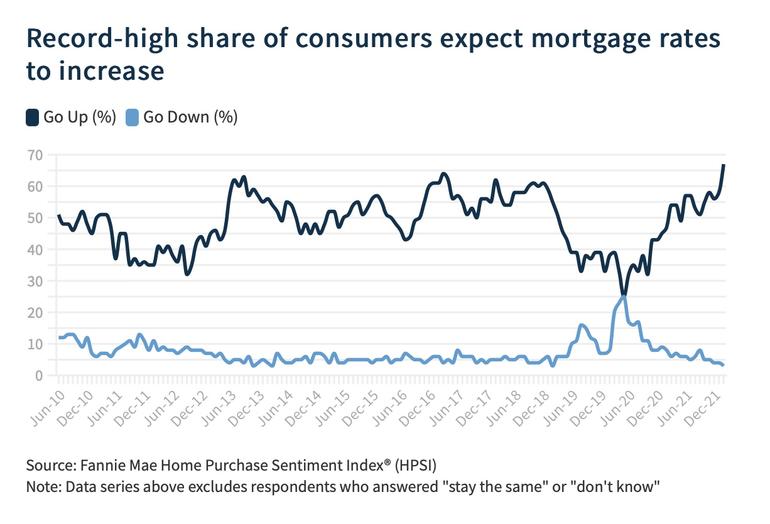
However, on net, the “Good Time to Buy” component remains near its recently established record low, as survey respondents continue to cite high home prices as the primary impediment to purchasing, Fannie Mae stated. Consumers did report a substantially improved sense of job security, but a much greater share indicated that they expect mortgage rates to move even higher. Year over year, the full index is down 1.2 points.
“A survey-record share of consumers – particularly homeowners and higher-income individuals – expect mortgage rates to increase in the next 12 months, likely owing to signals that the Fed will raise rates to slow the pace of inflation,” said Doug Duncan, Fannie Mae senior vice president and chief economist. “High home prices continue to be the most commonly cited reason by consumers for their belief that it’s a good time to sell (and a bad time to buy) a home; notably, the ‘good time to buy’ sentiment among renters dropped to a new survey low. This suggests that homeowners and higher-income groups may recognize the importance of getting ahead of the rising-rate environment, while renters are keenly feeling the double constraint on home purchase affordability of rising house prices and rising interest rates.
Geopolitical Events
“Nonetheless, the HPSI increased moderately in February, though the index still remains slightly lower on a year-over-year basis,” Duncan continued. “Continued negative perceptions around homebuying conditions were offset in part this month by consumers’ increased sense of job security, which we believe is likely due to labor market tightness and declining COVID case counts. However, with recent geopolitical events creating additional economic uncertainty – including likely increasing inflationary pressure – we believe the additional headwinds will compound existing affordability constraints to further soften mortgage demand in the coming year. It’s worth noting that this month’s National Housing Survey was conducted between Feb. 1 and Feb. 22, prior to the Russian invasion of Ukraine.”
HPSI Highlights
According to Fannie Mae, specific findings in the latest HPSI include:
- Good/Bad Time to Buy: The percentage of respondents who say it is a good time to buy a home increased from 25% to 29%, while the percentage who say it is a bad time to buy decreased from 70% to 67%. As a result, the net share of those who say it is a good time to buy increased seven percentage points month over month.
- Good/Bad Time to Sell: The percentage of respondents who say it is a good time to sell a home increased from 69% to 72%, while the percentage who say it’s a bad time to sell remained unchanged at 22%. As a result, the net share of those who say it is a good time to sell increased three percentage points month over month.
- Home Price Expectations: The percentage of respondents who say home prices will go up in the next 12 months increased from 43% to 46%, while the percentage who say home prices will go down increased from 14% to 16%. The share who think home prices will stay the same decreased from 35% to 32%. As a result, the net share of Americans who say home prices will go up increased one percentage point month over month.
- Mortgage Rate Expectations: The percentage of respondents who say mortgage rates will go down in the next 12 months decreased from 4% to 3%, while the percentage who expect mortgage rates to go up increased from 58% to 67%. The share who think mortgage rates will stay the same decreased from 28% to 22%. As a result, the net share of Americans who say mortgage rates will go down over the next 12 months decreased 10 percentage points month over month.
- Job Concerns: The percentage of respondents who say they are not concerned about losing their job in the next 12 months increased from 78% to 87%, while the percentage who say they are concerned decreased from 17% to 9%. As a result, the net share of Americans who say they are not concerned about losing their job increased 17 percentage points month over month.
- Household Income: The percentage of respondents who say their household income is significantly higher than it was 12 months ago increased from 26% to 27%, while the percentage who say their household income is significantly lower decreased from 14% to 12%. The percentage who say their household income is about the same remained unchanged at 56%. As a result, the net share of those who say their household income is significantly higher than it was 12 months ago increased three percentage points month over month.
Don’t Forget to Check the Spam Folder!
Don’t forget to check your Spam/Junk email folder if you didn’t receive your free, popular and daily CUToday.info news headlines on Monday.
And if you haven’t yet signed up for the new email solution on which CUToday.info has partnered with ResponseGenius, you can do so here. Signing up requires less than one minute of your time.
CUToday.info has received very positive response from readers following the move to an improved provider of the daily headlines, but many also noted they did need to go to their Spam/Junk folder and need to mark it as safe.
The new email solution has not only improved every reader’s delivery experience, but it also features a fresh, new format that is easy to read, especially on mobile devices.
Please note and/or make your IT department or email administrator aware the emails will be coming from the domains CUTodayinfo.com and CUTodayinfoReply.com.