

CHICAGO – Consumer credit activity picked up in the final quarter of 2020 as balances increased across most credit products and originations activity rose from the lows observed during the early stages of the COVID-19 pandemic, according to TransUnion’s new Q4 2020 Industry Insights Report.
The report further found subprime borrowers have followed the overall market trend, though this group’s activity has decelerated in the auto lending space.
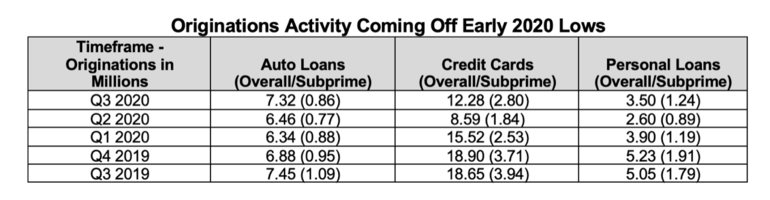
According to TransUnion, mortgage originations, measured one quarter in arrears, rocketed higher in the mortgage industry (rising 67% between Q3 2020 and Q3 2019), but the loan product’s performance has been an outlier in the consumer credit market. While low interest rates and greater housing demand have disproportionately propelled mortgage demand, the new notes origination activity for credit cards and personal loans have dropped by approximately 30% in the last year. For credit cards and personal loans, the lag in subprime borrowing has mirrored the overall market, the analysis added.
“On the surface, the consumer credit market is performing quite well. Serious delinquency levels remain near record lows while balance and origination activity is picking up,” said Matt Komos, vice president of research and consulting at TransUnion. “Additional stimulus and flattening unemployment rates point to a continuation of this trend. However, the performance of those accounts still in accommodation will help shape the true consumer credit picture. With many accounts expected to come out of accommodation between March and May, most notably mortgage accounts, we will soon see the true impact of those programs for both consumers and the credit marketplace.”
Other Findings
The Q4 Industry Insights Report also found:
Auto Loans a ‘Different Phenomenon’
Auto loans have “experienced a different phenomenon in which overall originations in Q3 2020 have nearly recovered to Q3 2019 levels, though originations to subprime auto loan borrowers are lagging – down about 21%,” the report states.
“A tightening in auto lending standards would generally be the primary reason for such a precipitous drop in subprime origination activity. We’ve conducted further analysis that demonstrates that, in this case, it could be a combination of lagging consumer demand and adjustments in lending criteria,” said Satyan Merchant, senior vice president and auto line of business leader at TransUnion. “This revelation points to the outsized economic impacts some subprime borrowers are feeling as a result of COVID-19.”
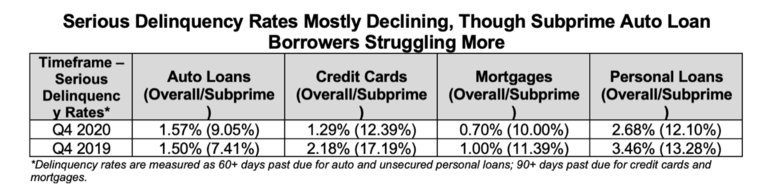
TransUnion reported credit performance of auto loan subprime borrowers also has deteriorated compared to similar credit risk consumers possessing credit cards, mortgages and personal loans.
“Whereas serious delinquency levels have risen about 22% between Q4 2019 and Q4 2020 for auto loan subprime borrowers, delinquencies have declined for the same credit risk consumers holding other credit products,” the company said.
‘Turning Point’ for Credit Cards’
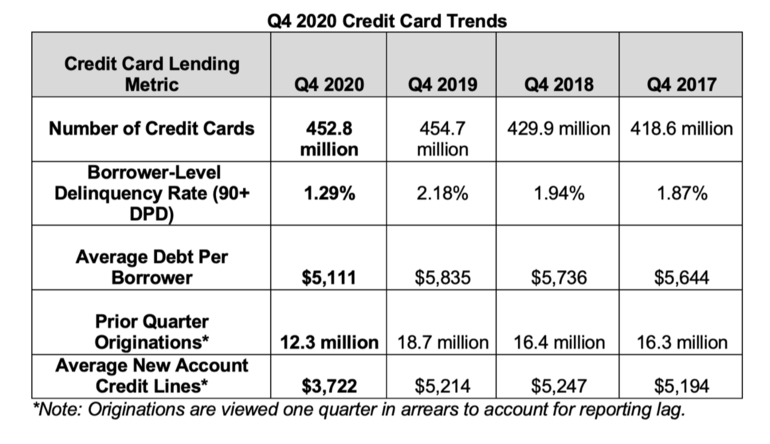
The Industry Insights Report found consumers with access to a credit card hit another all-time high at 187.1 million at the end of 2020, despite a second quarter of significant year-over-year (YoY) declines in originations (-34.1%).
Total balances declined for the third straight quarter (-12.7% YoY), while consumer-level average balances were down for the fifth straight quarter (-9.6%). Consumer-level delinquencies fell YoY to 1.29%, the second lowest level in five years, TransUnion said.
“Serious delinquency rates are now down 89 basis points from the 10-year peak of 2.18% observed in Q4 2019,” the report stated. “With about 2.4% of credit card accounts sill in some form of accommodation, delinquencies are expected to once more increase in the coming months as those accounts come of out of forbearance programs.”
The Analysis
“Though credit card balances and originations continue to be well below pre-pandemic levels, we are beginning to see stabilization of balances and rising delinquency compared to the lows observed earlier in 2020,” said Paul Siegfried, SVP-credit card business leader. “We observe many positives for consumers such as continued good news related to vaccines and improvements in the unemployment picture. Yet, some unknowns still exist. Most notably, how will those consumers still in some form of accommodation perform? We anticipate delinquency rates will rise in the coming months, but they also will be coming off of extremely low short-term levels.”
Mortgage Surge
According to TransUnion, mortgage originations surged in Q3 2020, reaching nearly four-million loans -- the highest level of originations since the Great Recession; and were 67% higher than last year at the same time. Originations were spread out evenly between refinancing and new purchases, with a 52% refinance share and 48% purchase share, TransUnion said.
“This differs from the same time last year when one-third of origination activity came from refis and two-thirds from purchase,” the analysis states. “New mortgages volumes grew the most at 118% YoY for lower risk consumers (those with a VantageScore of 760+). Total new origination loan amounts reached $1.1 trillion as of Q3 2020, up 79% from Q3 2019. As mortgage origination activity increased so did median origination balances, which rose 6% on an annual basis to $255K in Q3 2020.”
The report added the overall 90+ consumer level delinquency rate dropped in Q4 2020 to 0.83%, down from 1.16% in Q4 2019.
‘Cautious Note’ on Personal Loans
Unsecured personal loan lenders continue to be cautious as originations in Q3 2020 were 30.7% lower than the prior year, but grew strongly quarter-over-quarter, indicating a gradual ramp up in volume, TransUnion said.
“Serious delinquency rates increased slightly by 15 basis points (bps) in Q4 2020 on a quarterly basis, though remained 78 bps lower than Q4 2019. The relatively low level of lending resulted in balances falling again in Q4 2020 to $148B, and consumers with balances totaling 19.2M – a 7.8% and 7.3% drop versus prior year, respectively,” the analysis states. “Continued availability of lender hardship programs, in addition to eviction moratoriums and decreased consumer spending, helped keep delinquencies and new charge-off balances low.”