ST. LOUIS – Margin compression. Feeling “besieged” by competition. Overwhelming regulatory burdens. It sounds like a list of concerns from credit unions, but in this case it reflects the primary issues raised by community banks in a new survey.
The survey offers insights into how bankers are reacting to those pressures, where they intend to invest and—of course—their own thoughts on credit union competition.
During the Community Banking in the 21st Century Research and Policy Conference at the Federal Reserve Bank of St. Louis here, the Conference of State Bank Supervisors (CSBS) and the Federal Reserve published the results of a national survey and town hall meetings with bankers from across the country. The findings will sound familiar to most credit unions.
Those findings are drawn from 974 community bankers across 39 states and offer a national view of how bankers are thinking about key issues facing the industry and how they are responding to market conditions.
Additionally, state regulators in 27 states held town hall meetings with more than 500 community bankers from April to July. The town hall summaries within the Community Banking in the 21st Century publication provide insight from the industry on the state of community banks. The results of the town hall meetings provide a unique opportunity to connect the quantitative data in the survey with the stories and experiences of bankers serving their communities.
“The report strives for topicality,” according to its publishers. “What we noticed in last year’s survey and in state-by-state discussions was a heavy focus on regulatory burden. This subsequently has been underscored by intensifying discussions devoted to compliance that have been heard in the hallways of banks, in the news media, at bankers’ conventions, at research centers and within regulatory and political circles. This year, we expanded the number of questions concerning regulatory costs.”
The report notes that it considers any “community bank” to be those that are “small in size,” which it notes is commonly defined as those of less than $10 billion in assets. But the report adds, “We note that community bankers often define their role in terms of ‘customer service’ rather than size. They see themselves as complementing large banks by specializing in relationship banking and providing credit to small businesses.”
Among the findings:
- Respondents to the 2015 survey reported that regulatory compliance accounted for 11% of personnel expenses, 16% of data processing expenses, 20% of legal expenses, 38% of accounting and auditing expenses and 48% of consulting expenses. To the extent that these percentages are accurate and representative of the community banking industry, they imply a hypothetical compliance cost to community banks, in these areas alone, of $4.5 billion annually. This would represent 22% of their net income, the report states.
- There has been a narrowing of the breadth of mortgage lending activities. One- to four-family mortgages were named as primary product lines by 69% of respondent banks, compared to 75% last year, which is a proportionate drop of 8%. Retrenchment encompasses nonqualified mortgages (non-QMs) that, under rules implemented last year by the Consumer Financial Protection Bureau (CFPB), are considered to be riskier than qualified mortgages (QMs). Bankers also listed regulations governing them as among the most confusing and burdensome.
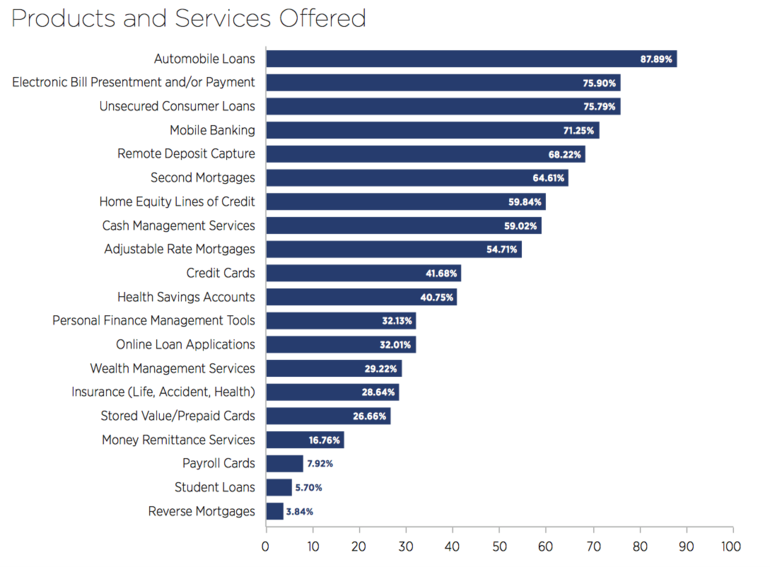
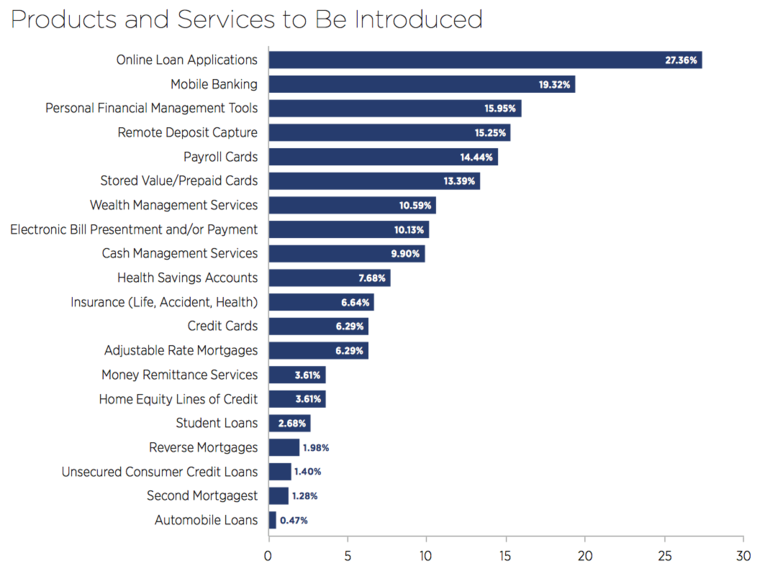
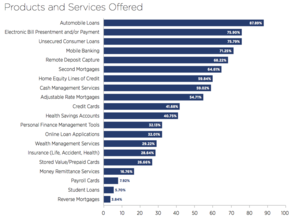
- Last year’s survey showed that bankers intended to expand product offerings in mobile banking, cash management, wealth management and personal finance. Their intentions materialized. Mobile banking services, for instance, now are offered by more than 70% of respondent banks, and nearly 20% of bankers this year said they expected to introduce mobile banking services within the next three years. Only a sliver of banks appeared reluctant to embrace relatively new technologies, according to the report.
- With respect to specific products and services that banks currently offered and planned to offer in the future, categories varied significantly in relative importance. As was the case in last year’s survey, automobile loans were the most prevalent (90%).
- Very few respondent banks indicated that they offered payroll cards, student loans or reverse mortgages. The scarcity of offerings for the latter two services appears likely to persist, as they ranked first and second in the categories that bankers plan to continue to avoid in the future, the survey found.
- Mortgage lending products also were prominent, but in relative decline. This year, home equity lines of credit (HELOCs) and second mortgages (other than HELOCs) were offered by 60% and 65%, respectively, of respondent banks. This was down considerably compared to last year’s levels of 66% and 73%. It is interesting to note that the decline in second mortgages was anticipated.
- A down market for ARMs, on the other hand, was unanticipated, the study’s authors note. They were offered by 55% of respondent banks, down from 66% last year. In last year’s survey, 55 banks said they expected to expand this offering, while 13 banks expected to contract it. “The extent to which slack mortgage lending may continue in the future can be inferred by looking at information on products and services that bankers expect to discontinue. Second mortgages, HELOCs and ARMs are prominent. They also ranked among the least likely to be considered by bankers as areas of expansion,” the survey noted.
- A surprise for bankers was in health savings accounts (HSAs). Last year, 27 banks said they expected to expand, and only two banks expected to contract, these accounts. Contrary to expectations, the representation among bank products and services was unchanged compared to last year.
- Mobile banking services were increasingly mentioned this year as products and services (as well as primary lines of business, as indicated previously). They were offered by 71% of respondents, which lifted it from the seventh-ranked category in 2014 to the fourth-ranked category this year. The growth of mobile banking, along with cash management, which also moved up in relative ranking this year, confirmed prior forecasts of bankers. Last year, 285 banks expected to expand these activities, while only one bank expected to contract. The trend may continue. This year, 19% of bankers said they expected to introduce mobile banking services within the next three years, the report states.
- Personal finance expanded significantly, more than doubling from last year’s survey, albeit to a relatively low level of 32%. Unsecured consumer loans were offered by 76% of banks this year, down from last year’s level of 80%. This category, along with second mortgages (as noted earlier), were the only ones that bankers last year expected to reduce more than they expected to expand. They were prescient on both.
- Online loan applications were an enigma. Last year, 190 banks expected to expand within this category, while only three banks expected to contract. And this year, it is the product or service that bankers named as most likely to be introduced.
Regulatory Compliance
“Longstanding debates concerning the costs of bank regulation became more pointed following the introduction of remedial policies after the most recent financial crisis. There was no other issue on which bankers in the survey were more vocal,” the report states
According to the analysis, bankers were asked to identify how much money was spent last year in five categories: personnel expenses, data processing expenses, legal fees, accounting and auditing expenses, and consulting and advisory expenses. Within a given category, they specified amounts spent specifically on compliance. The intent was to illustrate regulatory burden relative to various categories of operating expense.
Surveyed banks stated that regulatory compliance accounted for 11% of their personnel expenses, 16% of data processing expenses, 20% of legal expenses, 38% of accounting and auditing expenses and 48% of consulting expenses.
Overall consulting costs were low, at less than $800 million in 2014, but the percentage of them attributable to compliance was high, at 48%. “Because compliance exams are so daunting, community banks have been hiring consultants to help in the process,” one banker from Massachusetts is quoted in the report as saying. “However, consultants both are costly and provide no guarantee of tangible benefit when it comes to the examination results.”
The compliance component of personnel costs, on the other hand, was relatively small, at 11%. But this category accounted for nearly $32 billion across all community banks in 2014.
Much like credit unions, the report notes that “smaller banks bear a burden disproportionate to their size. A case study by the CFPB (2013) showed that two banks with less than $1 billion in assets had compliance costs that represented as much as 6% of retail deposit operating expenses—more than double the percentage for banks with more than $1 billion in assets.
“Small banks cannot afford to efficiently meet the same regulatory and compliance guidelines laid out for ‘big bank’ problems,” one banker is quoted as saying. “We are being forced to pay for all the same compliance as big banks without having ‘big bank’ income.”
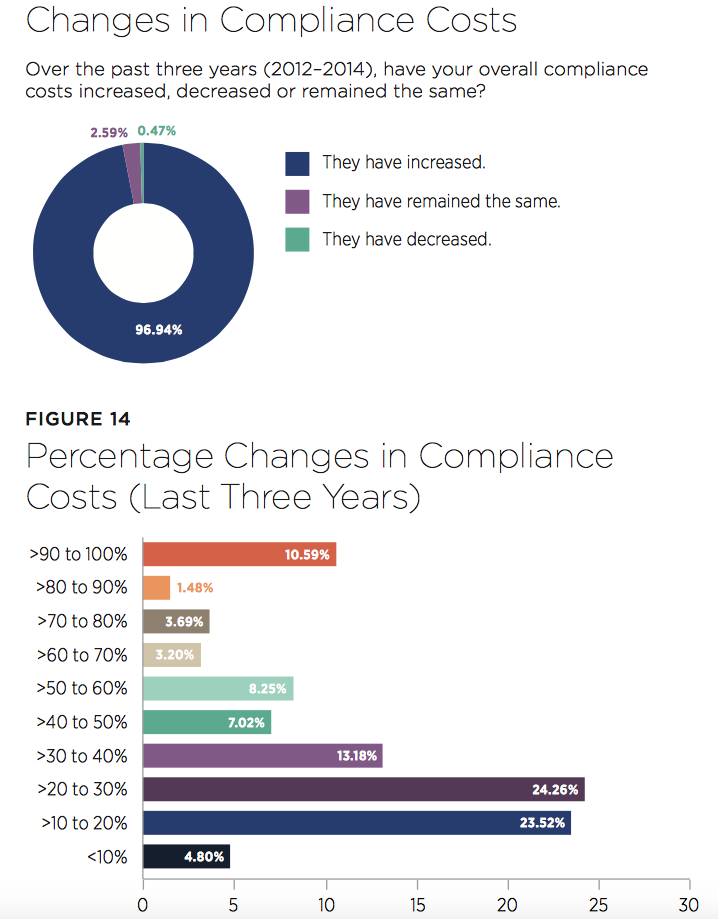
The report states that “over time and inclusive of compliance and noncompliance activities, consulting expenses have grown the fastest and most consistently, rising from $438 million in 2008 to $796 million in 2014. More generally, only a handful of banks in the survey said compliance costs have decreased or stayed the same over the past three years. The most common rates of increase are in the range of 10% to 40% Increasing compliance costs, in the opinions of some bankers, were driven not so much by new regulations as by changes to old regulations. According to one banker, the cost “is in the changes, not in the regulation...the pace of the changes is the issue.”
The Bank Secrecy Act (BSA), along with associated anti-money-laundering provisions, was named as one of the most difficult and expensive regulations with which to comply, by bankers.
Bankers also expressed dissatisfaction with the Real Estate Settlement Procedures Act (RESPA), the Home Mortgage Disclosure Act (HMDA) and Dodd-Frank. HMDA was thought to be ambiguous. RESPA was criticized for its inconsistency and immediacy. Inconsistency also was mentioned often in the enforcement of Dodd-Frank, and bankers also faulted it for its complexity and inapplicability to small banks.
Overall, bankers feel inundated by new regulations, particularly those introduced after the most recent financial crisis.
Competition
When it comes to competition, community bankers in the survey consider themselves “besieged.”
“Banks are scrambling to make the same money they made previously and are having difficulty doing so,” one banker said in the survey. “They will cut rates even more to generate the income they need to be equal or better than previous years.”
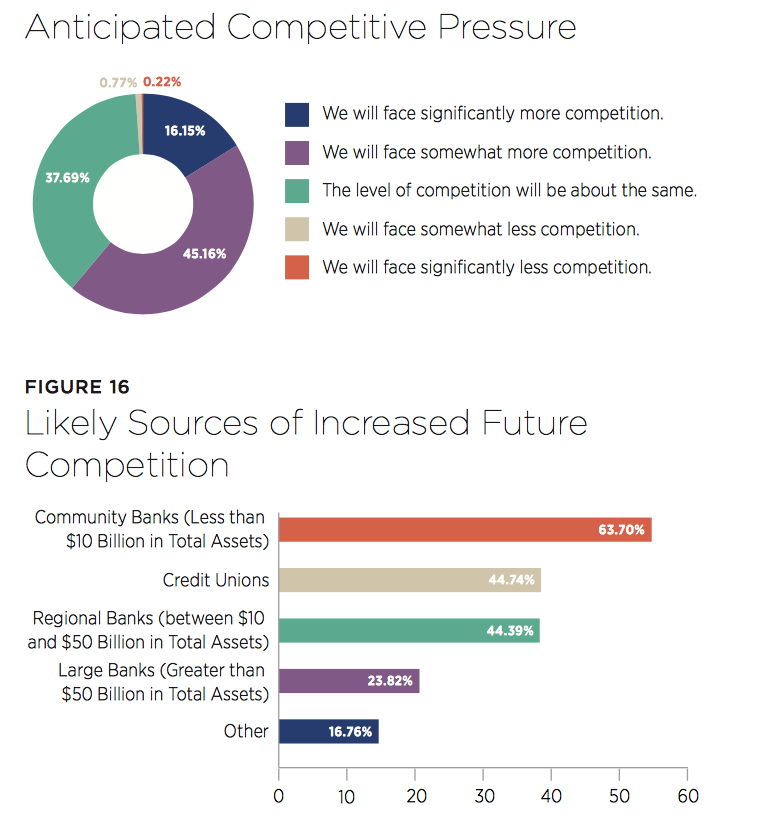
Many bankers described themselves as squeezed by regional banks (those with assets between $10 billion and $50 billion) and by credit unions. More than 40% of surveyed banks anticipated both of these competitors to be more formidable in the future. Large banks (those with greater than $50 billion in assets) also are seen to be a competitive threat. This was attributed by one banker to their “stepping down” into the community banking market.
According to the report, consistent with last year, community bankers view their greatest competitive threat to be from other community banks. This demonstrates both the vibrancy of community banks and the potential cannibalization of the sector.
“Margin compression at larger institutions is driving large and regional banks to compete more with us for loans to small- and-medium-sized business,” one banker stated. “Such banks have not traditionally participated aggressively in this marketplace . . . We have seen them offering terms, conditions and pricing beyond the typical structure offered by community banks.”
According to the report, “pressure from credit unions, on the other hand, is often described as arising from their inherent tax advantages and what is perceived to be a more lenient regulatory environment. It is evident in business lending—which one banker described as being treated as ‘consumer transactions’—as well as in consumer lending itself.
“Credit unions have reduced the ability of com- munity banks to diversify into consumer products,” one banker is quoted as saying. “They offer low rates at which we chose not to compete.”