WASHINGTON—Calling it the “most comprehensive survey” ever done on the subject, the FDIC released the results its 2013 National Survey of Unbanked and Underbanked Households.
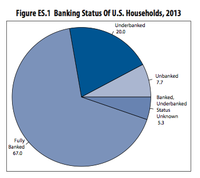
According to the FDIC, the survey found the proportion of unbanked households declined to 7.7% in 2013 from 8.2% in 2011, while the share of underbanked households remained essentially unchanged at 20.0%. “The decrease in the proportion of the unbanked can be explained by improving economic conditions and the changing demographic composition of households,” FDIC said.
The survey is conducted every two years by the FDIC in partnership with the U.S. Bureau of the Census with a goal of providing the banking industry and policymakers with insights and guidance on the demographics and needs of the unbanked and underbanked.
Among the new areas of research in the 2013 survey are questions related to how consumers access their bank accounts, and the survey found that nearly two-out-of-three households primarily used bank tellers or on-line banking when accessing their accounts.
“These banking methods, along with ATMs, were also the primary methods underbanked households used to access their account,” the FDIC survey reported. “Notably, underbanked households, however, were more likely to use mobile banking devices relative to other groups: 29.2% of underbanked households used mobile devices to access their account compared to 21.7% of fully banked households.”
Other key findings of the survey include:
- 9.6 million households representing 25 million people were unbanked in 2013,and the 0.5 percentage point decline in the proportion of unbanked households is estimated to comprise 1.5 million people and more than half a million households.
- One in five, or 24-million, households were underbanked in 2013, consisting of an estimated 68-million people.
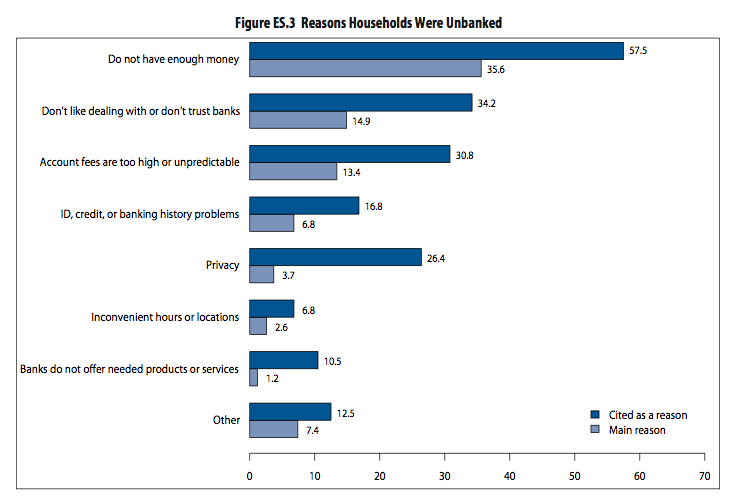
- 35.6% of unbanked households reported the main reason for not having an account being insufficient money to keep in an account or meet minimum balance requirements.
- 34.1% of households that recently became unbanked experienced either a significant income loss or job loss that they said contributed to becoming unbanked.
- 22.3% of unbanked households reported using a prepaid debit card in the prior 12 months, compared with 13.1% of underbanked and 5.3% of fully banked households.
- Also unchanged from 2011, is the finding that one-quarter of households have used at least one alternative financial service (AFS), such as non-bank check cashing or payday loans in the past year. In all, 12% of households used an AFS in the past 30 days, including four in 10 unbanked and underbanked households.
According to the FDIC, the survey report drew three implications from the findings that could point the way toward better meeting consumers' needs:
- Develop strategies to help households maintain or renew banking relationships through economic transitions, such as job loss.
- Explore opportunities to deploy and market checkless checking accounts and other options to meet the transactional needs of households.
- Integrate mobile banking initiatives with branch-based strategies in overall efforts to address consumers' needs
A complete copy of the FDIC report can be found in CUToday.info's The Vault.