

RALEIGH, N.C.–While good in and of themselves, job programs and other assistance aimed at the unbanked and underserved often overlook the criticality of something far more basic: the need for a driver’s license.
Erin Parrish
That’s what one city has found as it looked for ways to help many low-income people enter mainstream financial services. How that city has responded and what it has learned was shared by Erin Parrish of the Office of Performance and Innovation with the city of Durham, N.C., during a virtual session as part of the week-long “Commitment to Change” series being hosted by the African American Credit Union Coalition.
Raleigh’s Driver’s License Restoration Project, which is funded by the Bloomberg Foundation, conducted interviews in order to develop learnings from the lived experience of those without licenses.
A ‘Major Barrier’
“The loss of a driver’s license is a major barrier to employment, especially for justice-involved residents, yet there’s little focus on restoration efforts,” said Parrish, noting among the assumptions it made in seeking to provide an economic path forward for many people was all that’s needed is a jobs program. While that’s important—and the city has one—it found the lack of a driver’s license was the bigger problem for many.
In September of 2019, the number of people in Durham County with a suspended license due to failure to appear or failure to pay in fines or outstanding fees was more than 50,000, 80% of whom were people of color, said Parrish.
Good Intentions, But…
The county’s district attorney acknowledged it was an issue.
“Well-intentioned programs can unintentionally discourage participation,” said Parrish, referring to earlier efforts such as amnesty programs. “Traditional amnesty programs run over short time periods, require people to appear at the courthouse, require people to take time off work, and require people to stand in long lines.”
One such Amnesty Day in Durham attracted just 24 people seeking to have their licenses reinstated.
“So, we looked at what would it look like to do something different,” said Parrish.
That something different is reflected in the chart below.
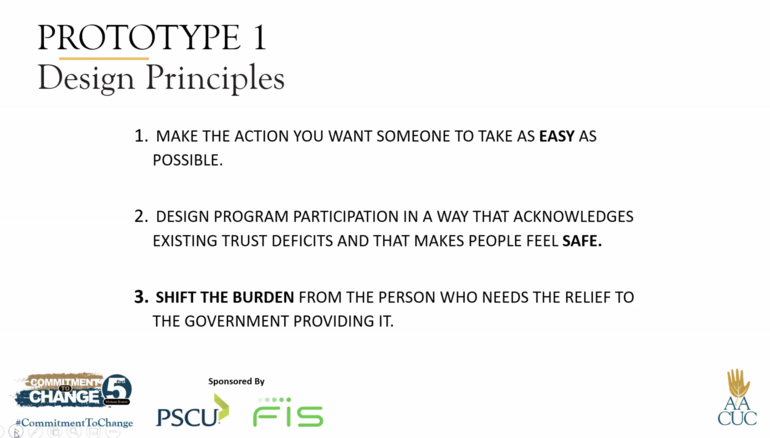
As part of its new response, it sent trusted messengers into the communities and made the process easy, meaning no visit to a courthouse.
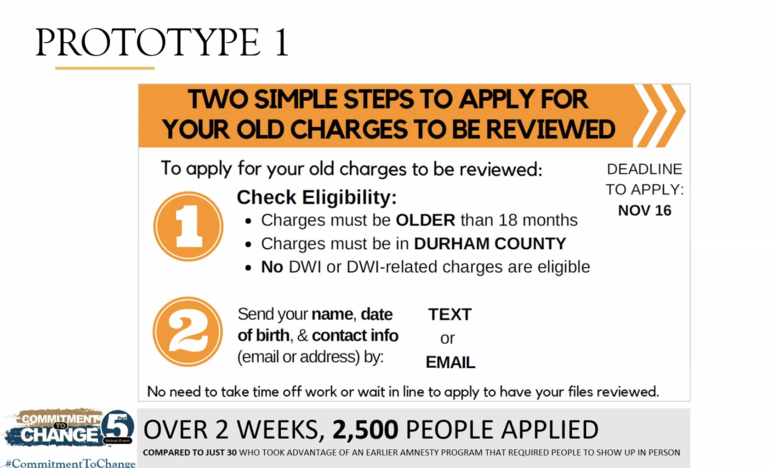
The design principles are outlined below.
“The district attorney and us thought we’d get 200 people; we got 2,500,” said Parish.
Of those, 500 people had old charges dismissed that had been preventing them from getting their licenses back. Another 79 people were provided by pro bono attorneys in court to deal unpaid traffic tickets.
New Challenges
But that surge in responses also created challenges, said Parrish, including the need to individually respond to every text message, which took considerable time.
“We had to pull data from the cellphone and manually clean and prepare it for the DA’s office, and that took more time and created errors,” said Parrish.
The second iteration of the project included a number of improvements, including a doubling down on strong partnerships and the discovery the Administrative Office of the Courts had all the data it needed for mass relief.
“All we had to do was put the eligibility data in place and enter it and wipe people’s slates clean,” explained Parrish.
50,000 Charges Dismissed
The second prototype of the program led to 51,116 charges being dismissed for 35,292 people and 6,183 old traffic tickets being dismissed for 4,534 people totaling $2 million. The average age on the tickets was more than 16 years old.
To let people know they had received relief and could reapply for a driver’s license, the city created SecondChanceDriving.org.
The lack of a license, said Parrish, results not just in financial distress, but also has brings physical effects and mental health issues.