

TAMPA, Fla.–The income and wealth gaps between African Americans and that of whites remains stark, according to one person, who advocated for reasons why everyone should care about the issue, and also shared strategies for younger workers to advocate for themselves financially.
Camille York
Speaking on the issue of the Racial Wealth Divide part of the African American Credit Union Coalition’s Commitment to Change webinar series, Camille York, a financial advisor with Raymond James and Associates, sought to explore what it really means to bridge the income equality gap, and further shared advice for younger African American workers on how they can advocate for themselves.
“Often, when someone mentions racial financial inequality, they only think about income,” said York. “But there are many more layers to it. When I think about the income gap, I think of Martin Luther King’s quote, ‘Whatever affects one directly affects all indirectly. I can never be what I ought to be until you are what you ought to be. This is the interrelated structure of reality.’”
In keeping with King’s observation, York added, “It’s not just a black problem or a Latino problem or a white problem. It’s all of our problem.”
A Pay Comparison
York said the average black man earns 87 cents for every dollar earned by a white counterpart. But black males earn 98 cents with white counterparts when experience and education are equalized. But even that—using national averages for compensation—adds up to approximately $1,400 every year in lower earnings by the black man.
“That may not seem like a lot, but that’s $14,000 over 10 years,” she said. “Think about all the other financial choices that could have been made that now become missed opportunities.”
York said the income gap is exacerbated for black women, who are overrepresented in lower paying jobs and underrepresented in higher paying jobs. But even black women with an associate degree still earn less than white non-Hispanic men who have a high school degree.
“So, black women can’t rely on education alone to close the pay and wealth gap,” said York. “Black women live at the intersection of sexism and racism, and that’s compounded when a person experiences both of them at the same time.”
Closing the Wealth Gap
What is wealth? It’s the buffer for families facing unexpected shocks, said York. But it’s also the capital to be used to take advantage of economic opportunity, she added, sharing the James Baldwin quote, “Not everything that I face can be changed. But nothing can be changed until it is faced.”
“No longer can we not face this head on,” said York. “It’s not until we choose to address it that change can actually occur.”
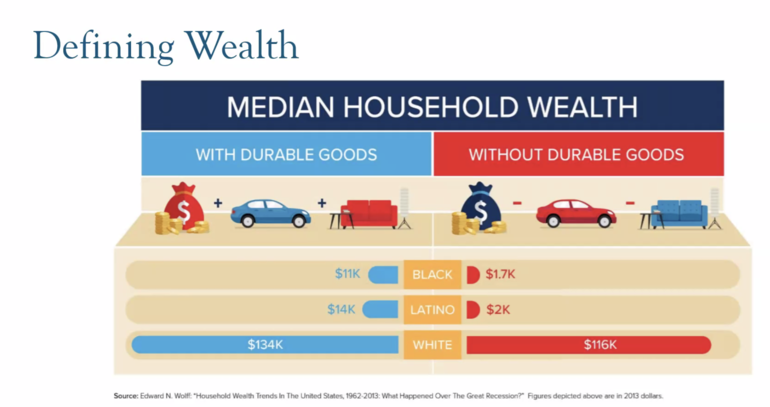
Income inequality is stark, but it pales in comparison to the disparities in wealth, according to York, who used the infographic below to illustrate her point.
Advocating For One’s Self
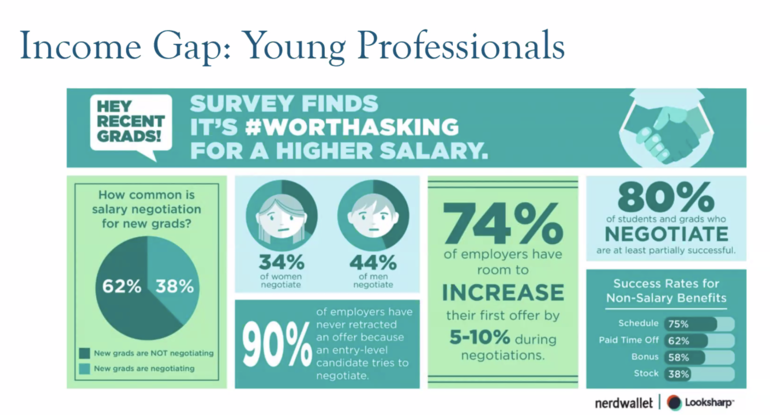
To build income and wealth, York called on everyone, but especially young people of color, to be their own advocates when it comes to equal pay by doing a better job of negotiation. Not doing so, she said, means “leaving money on the table.”
She shared with her audience the infographic, below.
“Negotiation is not always about salary; maybe it’s more vacation days,” said York. “Or maybe it’s a flexible schedule. It may not all be negotiable, but you won’t know until you ask.”
When it comes to “income advocacy,” York recommended the following: Payscale.com (with hard data), the Salary Project, Glassdoor’s Know Your Worth, Comparably, and an individual’s own network. “Leverage all these for a much stronger ask,” recommended York.