

JACKSON, Miss.–There are deposits, and then there are “transformational deposits,” according to one credit union that offered some insights on the kinds of transformation it has been involved in.
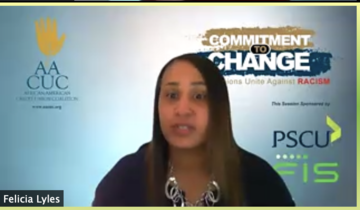
Felicia Lyles
In the case of HOPE Credit Union in Mississippi’s poor Delta region, the credit union has used low-cost deposits (10 basis points) to reinvest in its communities, helping both the CU and the members who live in the largely rural areas, according to Felicia Lyles’ comments came during a virtual session titled “Taking Action to Affect Change” that was part of the week-long “Commitment to Change” series being hosted by the African American Credit Union Coalition.
Lyles, SVP of retail operations, said the credit union realizes if it can bring down its cost of funds, for every $50 million in deposits it saves $1 million, and that is money it can then put back into its communities.
Dire Need
And those are communities in dire need of economic advancement. Lyles said the poverty rate in the $361-million HOPE CU’s markets is 42%, and that in one community there is an estimated $1.2 million in total deposits.
“So, even if we had100% market share, that’s just 12 mortgages at $100,000,” Lyles said. “These transformational deposits are critical for transporting capital into these communities.”
As CUToday.info reported here, HOPE CU in June received one such large deposit from Netflix, which has announced a $100 million plan to invest in Black lenders.
An Example
Lyles said the credit union is hopeful the Netflix investment will serve as an example to other corporations seeking a meaningful way to invest in efforts to close the racial gap. She noted the $10 million will provide financing to more than 2,600 entrepreneurs, homebuyers and consumers of color.
The need is clear, Lyles said, pointing to the fact in many of the communities it enters HOPE FCU often moves into a former bank location. Those banks typically didn’t make any loans in the community; residents could only use them to cash checks or open deposit relationships, she said.
“HOPE being in these communities is huge,” said Lyles
The Stats
Lyles further noted:
- 80% of HOPE’s branches are located in majority black communities
- 61% of HOPE members were previously unbanked or under banked
- 80% are members are people of color
- Two thirds of members are women
- 69% of members earn less than $36,000 annually.
Not surprisingly, Lyles noted many of the CU’s members were previously unbanked and were using high-cost providers. To help those individuals reestablish themselves, the credit union offers second chance accounts.
Lyles cautioned credit unions that with low-income members more is needed than just financial education.
“The financial education piece is critical, but it’s not about just telling them what they should do, but also about having the products to guide their financial education,” she said.
Building Partnerships
Lyles explained the HOPE Community Partnership provides strategic and focused community and economic development training and technical assistance for communities.
Lyles said HOPE FCU works closely with municipalities and community stakeholders to identify underperforming schools, hospitals, and availability of groceries to find a resolution. It also works to identify high quality, affordable housing.
“When we import capital we want to do it in a way that supports community goals,” said Lyles. “We are a mission-driven organization that is focused on meeting people where they are. One thing we have identified is financial education 101 and do it in group settings with partners, such as community groups and churches.”