

DULUTH, Ga.–The reason why no credit union can self-actualize if it isn’t doing something about poverty, what senior managers need to know about the “frozen middle,” and potential plans for an NCUA-hosted meeting on getting more capital into communities were all discussed during a webinar featuring a number of CU leaders.
The insights were shared during a discussion titled “Here, Now, Forever: Diversity, Equity and Inclusion” during the last day of the African-American CU Coalition’s week-long Commitment to Change meeting.
During the Q&A NCUA Chairman Rodney Hood said he is hopeful of holding a summit for the “ecosystem” surrounding minority owned depository institutions (MDIs) in the months ahead as part of a long-term solution to a number of issues, but primarily getting much-needed capital to those who need it.
In addition to Hood, participating in the discussion were Cathie Mahon, president/CEO, Inclusiv; Angela Russell, VP-diversity, equity and inclusion with CUNA Mutual, and Maurice Smith, CEO, Local Government FCU. The session was moderated by Monica Davy, director of the Office of Minority and Women Inclusion with NCUA.
Below is a look at what was discussed:
Davy: Talk to us about why you believe fighting poverty and economic inclusion are so important.
Smith: Our credit union has this commitment to doing something about poverty, about answering how do you eliminate poverty and give people a track to building wealth. The common denominator for all these concerns is economic empowerment. It’s about giving individuals an opportunity to manage their money and build intergenerational wealth. As we think about how we help our communities thrive, I don’t know how a credit union or a community can claim it has reached the pinnacle of its self-actualization if any one group of its population is not doing well.
Our credit union wants to be the best it can be, but if we have any staff member who feels unappreciated our credit union is not going to be the best credit union it can be. We see DEI as an ethical and moral issue. We see it as a smart strategic value for our organization. We want to compete in this commodity market; a checking account is a checking account. So how do we as an institution stand out in a crowded field? We feel our core values gives us a strategic advantage. We want every member, every employee to be their best.
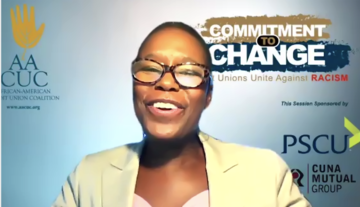
Monica Davy
Davy: Tell us about the move to the new name of your organization (from the National Federation of CDCUs to Inclusiv).
Mahon: It was a very scary moment for me being up on a stage with our members and partners assembled to unveil that new name. It was scary because a lot of our members felt a lot of ownership and love for (National Federation of CDCUs). It had existed for almost 40 years. We knew we were coming to a point where we were rethinking our name and the ways in which we talk about our work. We knew it was not going to be easy with so many people invested in the organization.
We tried to make the process very inclusive; we spent a year engaging our members in multiple ways—surveys, town halls, webinars, phone interviews. We wanted a voice from everyone about what it meant to be part of the organization. We knew we were going to move away from a name that was descriptive and wanted something that conveyed the work we were trying to do.
Again and again, the members talked about the sense of inclusion; it was pervasive. It was about making sure to fulfill the promise of who we are as credit unions. We believe the financial system has not worked for everyone in an equitable way. And it all came together and we had a very positive response.
Davy: What does a world with no racism look like?
Russell: I was talking to my 12-year-old son about this and he said, ‘Duh, people just love each other.’ I wanted his innocent way of thinking about things. But there are a couple of other things I think a world with no racism would look like. Number, one (as African Americans) we would no longer have to hustle for our worthiness, because we would be seen as inherently worthy because we are in humanity together. The other thing is in a world with no racism the color of our skin wouldn’t place barriers on us even before we are born. A world without racism would end some of the historical trauma we have to live with day in, day out. And all of that comes back to my 12-year-old’s answer.
Davy: Tell us how the George Floyd murder touched you and what was healed from it.
Russell: That was hard. We were having a meeting at work and the meeting was about to start and it was business as usual, and (a group of us) were not in a space where we could do business as usual. We all started crying. It was necessary and cathartic. My son is now coming to the realization something that is just talked about at the systemic level (is now about) people who could kill him. With healing, we need for black folks and our country to be able to heal from historical trauma passed down; inter-generational trauma. We are now seeing the trauma showing up at the DNA level. I don’t think three months is going to (heal things). Healing is a lifetime of work. But just as trauma is passed down, healing is passed down.
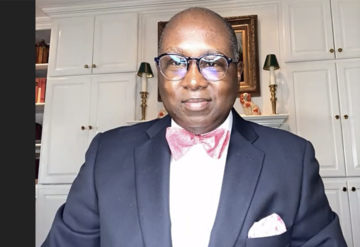
Rodney Hood
Hood: I was deeply and profoundly troubled by the murder of George Floyd. It was not the first time I as a man of color have heard about abuse of power and authority by our police forces. But it was the first time it played out for the whole world to see; this egregious lack of respect for life by this cavalier police officer. He knew he was being recorded and thought he could still get away with it.
I, too, could be George Floyd. My father in North Carolina taught me how to respond if I am pulled over. This was 40 years ago, and I am still having similar talks with younger men, and it’s troubling that we haven’t gotten past that. In my 30 years in business I have never been able to have a platform to discuss these sorts of issues, but I am now finding CEOs and other people of color like me are recognizing it is our duty to address these issues. I, as first person of color to oversee a federal regulatory agency, would be derelict in duty if I were not to address these issues. I am using this opportunity to be a champion for those who need a champion more than ever.
Mahon: I felt a sense of shock…As a person who has been a part of this work and supported social justice work for most of my life, it felt for the first time in my life in talking with so many others in our community that I was finally listening and hearing the pain and the fear and the day to day of issues that are being talked about.
I was part of a community discussion and a young woman who had just graduated from high school talked about the pain of going through high school and never feeling the heroic narrative was ever about her. It made me think about my own family and my upbringing. I am the granddaughter of four Irish immigrants and we had this heroic immigrant narrative that we had made it against all odds. And now we are looking at these narratives through a new lens of systemic racism and I realize my entire narrative has been one of white privilege. It was a benefit that so many of my friends and colleagues have not had.
Smith (who is an attorney): I have had that talk with my son, as well. We raised both our children in a fairly calm suburban environment. My son is 32 years old, 6’3, as gentle as a butterfly and would help anyone he comes across. But I explained to him that if it’s late at night and a police officer pulls you over and you step out of a vehicle, as tall as you are you look like a menace. So, you need to be very careful. I talked to him about how he responds and about keeping me on speed dial and put the phone down so I can listen to the conversation. I gave him lessons on his constitutional rights and search and seizure and his rights.
What particularly hurt with George Floyd’s murder was it was done with such impunity. That the officer would act in that manner was particularly shocking. I don’t mean to imply all law enforcement officers are bad actors, but apparently there are enough. I wrestled with what the solution should look like; more informed police officers or more equipped citizens to respond. I’m not sure what the answer is.
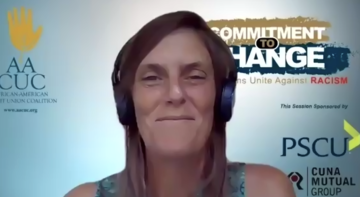
Cathie Mahon
So, as we think about how to fix our communities I’m happy to see that we as citizens have said we’ve had enough and we’ve decided to speak out. As much of a tragedy it is, I am encouraged to see the hope coming from this.
Davy: As an industry we tout that DEI is in our DNA and part of the mantra of people helping people. How can FIs help heal America?
Hood: It’s a timely question. When I talk about the healing process by way of financial institutions, it’s about (bringing about) change and providing capital for small businesses and communities.
It’s not happening at the rate I or many others want to see. To really address this, it’s about being proximate. Doing a drive-by doesn’t do it. The MDIs are the institutions in the community that I want to empower. I want to host an MDI Access to Capital meeting in the months ahead. It would bring together all the folks in the ecosystem. I want to build an infrastructure to bring all of these individuals together to bolster MDIs…The summit may look at de novo MDIs and how to sustain them. That is a way to create a long-term solution and to get proximate.
Davy: You proposed (while chairman of CUNA) that we add DEI as an 8th Cooperative Principle. How is industry receiving your suggestion and what is your response to those who say DEI is already in the 7 Cooperative Principles.
Smith: The eight cooperative principle, I think, has been received warmly in the credit union business. I talked to people in the business who believe this is something whose time has come. The debate I often have with individuals is why should it be an 8th principle; these principles are like stone tablets coming off the mountain, and if you have a generous interpretation of Principle 1 (voluntary and open membership) they will say it is a part of that. I would say it is not.
With constitutional originalism, you look at something in the context of when it was written so you know what was in their minds. The 7 Cooperative Principles were written in 1844. What did the world look like? That was about 20 years before people who looked like me were freed of slavery in the U.S. So, for the authors of the cooperative principles in 1844, they were not thinking with the same sensibility we are.
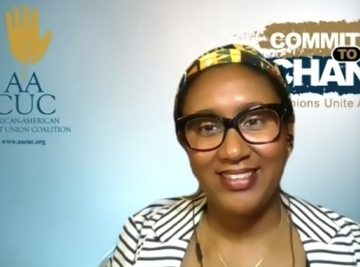
Angela Russell
I think as a credit union movement need to have an 8th principle and make it unambiguous. Put a stake in the ground that we are for DEI.
The 7 Cooperative Principles are owned by the International Cooperative Alliance and are reviewed every so many years. My contact with the ICA suggested they wouldn’t normally look at these for another three years, but it turns out they are going to have a conference in South Korea in September and the idea of an 8th cooperative principle has been put on the table. So, we have some hope to have it memorialized as its own separate item.
This is not just for credit unions and not just for the U.S., it’s for other cooperatives and for the whole world. I think the credit union movement is accepting this. My challenge for CUs in the world is let’s lead on this. What will the language look like? There are smarter people than I who can come up with the specific language. I’m looking forward to continuing the dialogue and the debate.
Davy: We spend a lot of time talking about the D and the I. But you have been talking about the E (equity) for a long time. I once heard you say, ‘The status quo is resilient.’ What do you mean when you say that and what does it have to do with equity?
Russell: We have a short attention span in general. We get excited and then things revert to normal. We are not going to have financial inclusion unless we have capital at the center. It’s about what are we intentionally doing to become an anti-racist movement; it’s about understanding how our country was built to benefit white men financially. We know that most DEI efforts have benefitted mostly white women. (There was a gentleman) at Netflix who said it’s good we’re talking about George Floyd right now, but what happens when the hashtag changes? We will go back to the status quo.
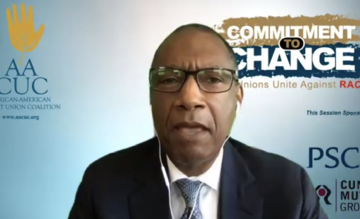
Maurice Smith
Davy: In the DEI space we often talk about the frozen middle. Sometimes it’s easier for those at the top to make a commitment to DEI. What’s hard is to have that trickle down to the frozen middle. What actions should leaders take to help middle managers and to eliminate this frozen middle?
Smith: It’s important if you are a senior manager to understand the obstacles that get in the way of DEI. Part of that is scalability. There are only so many seats in the board room and the C-suite. When we start talking about bringing in other points of view, if I am already in the C suite and you are bringing in someone new, somebody has to go. So, it creates friction and some insecurity in having this conversation.
Those who work in the C suite are usually blind to what the barriers are. I have spent my career advocating that I don’t need handout or a lucky break, I just need you to move the barriers to allow me to succeed. So, someone may need to be shown where the barriers are. If you already know where they are, don’t assume the senior leadership of the organization knows, too. Getting those out of the way is in the credit union’s interest to see middle management do well. Give your organization the opportunity to remedy those. I judge an organization by how inclusive it is, how open it is. If someone is underperforming because there are systemic barriers to improvement, you are hurting your own credit union. If you see it, point it out and throw a flag on the play.