

LOS ANGELES–The CEO of one credit union admits it may sound “crazy,” but he’s calling on the CU community to come together to immediately create a digital credit union to serve those historically black colleges that don’t have their own CUs.
And that’s not all. Gary Perez, CEO of the $660-million USC Credit Union, which serves the University of Southern California community, is also challenging credit unions to help save small credit unions, come to the rescue of student debt-holders, and to help keep renters from being evicted and homeowners from being foreclosed upon.
To achieve one or all of those things, Perez said the key will be embracing the Sixth Cooperative Principle.
“The one principle that is least discussed is cooperation among cooperatives,” said Perez, speaking as part of the African American Credit Union Coalition’s Commitment to Change webinar series. “At the end of the day I believe credit unions are in fact better when we work together.”
Here is a look at the cooperative challenges Perez has for credit unions:

Chartering a New Credit Union
Credit unions could do something wonderous if they came together and applied all eight cooperative principles to further the education of tomorrow’s African American leaders, said Perez.
His challenge to credit unions: Immediately create an all-digital credit union chartered to serve the approximately 90 historically black colleges (HBCs) that do not currently have a CU to serve their students, faculty, alumni and community.
Gary Perez
‘That credit union in today’s climate would be instantly certified as a LICU, CDFI and MDI, and would be the recipient of government, corporate and non-profit grants that could be used to provide low-cost education loans and other support to HBCs,” said Perez. “I’m telling you this could be something incredibly useful and important…We could do this.”
Perez said credit unions shouldn’t be talking and dreaming about the proposal, they should be acting on it. He said “NCUA would be all over this," and support would come from the AACUC, large credit unions, trade groups and even vendors.
“What if right now with the support of the AACUC, credit unions, larger credit unions and other CUs, I think NCUA would be all over it, our trade associations would join in, as would our vendors," Perez said.
Small Credit Unions
Perez said he believes with the “very fiber” of his being small credit unions are the “heart and soul” of the credit union movement, but acknowledged neither he nor anyone has attended a credit union meeting in the past 25 years at which the “alarming rate” those same CUs are disappearing hasn’t been mentioned.
“And I’ve got nothing against large credit unions,” said Perez. “But the smaller credit unions feel their members, they touch their members. I would offer we need to work together to help uplift small credit unions so they can uplift the largely underserved and unbanked communities they serve."
Perez said smaller CUs in the U.S. are facing fundamental, “existential” threats, but “we can stem, if not reverse, the tide through cooperation and collaboration.”

It’s no secret smaller CUs lack scale and Perez said that challenge can be addressed through collaborations to reduce operating expenses, reduce net interest margin problems, increase price competitiveness, and expand service offerings, “all without losing independence, identities, purpose and the passion that makes small credit unions so vital to their members.”
Perez said the concept isn’t new, but what’s needed is the “will” to make it happen. To date, he added, the main solution to solving the dilemma has been to merge.
“My solution isn’t to merge the credit unions; let’s merge the back offices,” he said. “Let’s build the same scale by working together on the back office. Let’s develop the will to help small credit unions help each other and help their members.”
Student Loan Debt
Perez said credit unions are in the business of fulfilling dreams, and few dreams are more important or more life-changing than a college degree.
The financial advantages over a lifetime to having a college degree, he said, are obvious, and he provided the chart below to illustrate his point.
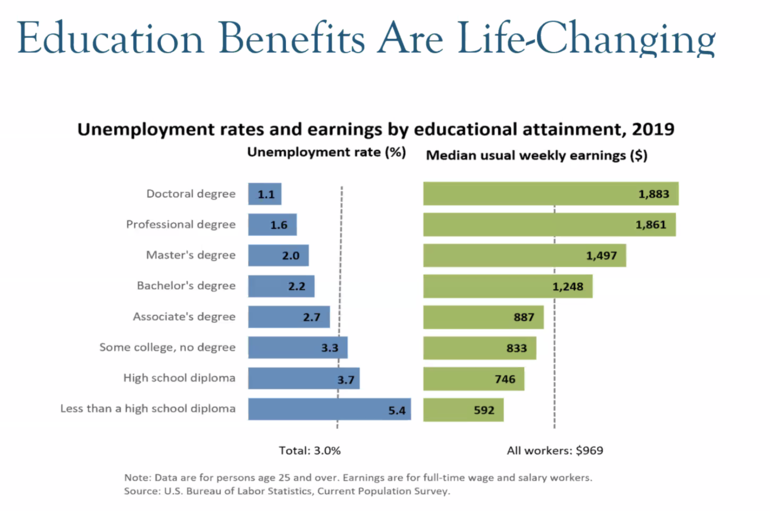
“That void is not going to become narrower, it’s going to widen,” said Perez, whose credit union has a large student loan operation. “We need to work together to enable a college education for all of our members. We really need to understand our members are receiving student loans, but they are not getting them from their credit unions. They are going elsewhere and paying higher rates and less than favorable fees. Working together, credit unions can and should finance the education of current students and refinance the crushing debt of graduates.”
Perez said by leveraging the sixth cooperative principle credit unions can create a “loan restructuring program second to none. I would offer it’s both good for the credit union and good for the member. Private student loans are performing loans. Forget the headlines for a moment; the headlines that say there is a 25% default rate on those loans. Yes, student loans are a problem, but most of the problem is centered on the federal student loan programs and loans made for tuition at for-profit colleges. Private students loans perform exceptionally well, better than your credit card portfolio by and large…There is a place for student loans in your portfolio, especially if we approach it from a cooperative standpoint.”
Evictions & Foreclosures
The final area where Perez said credit unions can fully put cooperation among cooperatives to work is in dealing with the looming eviction/foreclosure crisis.
“I think we as credit unions might benefit, and I know our members and communities would benefit, if we could find a way to finance, not over a year, but over three to five years, the rent that’s been missed in this crisis,” said Perez. “How can a person who has missed three or four months of rent payments repay that on top of their rent? Let’s get corporate and CDFI money to backstop loans to help people stay in their homes.”