

TUCSON, Ariz.–Payments are actually “sexy?” Yes, according to one card executive, who also shared some insights on an alignment around purpose, card trends, tokenization and more.
Linda Kirkpatrick, president of North America with Mastercard, shared her insights during a Q&A with Co-op Solutions Chief Experience Officer Samantha Paxson during the CUSO’s THINK 23 event here.
Here is a look at some of what was discussed:
Paxson: You have been with Mastercard since starting as an intern. Can you tell us more about that?
Kirkpatrick: Payments is actually quite sexy. You only need to look at the bevy of fintechs that are in the market today to recognize that sitting at the center of payments globally is a pretty interesting place to be. The industry is constantly evolving. The challenges, the opportunities are so great. For me, it’s about being at the cutting edge of innovation, being with a global organization, being with an organization that is concerned with diversity and inclusion.
Payments is something we do every day. It’s so embedded in our lives. What I didn’t appreciate when I started 26 years ago is just how important payments is to inclusion. When you think about bringing underserved people into the mainstream, payments is at the heart of that. It’s not just serving a market to do the right or moral thing, it’s the commercially sustainable thing to do.
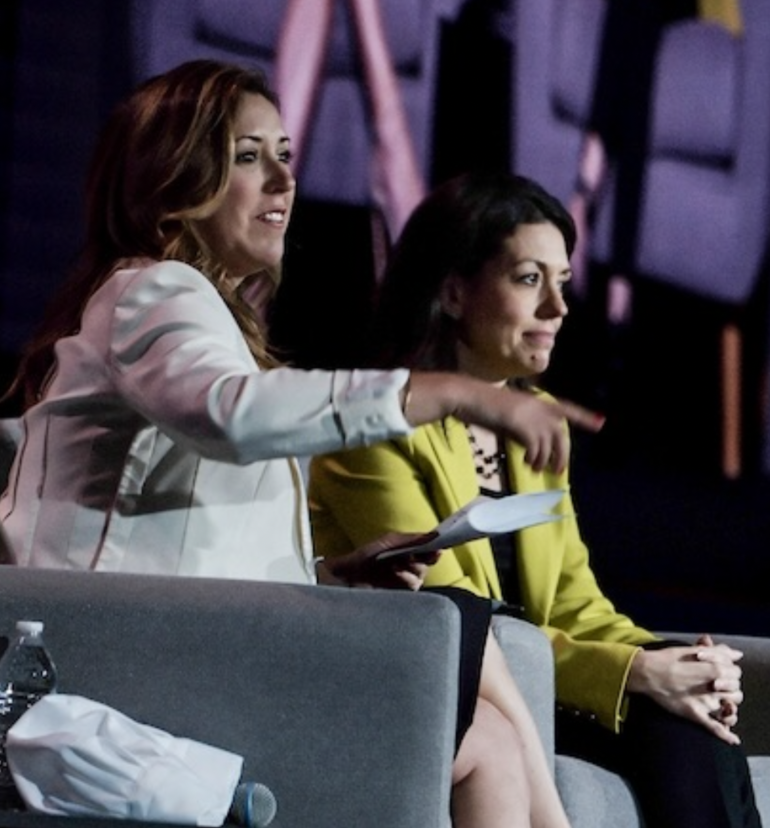
Samantha Paxson, left, with Linda Kirkpatrick.
Paxson: Why is the credit union space so critical to Mastercard?
Kirkpatrick: It comes down to shared values. When I look at what’s important to you, the communities you serve, the emphasis on small business, the focus on giving back--if you look at Mastercard’s corporate scorecard you will see the same objectives front and center. The alignment is not forced, it is very, very natural. You are the force that consumers can trust. You were focused on conscious consumerism before any other companies. You are at the cutting edge. Your segment is at the top of our list.
Paxson: Can you talk a little about what Mastercard has done in serving the community? What is your purpose?
Kirkpatrick We have a very strong sense of purpose. It’s who we are as people. We hire really terrific subject matter experts for what’s up here (head) and for what’s here (heart). People stay at Mastercard because we have great purpose beyond what we are as a company. We see a great responsibility for giving back.
A few years ago, those of us in the public company sphere got a very large tax refund. What we did was establish a $500 million fund to help close the racial wealth gap in the U.S. Two-hundred-fifty million dollars of that is dedicated to small businesses. We have been very deliberate about how we’re placing our bets in cities and communities across the U.S. We also committed to bringing one-billion consumers into the financial mainstream. We met that goal, and are now trying to double that goal. And we are also doing things in our product development suite.
And our employees’ bonuses are also tied to our ESG goals.
Paxson: We have been talking all week about being at the center of members’ lives. It sounds like you have done a deep dive on the use-cases to get the consumer engaging with you. Is your product development around consumer centricity?
Kirkpatrick: Yes. We try to develop on where the puck is going rather than where it is today. We are a B-to-B-to-C organization. We are here to infuse your businesses with new products and capabilities that you might not be able to develop on your own.
Paxson: The world has changed dramatically in three years. What trends are you seeing?
Kirkpatrick: I see a few trends that we've observed and these were deployed prior to the pandemic and then were amplified and accelerated by three to five years during the pandemic.
There’s this notion that everything has been designed, friction has been removed from the consumer experiences to the point where consumers have no tolerance for friction. Fortunately, we've been developing communication technology, which is the idea of taking a card number and replacing it with a dynamic token for the purposes of conducting commerce on a digitally connected device.
Tokenization has been completely on the rise and what and we're seeing in the Mastercard ecosystem is we eclipsed two-billion tokenized transactions last month, which is about a 15 to 20% increase. It’s easy to see why more and more consumers are using their digital devices to do that commerce. They want commerce to be where they are; they don't want to have to go seek it out and whether it's a digital device, whether it's a browser, whether it's in the air, whether it's while you're driving, tokenization allows for that commerce to take place in a safe and secure way. The trend around tokenization is very, very real.
The utility behind digital wallets has been extended so wallets are no longer about just payments, they're about authenticating people, they're about including things like airline passes and tickets and really anything that needs some level of authentication with the consumer.