

CHICAGO–Better understanding where to best invest a credit union’s limited resources and how to also get a clearer view around members’ and potential members’ needs were among the issues examined during a panel discussion here involving four experts that yielded numerous insights.
The discussion took place as part of Co-op’s THINK Conference here and was centered on findings in ongoing research that are aimed at providing some guidance to CU decision-makers.
Emceed by financial journalist Jean Chatzky, panelists included Rob Mannamkery, senior manager, financial services and digital strategy consulting with EY; Samantha Paxson, chief experience officer with Co-op Solutions; Josh Sledge, senior director-incubation with Filene, and Scott Schmidt, VP-digital transformation with GreenState Credit Union.
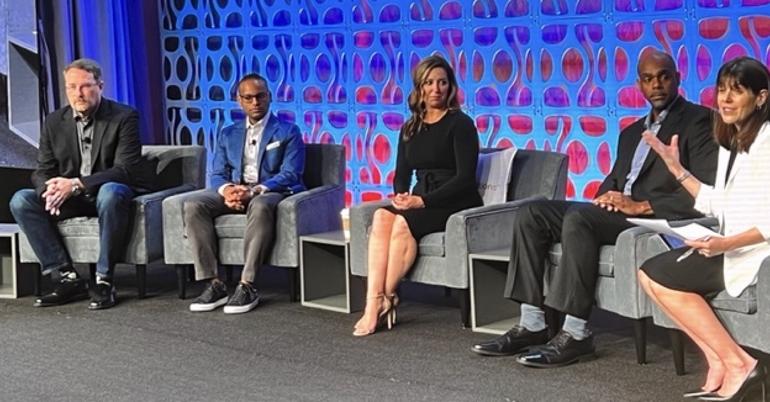
Here’s a look at some of the discussion:
Chatzky: How did the Co-op/EY/Filene research come together?
Paxson: A couple of years ago I was attending a lot of conferences and credit unions would come and say to us, ‘I just don’t know where to invest. We are trying to make the best strategic decisions.’ They were getting overwhelmed in the space. We had this traditional model of savings and loans, but things were changing. At Co-op we already did work with EY and I was in the audience when someone from EY was speaking and they had done this research on having financial institutions understand, ‘If I invest here, how might my revenue change?’ My mind was blown.
We decided to partner and do some proprietary research. We wanted to better understand how specific members were behaving and how prospects were behaving. We wanted to be able to see our opportunity from the member perspective. We decided to double-down to get better information on how credit unions are behaving, so we went to Filene. We wanted a better understanding across credit unions of how credit unions are attacking these issues, and how do we compare that with how the market is behaving. It underpins now how Co-op is behaving and how we build out our ecosystem to help you meet your market needs faster and faster and faster.
Chatzky: The landscape of choices is amazing. When credit unions have to decide where to make individual investments, how do they justify spending and focusing on investments that might not have immediate ROI?
Sledge: it’s a tough dynamic. There is a feeling of anxiety and strain in trying to figure out what is next. Forrester Research shows 70% of credit unions are planning to add a new product or service this year. What’s important is thinking about the long term and building the backbone for continued innovation. This pace of change is going to be continual. The key is having that foundation, which often takes longer to build and is a little more costly upfront. When you look at the long-term investments, how do they help you to innovate faster? It’s something credit unions have to do. This pace of innovation is only going to accelerate. It’s easier to do when you have the foundation built.
Paxson: This is a shift in mindset for all. We all make investments with an expected ROI that you have to prove to your board. It’s hard to prove out the (longer term investments). Thinking long game and zooming out, we don’t have strong muscle memory on how to do that. We think investment and we think about an immediate return.
Chatzky: Thinking about financial wellness, this has been percolating for years. All of a sudden it seems to have bubbled up. Where are you seeing the conversation converge? What are the next opportunities you think will bubble up?
Mannamkery: When you look at trust it comes down to personal engagement. When you think about financial wellness specifically, that is the engagement tool. It demonstrates you care about the member. That translates into loyalty. Trust is where you really need to focus.
Chatzky: As you look at this, from the point of view of your credit union, where do you fall?
Schmidt: It’s nice to have the tools out there, but it’s hard to get members to use the tools. You have to have the tires on the car to go anywhere. You have to listen to your data. If you don’t know how much money is moving out via crypto or P2P, you’re blind. Look at your NPS scores. Listen to what your call center is hearing. Once you find out what you want to do, you have to find the right partner. If you can do it right and do it well, you win that person for the rest of their life. When it comes to activation we look at our employees first and our members second. If your employees are excited about it, they are going to be better at (recommending to members). Structure your products around encouraging use. Lastly, you really have to take that long-term view. We are conservative with technology. It’s not ‘no,’ it’s just not ‘now.’
Chatzky: How do we know what is table stakes and then where the research is guiding you to make next investment?
Paxson: What’s beautiful about this research is it shows the use-cases that are helping to grow share and helping to grow revenue. I bring it back to what Scott said: if you have (the offerings), usage goes up, but service also goes up. Think about the needs, break down the journey of what members might need and then look at use-case by use-case to identity the gaps you might have.
Chatzky: All credit unions are not the same. As you are looking at all the options, how do you choose a path forward?
Mannamkery: This is really interesting question. We look at payments and financial services in three waves. The first wave is from analog to digital. The second wave is from discreet to embedded. Wave three is where it gets really interesting. This is the move from centralization to decentralization. This is where you start to have deposits, payments and lending and there is a convergence starting to happen between those products. You need to start investing in that infrastructure. Define your strategy behind that and the services that will let you go to the next audience.
Chatzky: Why are digital payments so segmented and will it all merge into one solution?
Mannamkery: Ultimately, there will be aggregation of payments. Will brands go away? I think they will remain. Fragmentation may not go away but for the end-user they want the right set of tools and that is where you need to really start to focus. There are always going to be new players coming to market. The question is how can you think about members and aggregate those services?
Schmidt: You also have to have the education. BNPL is really about managing cash flow and helping members to understand better, so they may not need BNPL the next time they buy something. You have to have the features and functionality, but you’ve got to have the education.
Mannamkery: Younger demographics love to consume education.
Paxson: It’s about engagement to an outcome. We are moving from product-based decisions to audience-based decisions. Start by deeply understanding your members and the segments. When we create homogenized experiences for everyone we are missing out on the use-cases a member segment may be needing and then they go someplace else.
Chatzky (reading an audience question): What about having to meet goals for certain numbers of accounts, for instance?
Mannamkery: At the end of the day you’re not selling a product, you are selling an experience and a benefit. If you start to look at it that way you start to see the impact you are having on communities and it stops being a commodity.
Paxson: I love this idea of credit unions going out into the community and discovering what the needs are. We don’t want to leave a service on the table. Why are there prospects who are not members of a credit union? Rather than the traditional metrics, how do we better serve the underserved? There is so much more help we can provide to be true to our mission, which differentiate us.
Chatzky: We heard earlier in this conference that people don’t take surveys. What is the secret sauce these days?
Mannamkery: Younger demographics do like to let you know how they feel. But other segments want to let you know how they feel, too. There is also the behavioral approach: what are they doing? It’s what are they drawn to vs. us asking them what they want. People don’t always know what they want, but they do gravitate toward certain needs. Capturing behaviors helps you to understand (those needs).
Paxson: Payments are a great way to see how consumers and members are behaving and how you might make a difference.
The chart below shows responses to a question posed to attendees at the THINK Conference.
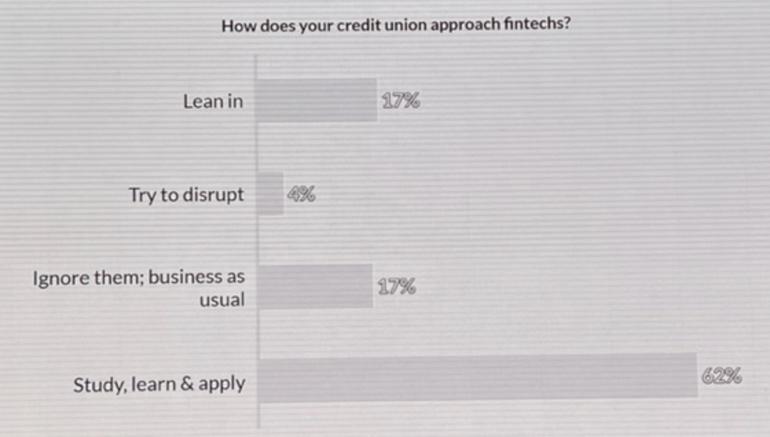
Here is how a THINK audience responded to question related to their approach to fintechs.