

TUCSON, Ariz.–Myths and assumptions around “debit-prefers” and “debit-defers,” what the psychology of member behavior means, and why some credit unions are really prospering, and other lessons from research just released by Co-op Solutions and EY were all shared during a panel discussion here.
The panel, which took place during Co-op Solutions’ THINK 23 event, featured moderator Jean Chatzky; Maria Rydzewski, principal, Mastercard data and service; Nikhil Lele, EY Global and Americas Consumer Banking Leader, and Samantha Paxson, chief experience officer with Co-op.
The conversation was in follow-up to the release of new consumer research by Co-op and EY (see related story in CUToday.info).
Here’s a look at some of what was discussed:
Chatzky: Give us some real-life examples of how these suggestions are playing out.
Lele: I want to (focus on a chart Samantha Paxson) shared earlier that shows having better rates and convenience is that sweet spot. The way I like to think about this strategic question is how do you find that sweet spot? Think about a strategy that hits that spot to maximize your value and the way you invest.
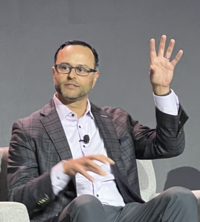
Nikhel Lele during THINK panel discussion.
I'd like to frame this through the lens of models that could be more universally applicable to any kinds of institutions and of any sizes and shapes.
The way we see good examples taking shape in the market today is through these three specific models.
One model is what we call segment-driven, one model is what we call end-to-end ecosystem, and the third model is called interaction hub.
These are just useful summaries of understanding what's really going on with this institution and what strategies different companies are taking to find that sweet spot. These are the models that we see leaders use to drive growth.
Chatzky: We learned the profiles of the budgeter and the non-budgeter (from the research), but there are four elements of this psychologically that overlay this.
Rydzewski: We have focused on behavioral science because it gives us a framework to really understand the underlying motivations for change.
The four elements include consumers who perceive their (finances) as a single pool or as being in different categories. We know some people are very aware of how they spend their money and whether they're in the red or the black, and others are not as aware.
The second one is ‘pain of payment,’ which is exactly what it sounds like. Do people enjoy spending money, or is it painful for them to part with their money?
The third one is temporal focus. Are they future oriented or are they really focused on the day-to-day?
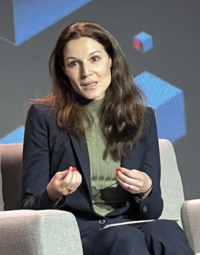
Maria Rydzewski during THINK panel discussion.
And the last one is regulatory focus. Are they trying to optimize, are they trying to maximize positive output or are they trying to prevent negative health outcomes?
When we applied this framework to choices we found out that credit-prefers tend to be more budget oriented. They're more future-oriented and they're really focused on setting themselves up for success in the future.
The debit defers, on the other hand, are less likely to be budgeters. They’re really focused on the day-to-day survival, and so for them debit is a mechanism to prevent overspending, to prevent that negative outcome. For them, credit is a tool for financial success. It's a way to enhance their life and it's important because traditionally we always thought of debit-prefers as financially responsible people, that they're trying to avoid debt and they have a really good grasp of their finances.
But that is not necessarily true from the fact they need more money and they need help to get them on this path to financial wellness.
Chatzky: From the credit union perspective, how do CUs start to activate on this information?
Rydzewski: It's about making sure we customize the product to meet the needs. That could be providing them with a personal financial manager debit (offering). But it goes beyond that.
We know that they really value security, they value trust. You want to establish yourselves as that financial partner that is helping them. A lot of times they may feel the financial institutions are predatory, but it's actually the credit unions where they are more likely to be a partner. With credit-prefers you want to make sure they have access to opportunities. They're looking for investments. They're looking for those robust digital tools and they just need the resources to reach their financial goals

Samantha Paxson during THINK panel discussion.
Paxson: What I’m hoping a credit union will do is say, ‘Wow, if I just focus on the member and act on this research I can start to get creative and look at my existing solutions sets, and say, gosh, if this debit user needs more guidance, what little things can I do that I already have in my arsenal?’ That’s service. That’s really aligned with our mission. In this industr y we have payments leaders not in the senior management team who are trying to grow volume and usage. We need to elevate that position. We need to put more focus on the daily interactions and get creative in helping them to problem solve.
Chatzky:. If you have to plant a stake in the ground, where do you focus?
Lele: When we did this research we looked at 4,500 or so credit unions nationally, everyone from sub-$10 million all the way through up $5-billion in assets. We found 30 specific credit unions that really met the bar for being differentially higher.
When you look at it from an asset growth perspective, you're talking about positives when the rest of the industry is negative. We're talking about revenue growth that’s about 250 basis points higher on a five-year average basis. When you're talking about member acquisition efficiency, you're talking about 3X the level of efficiency than the average credit union and they have positive member growth as opposed to in aggregate, negative number growth.
So, what did they do to create that is the question and here it's not about what they specifically launched and deployed, it's how they approach the strategic problem at hand and execute with a long-term mindset.
Number one, they found new members and different ways of extending the credit union proposition. They expanded the demographic of people and they tailored everything it means to be member-centered. So, it’s bringing the promise of what makes a credit union incredible and just offering it to more people in that same kind of very tailored way.
Number two, they executed better and they made more efficient use of their capital. They just did it better.