

TUCSON, Ariz.–Just-released research reveals the long-held, traditional marketing funnel at credit unions needs to be “flipped,” that there is something that when combined with good rates really drives growth, and that the concept of “PFI” is officially obsolete.
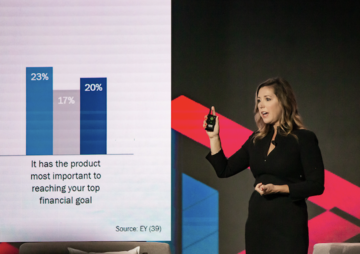
Samantha Paxson speaking to THINK 23.
Those findings and others, along with strategies for how credit unions can leverage the new information, were shared during Co-op’s THINK 23 conference here by Samantha Paxson, the company’s chief experience officer, who unveiled the research Co-op conducted with EY and Mastercard.
This is the fourth year Co-op has partnered with EY and others for deep dive research into the behaviors and thinking of both members and non-members. At the heart of that research, according to Paxson, is the question, “Which strategic bets should credit unions and Co-op be placing to grow?”
Paxson shared this slide, below, illustrating how fintechs have responded effectively to member demand.
“Fintechs made it happen. Are now our primary competitors in tech are in the market,” said Paxson.
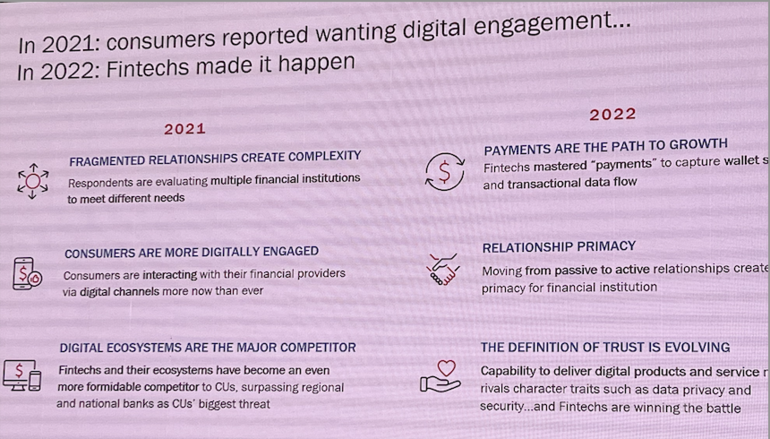
She noted the research continues to confirm that payments are the best opportunity for any credit union to grow wallet share among members, while helping members at the same time.
Credit unions, she said, must recognize they need to move from passive relationships to active relationships in order to create “primacy” in their relationships with members.
“This year we’re doubling down on primacy, trust and connections,” said Paxson of the research findings. “We wanted to understand the convergence of short-term member engagement with the long-term engagement in terms of what means in growing market share and more.”
To that end, she said the research, which involved more than 3,000 people, probed for both micro money management and macro money management behaviors.
The Key Findings
The key findings of that research are shown in the slide, below.
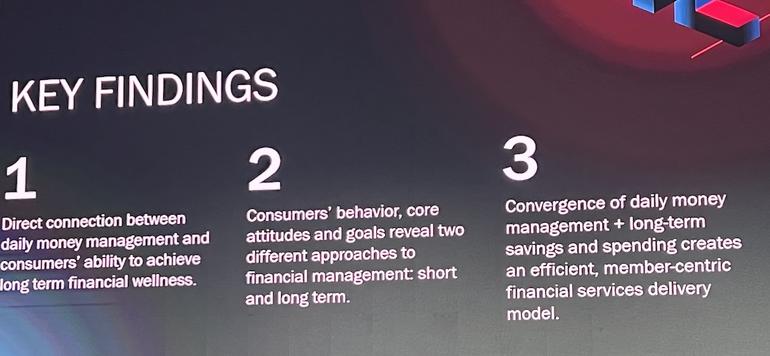
“This is what consumers expect; they expect a dynamic, needs-based ecosystem of solutions anchored by life goals and financial health priorities,” said Paxson. “This is truly the Amazon application of financial services…They want to be delivered financial solutions based what I'm trying to do in my financial life, my short-term goals and my long-term goals.”
An Obsolete Concept
Paxson said the research makes clear the old idea of being a primary financial institution, the much discussed “PFI” status financial institutions have long sought, is obsolete.
“Where we are today is we are looking to win the primary financial interaction. We are competing for members’ attention and their loyalty on a daily, moment by moment by moment basis,” Paxson said. “It isn't just day by day, it's hour by hour. Which card are they going to use? Which app are they going to open? How are they going to pay? How are they going to check where they are in their financial life? You're trying to win that next-best-action interaction and this is our opportunity do so.”
According to Paxson, becoming member-centric is about three components:
- Engage Every Day. This is about becoming that preferred financial interaction and being embedded in the transaction stream.
- Guidance. “We need to help our members with their short-term goals and their long term financial performance.”
- Earn the Member Balance Sheet. This is about creating personalized value propositions that really combine both good rates and convenience.
Paxson then offered additional detail from the research around each of those three “pillars.”
Engagement
According to Paxson, the current state is to over-index on a product-centric, rate-driven distribution model, with fewer interactions leading to dormant members.
The target state is a product-centric, engagement paradigm in which credit unions hope to move members down the funnel.
Speaking of the traditional marketing funnel, Paxson said, “We need to flip this. What we need is higher relevancy. Relevancy deepens relationships and captures long-term usage and values. Digital channels continue to grow in usage. These are embedded in ‘in the moment’ transactions. This is why people do business with Apple.”
Paxson said the research found 45% of respondents indicated engagement is their top reason for relationship primacy, and yet credit unions are not considered for highly interactive products.
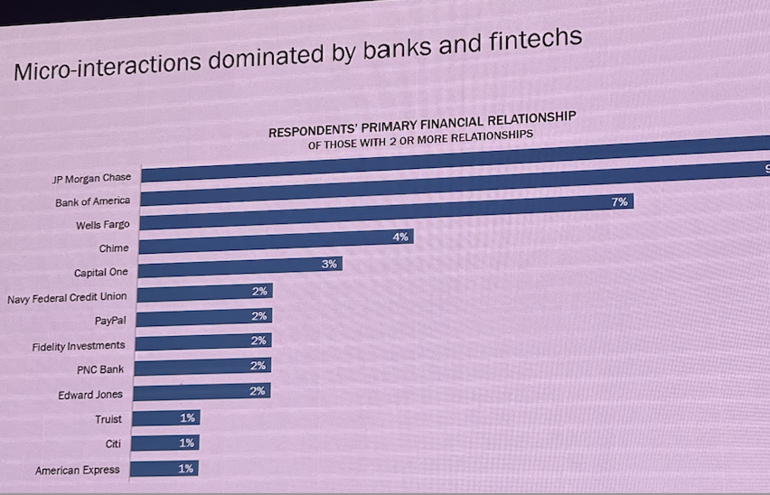
Paxson said credit union primacy is “really based on character and critical products. They believe in you. They trust you. Banks and fintechs earn this spot based on interactive convenience. However, respondents who consider a credit union as their primary financial relationship have three times the relationships of other respondents. This is interesting. They don’t quite believe they can get everything they need to get done at their credit union. This is the paradigm we need to understand. Ninety-one percent of members have a deposit account with a credit union; 84% of members have a deposit account with a bank.”
The objective, said Paxson, is to move members from transitory banking and set-and-forget accounts, to long-term value such as mortgages and auto loans and investments.
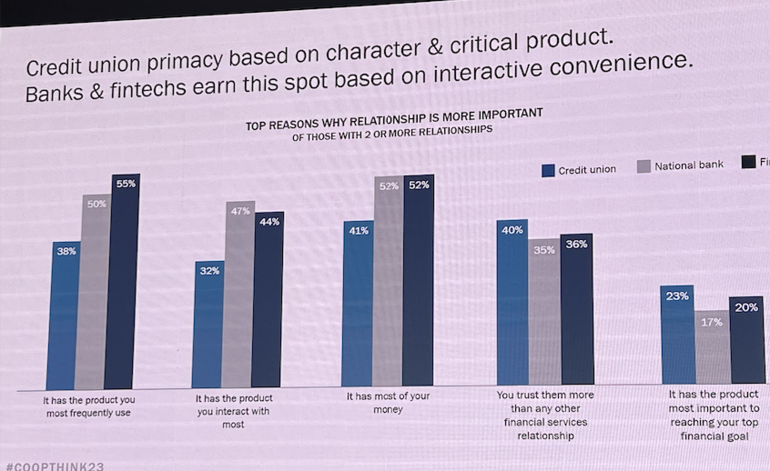
“The problem is this is really expensive. The member acquisition costs are high,” she said. “On average, when members try to go from a passive relationship to high-value relationships, it costs $400 to $600 per member, and 20% to 25% of those members do not stay with you for one year. That is sobering. So, how do we flip that? With micro-interactions. The result is lower member acquisition costs and greater value. These include financial planning, credit cards, BNPL and digital payments. It includes daily engagement and is much more efficient.”
Good Guidance
After getting members engaged comes the opportunity to give good guidance, which is especially important as the research found 43% of respondents said they are “not very” or “not at all” financially secure, Paxson reported.
“The current state of guidance emphasizes product transactional value as opposed to long-term relationship value,” Paxson said. “Credit unions lack the full picture of the members’ portfolios.”
The “target state” of guidance is connecting short- and long-term member financial performance to drive stickiness. It also involves aggregating member financial performance across behavioral and product usage, Paxson said.
“This is a huge opportunity for credit unions to be that trusted partner,” she told the meeting. “This is the opportunity to reframe this. It means embedded guidance offerings are the path to member financial performance. This is especially true with those younger members we are seeking to engage with. We have an opportunity to dive in and help members.”
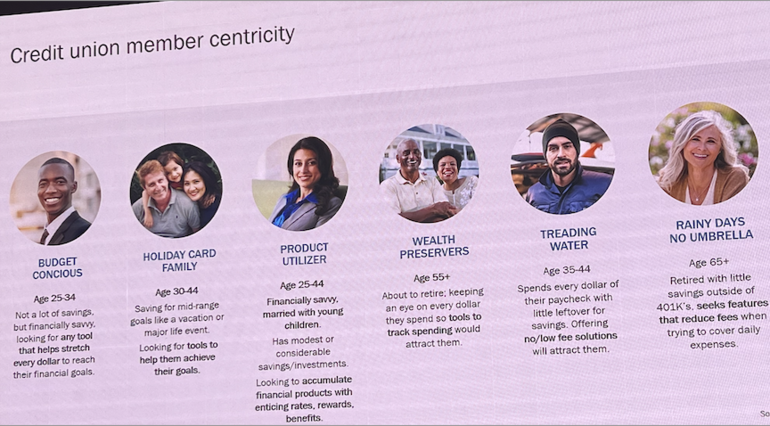
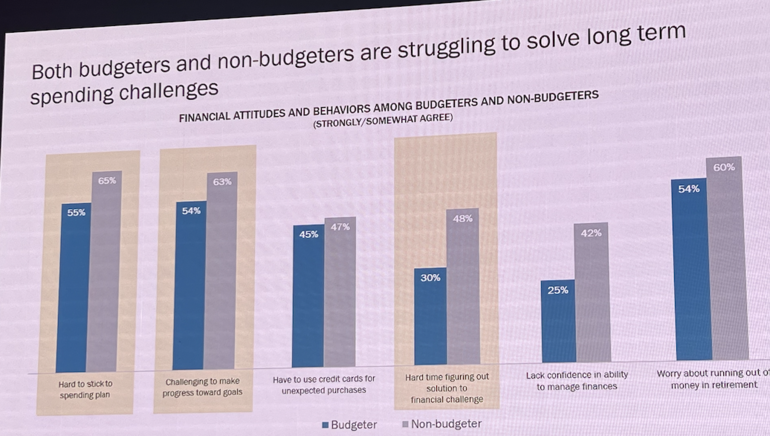
The research found 80% of paychecks go to short-term needs, 10% to intermediate needs and 9% to longer-term needs. But consumers said they want to reallocate that mix and need help doing so, Paxson added, before sharing the slide below of the types of consumers as identified by the research.
Earning the Balance Sheet
When it comes to earning the balance sheet, Paxson said the current state is the existing value proposition is predicated on reactionary price competition, which increases the cost base and means not being present at personalized, in-the-moment product decision points.
The target state, she explained, is designing for the total value of the relationship and is about convenience, contextualization and immediacy to gain member usage.
Rates Important, But…
A point the research also brought out was that while rates are important and always will be, when a credit union can combine attractive rates with convenience, then it is “cooking with gas,” said Paxson. “We look at products vertically, but we also need to look at them horizontally.
She further noted:
- CUs need to lean into “micro-interactive” product offerings like payments to be top of mind.
- CUs must meet members’ holistic needs, create personalized value propositions based on each person’s values.
Paxson reviewed a number of data points illustrating opportunities to be more efficient and to drive growth. She said there is a $5.48 per acquisition cost under the new method, vs. the $16.35 cost under the traditional model of acquiring members.
“Members want us to do this. They said if you can combine convenience and guidance I will use you every day over a bank or a fintech,” said Paxson. “They want us to win.”