

CHICAGO–One person who was deeply involved in the creation of Apple’s iPhone shared with credit unions here how that world-changing product came to be, and the lessons it offers for CU leaders.
Ken Kocienda, a former Apple product and design engineer who was involved in the creation of the iPhone and who is now a product architect for Humane, told Co-op Solutions’ THINK Conference there are “elements” and “molecules” that must be considered in great product/service experiences.
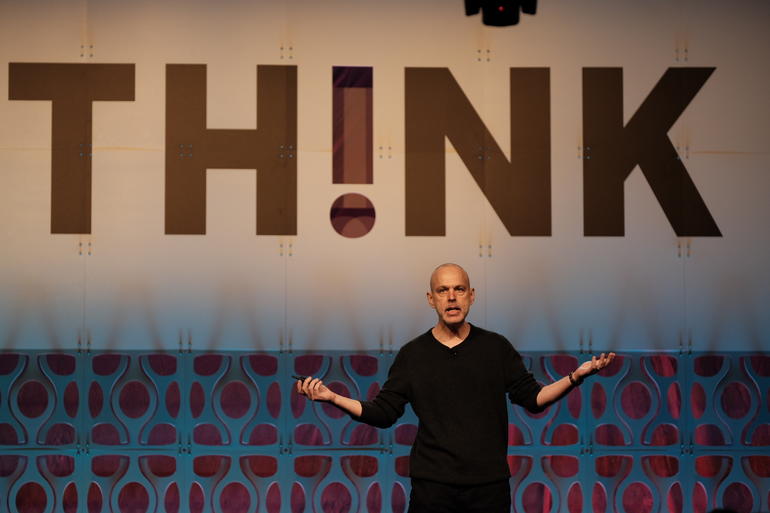
Ken Kocienda addresses THINK meeting.
Kocienda, who had a varied career background before joining Apple, played a role not just on the teams that helped create the iPhone (including its keyboard and, famously or infamously, auto-correct), but also the Safari browser, the iPad and Apple Watch.
The incredible work done to bring the revolutionary iPhone to market 15 years ago continues to be relevant today, according to Kocienda, who said the foundation of success involved four basic themes, each of which he touched on with examples and anecdotes. The four themes were Elements, Molecules, Alchemy and Future.
Elements
According to Kocienda, there are seven elements fundamental to creative work and building products that make lives better.
- Inspiration. This is about “having big ideas and imagining what might be possible. You have to have a big idea to have big results.”
- Collaboration. This is getting everyone pulling in the same direction.
- Draft. This is about applying skills to achieve high quality results and always striving to do better. Kocienda said the Apple team looked to great art from the past as it polished its screen pixels to make the most beautiful icons it could.
- Diligence. This is about doing the necessary grunt work and never turning to shortcuts and half-measures.
- Decisiveness. This is about making tough choices and refusing to delay or procrastinate.
- Taste. This is about developing a refined sense of judgement and finding the balance that produces a “pleasing and integrated whole.” As an example, he cited the “slide to unlock” control on the iPhone screen.
- Empathy. This is about trying to see the world from other people’s perspectives and creating work that fits into their lives and adapts to their needs.
Fitting into Lives
“We dreamed when making the iPhone that it would fit into people’s lives, that it would help them,” said Kocienda. “And it wouldn’t be confusing like your typical TV remote. These are a good tool for 360 analysis. When a project is done, think about how these elements combined to produce the results that you got.”
Molecules
The second theme covered by Kocienda was Molecules. He even showed a graphic that arranged the elements into a periodic table of sorts that he described as highly reactive when used to combine the various molecules.”
As an example, he said two of the elements, taste and empathy, when combined can form intuitiveness.
Alchemy
Under the alchemy umbrella, Kocienda shared examples of mixing elements and molecules while at Apple.
He quoted Apple co-founder Steve Jobs as once stating, “Ideas are not a product.”
“Ideas are important, but they are cheap,” said Kocienda. “It’s important to have inspiration, but ideas are not the ends, they are the beginnings.”
At Apple the big challenge, of course, was how to turn the idea of the iPhone into a product.
“From the beginning the hardware vision was clear: a pocketable, multitouch computer. But we didn’t have the software. We collaborated with this team of designers and they came up with two great software ideas: scrolling and the home screen of icons. This was the software counterbalance. We focused on these ideas for our new OS, and they provided the spirit for our direction. We found our direction and then we committed to it. We focused on accomplishing a few great goals.”
Not Easy
Kocienda described the iOS home screen as “intuitive,” but it was by no means as easy to create as it is to use.
“But what does that mean? Intuitiveness falls back on two essential elements: taste and empathy. Empathy is about developing a feel for what people know, and then tastefully designing for that reaction. Intuitive is based on previous knowledge.”
Kocienda shared with the audience how the screen icons that are familiar to everyone today on their phones came to be.
“One question was how big should the icons be. We didn’t know with the first prototypes how big a touch-target should be,” said Kocienda. “We thought maybe with a little bit of practice people would get very good at touching and we could get 50 icons on a screen. Or maybe they would not get good and we could only get six on a screen? This question turned out to be very, very important.
A Fun Answer
“The solution was fun in the form of the first-ever iPhone game, which happened more than a year before release,” Kocienda continued. “A colleague created a game where there were 20 icons on the screen and you tried to touch as fast as you could. When done it would tell you how many targets you hit and how long it took. After a couple of days discovered the ideal icon size was 57 pixels. Everybody could tap it. We were aiming for comfortable technology. We built on and extended what we already knew to deliver intuitiveness, simple and clear.”
But the size of icons was actually a smaller challenge than creating a functional touch keyboard. Prior to 2007, the Blackberry was hugely popular with its touch keyboard. Apple’s engineers, Kocienda said, had no idea how to build a touch keyboard.
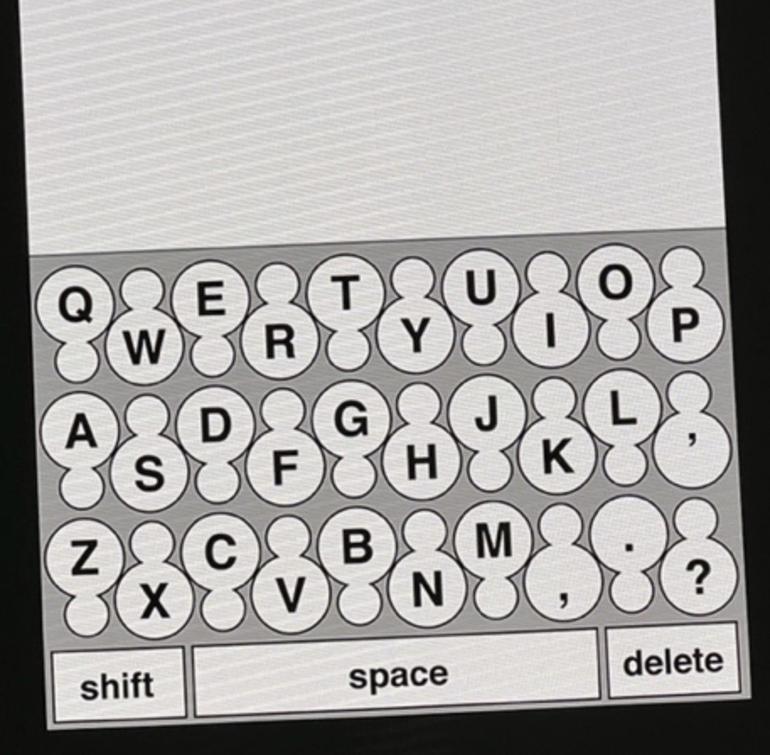
Here is one of the early prototypes for the iPhone keyboard as developed by Ken Kocienda.
“The first idea was to take a normal sized keyboard and shrink it down,” Kocienda said.
But after several demos for such a keyboard went badly, Kocienda said all the software engineers were called into a hallway, told to stop working on whatever they were working on, and get to work on the keyboard.
Kocienda proposed several prototypes that just didn’t work, but in the process he incorporated a dictionary and married it with an algorithm that attempted to guess what the word was to be. The software worked pretty well on short words, but couldn’t guess at longer words with any accuracy.
After numerous fits and starts, the iPhone keyboard was finally developed, and that included auto-correction, for which Kocienda is largely credited. And while auto-correct has led to frustration and memes from many users, Kocienda said it has been critical to the usage of the keyboard.
Future
Kocienda offered three ideas on future alchemy.
“The future is digital. It seems obvious in a way,” he said. “Digital lifestyles have less friction.”
But that digital lifestyle requires several other things if a provider, he said
- “Trust. Nobody wants to feel like the live in the matrix. People need to trust the service we offer. If people don’t trust us, we can’t help them,” he said. “Privacy and security form the foundations of help.”
- Relevance. “We’re all distracted. Our wonderful iPhones sometimes distract us. You want to be the ones there at the moment of a buying decision, a financial decision. We have all these apps and services and options and people competing for our attention. The goal is when people interact with the products and services we make, we need to make it relevant for them.
Be Useful and Meaningful
“Make things useful and meaningful to people,” Kocienda recommended. “That’s what you do. That’s why credit unions exist. If we put empathy at the center and make a master molecule where all the other elements are connected, you get relevance. Empathy makes the difference for a more digital, trustworthy and relevant future.”