CHICAGO–With overall fintech growth rates exceeding 500%, credit unions could easily conclude there is little chance to defend much less recapture market share from the startups.

Samantha Paxson
But one person says that’s not true, and that CUs even have a few advantages.
Speaking to Co-op Solutions’ THINK Conference here, Samantha Paxson, chief experience officer with the company, outlined the hard realities around what is taking place in financial services, the disconnect between what CU leaders think and what members want, and where Co-op has invested significantly in what it believes to be the best path forward for credit unions.
But before plunging into the specifics, Paxson related that she had recently had the opportunity to meet one of her heroes, Indra Nooyi, the recently retired president and CEO of Pepsi. Nooyitalked about two distinct things that helped her be a really good leader, said Paxson.
“She had a tremendous ability to zoom in on a business and really understand the details, and then zoom out. She could then connect what was happening in the environment and then connect it to the details of that business,” Paxson said, explaining she shared the observation because those two things are what Co-op Solutions and the THINK meeting are also striving to do.
The Typical Balance Sheet
Paxson began by zooming in and showing a “typical” balance sheet of a “typical” billion-dollar credit union. The sample CU, like all others, makes money on loan interest, interest on spare cash and fees. And it spends money on interest, loan write-offs and operational expenses. In this case the CU had 0.8% ROA, or $8 million net income. The challenge to this CU, like all CUs, said Paxson, include:
- It’s hard to find new loans
- It cannot charge more on loans due to competition
- Consumers hate fees
- It needs to invest in technology
- It must decide which expenses to cut in a capital-intensive environment.
Paxson quoted Scott Belsky, chief product officer of Adobe, who has twice addressed the THINK meeting, as advising, “Don’t let the urgent get in the way of the important.”
“That is really hard,” acknowledged Paxson, as any credit union is trying to respond to all the market forces surrounding it.
The Hypothesis
In looking for a path forward for any credit union, Paxson said Co-op research has identified what it believes is the best and perhaps only opportunity.
“Payments is that path to growth. Payments is something we are pretty passionate about at Co-op, and what we have found is this is an incredible opportunity for you,” said Paxson.
Paxson pointed to the research Co-op has done with Filene and EY to examine both CU priorities and member and prospect experience with a goal of marrying together those two fields. That research, which has been ongoing, involved approximately 3,000 people, including both members and non-members, over a period of several years. The 2021 research found three market shifts:
- Change in Needs. “Members and prospect needs are no longer straightforward; they have been permanently affected by today’s environment
- Change in Expectations. “Financial experiences are no longer based on FIs, but are shaped by all different industries”
- Change in interactions. Interactions no longer have to be in person
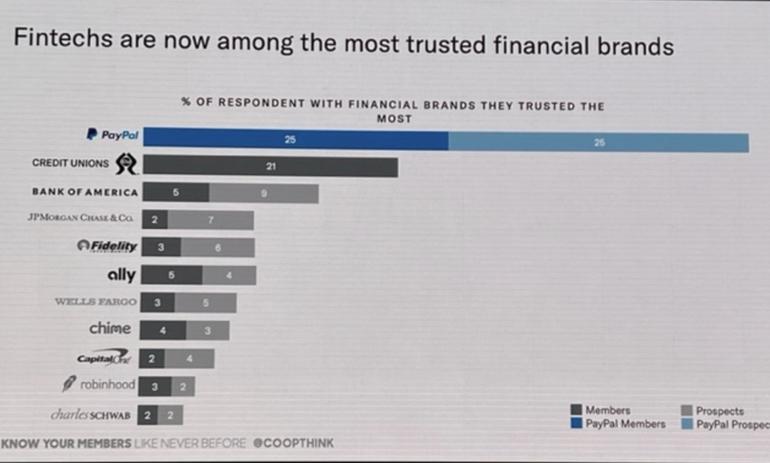
Another change that has also occurs speaks right to a long-time CU advantage, with Paxson noting that in 2021 the most trusted brand in financial services was PayPal, as the slide below shows.
“So, we have a tremendous opportunity when you can deliver on eight basic features,” said Paxson. Those features are outlined in the slide below.
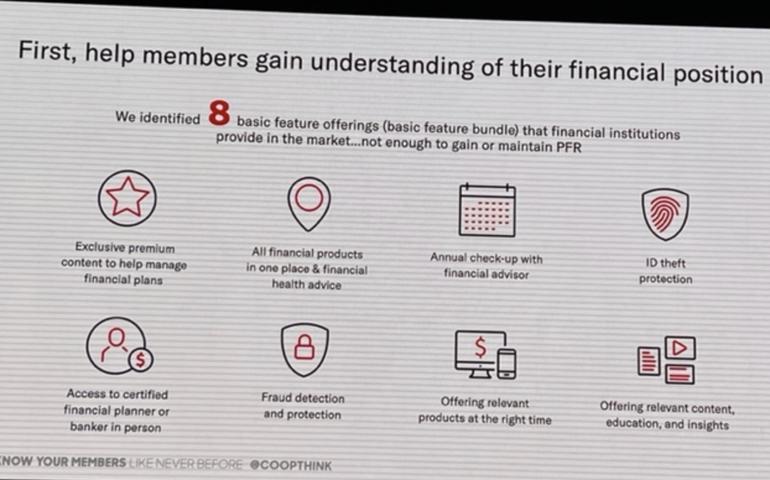
“Adding impactful features to the basics captures market share,” said Paxson. “This is proven. This is something we’re seeing in the market that is working for our competition.”
New Insights
Meanwhile, Paxson said initial Insights from Co-op’s 2022 research with Filene and EY found that while in 2021 consumers reported wanting more digital engagement, in 2022 it has been fintechs making that happen.
“Digital ecosystems are the major competitor,” she said. “Fintechs met the moment. Fintechs were there to meet consumers where they are and where they want to go.”
Fintechs dominate in all the most important digital payment spaces, Paxson noted, including P2P, virtual wallets, contactless payments, social media payments, cryptocurrency and BNPL. Moreover, credit unions trailed fintechs and national banks in terms of “being embedded in your members’ daily habits.”
“These types of use cases are what are driving that stickiness with the member,” Paxson told the THINK meeting. “What we also see here is there is a model for us.”
In the meantime, the data show just which companies are winning the battle for primary financial relationships, with fintechs growing by 505% in recent years, led by PayPal, Chime, Robinhood, Varo, Sofi, Acorns, Mint and more.
“They are coming in and providing consumers with the digital solutions that they expect. This is accelerating,” said Paxson. “We can do this. We have the assets. We have the cooperation. What we also have is an incredible level of trust with your members. I believe trust is character and capability. Our members believe we will do the right thing for them. They also believe we might not have the capabilities to deliver what they expect. They trust that fintechs can meet the moment, and what that is doing is siphoning share.
Differing Priorities
Paxson noted the research done by Filene identified what’s on credit union leaders’ minds, and it often is out of alignment with what members are thinking. Filene found CU C-suiters are thinking:
- Earnings: Evolve the Mix
- Experience. Deepened Member engagement
- Expenses. Manage infrastructure transformation
- Decision making. Capacity is limited
But when it comes to members/consumers, Paxson said, “What we are seeing is a relationship decline. Forty-one percent of consumers said they would consider leaving their credit union because you don’t offer the payments services they need, and 78% believe you might not have the digital payment solutions. Sixty-six percent of members use some form of digital payments, but just 16% do it with you.
“Financial well-being is true to our mission. If we don’t know what they are doing in their daily lives, we can’t help. Research confirms that financial wellness strategies must embrace digital daily behaviors and management tools. “This is a way for you to live your mission,” said Paxson, referring to better understand how members make their daily choices and then helping them to make better decisions.
Potential For 5-Million New Members
Paxson said there is an opportunity add 4.9 million members over the next three years by using a payments-focused strategy.
“We are seeing more connection between digital payments and consumer behavior leading to lending behavior, and that includes BNPL,” she said. “When we do this we’re going to see interchange, marketshare and cross-product-line growth. Bridging the gap between current state of solutions and consumer expectation involves active payment engagement.”
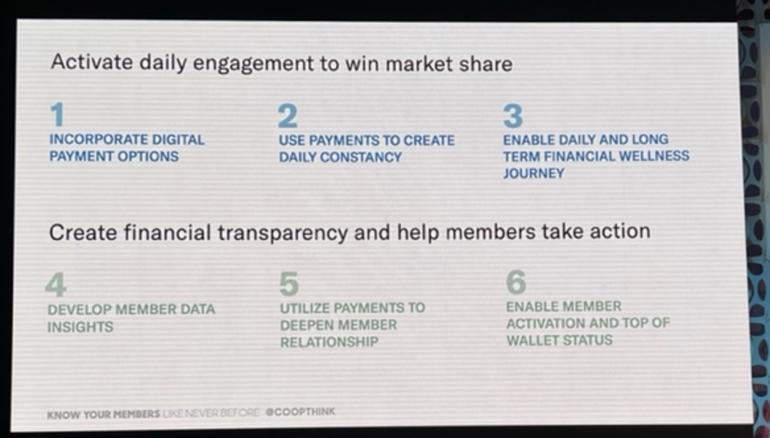
Paxson said there are six steps to activating daily engagement to win marketshare, as outlined in the slide below.