

CHICAGO–If you’re convinced of your management acumen because direct-reports do everything you say, you’ve got a problem, according to one expert, who says many of those workers have simply concluded their work lives “suck.”
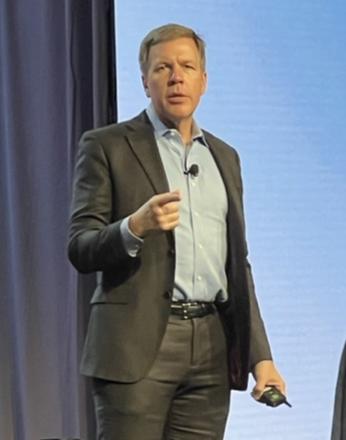
Dave Logan on stage at THINK.
And that’s a reflection of any company's culture, according to Dr. Dave Logan, a senior lecturer at University of Southern California (USC) Marshall School of Business and author of several best-selling books.
While there are four major elements common to every company and organization, Logan says it is culture that is especially important. In addition to culture, the other three elements are strategy, governance, and systems.
Logan has primarily focused on culture in his work USC. Logan also has more than two decades of experiences as an executive and consultant, and he is co-founder and head of transformation and leadership at Care4th, which says its mission is to create a world where people love going to work every day.
Logan, in remarks to Co-op Solutions’ THINK Conference, called the changes over the past few years “massive and industry shaking. I can’t think of an industry that has gone through the seismic shift financial services has.”
Logan said his own observations in spending some time listening to credit unions at the THINK meeting gave him the impression “there was fear in the room," with attendees wondering, 'What are we going to do with this? How do I go back and lead people to be as member-centric as possible and give fintechs a run for their money?'”
In response to that last question, Logan said many people will respond by saying “innovation.”
‘Backward on Innovation’
“But with innovation people approach it backward. It’s not about the idea and then you come up with the process to create it. That is not how it works,” Logan said. “Innovation is about your culture. Most cultures are change-resistant and some are even change-immune so that when change comes up, even when it’s clear to everyone that there needs to change, it doesn’t change”
Culture requires two steps, said Logan: the ability to measure it, and then the willingness to take the appropriate steps to up-level the culture.
“You have to measure the type of culture you have to see how it is going to deal with change. Is it resistant? Change immune? Is it embracing of change? Excited by change?”
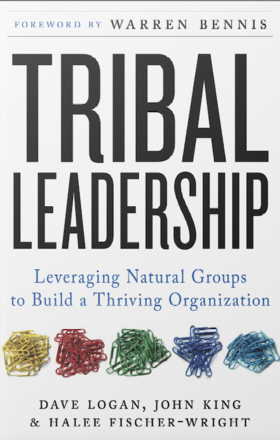
Logan, who is the co-author of “Tribal Leadership: Leveraging Natural Groups to Build a Thriving Organization,” said what is meant by “tribal” in the title is “the people at work.” But not all of the people unless the organization is small.
“I get asked a lot what is the culture like at USC and I answer, ‘I don’t know, the place is too big.’ Some of your credit unions are big and you may not know the culture. So, what we focus on is microculture. It’s a group that’s bigger than most teams but smaller than most business units and organizations. It’s from 20 to 150 people,” Logan said. “What we measured wasn’t people, we measured what we called tribes, and all that means is your people are work.
“Once armed with the view that we could look at culture as a microphenomenon, everything can change. You can change the culture of a microculture in an afternoon. But you need to have retention.”
One Measure
One aspect of culture requires measuring the distance between each individual’s personal core values and then what they have to tolerate at work. For example, Logan said, a company may say it values employees’ feelings but then it tolerates misogynistic or racial jokes in the workplace. That leads people to have to compromise their values at work, and compromised values make for poor cultures, Logan explained.
He further clarified that there can be micro-cultures in larger organizations that are not representative of the whole company.
Five Levels in Organizations
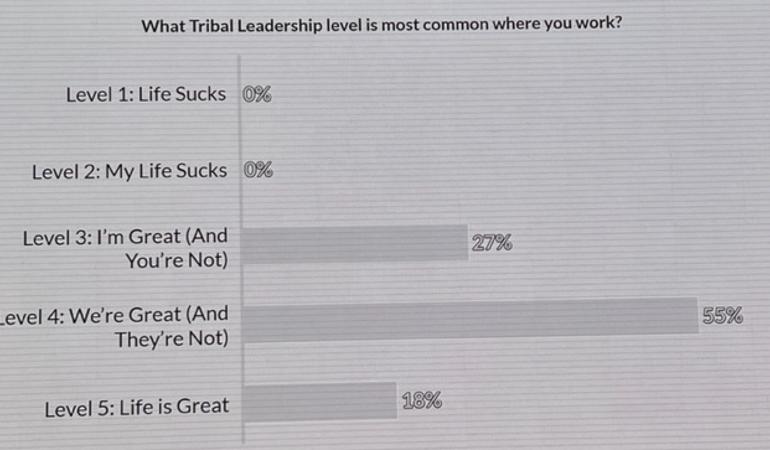
In his and others’ research Logan said there are five employee perceptions/levels of culture in organizations:
- Level I: Life Sucks (2%).
- Level II: My Life Sucks (25%)
- Level III: I’m Great and You’re Not (49%), which is also called a Hub and Spoke work culture. “This is ‘Welcome to any group of experts.’ Welcome to the United Nations, where every person there knows more than anyone else they’ve ever met. The problem is there is no gelling. We can talk about this for five years and it’s groundhog day. It never gels.”
“When we go into companies ‘I’, ‘me’ and ‘my; are the most common things we heard. We would tell bosses you talk a lot about yourself, and they will say they do not and then talk about themselves,” Logan said. “That finding knocked us down. When we ask people questions like, ‘What is your leadership styles?,’ people with lots of I’s, me’s were not getting results at work. Employees say, ‘You’re going to tell me what to do anyway, so why don’t I shut up and wait. I’m going to become passive, because my life sucks’.”
And Logan said there is a common culprit behind why there are so many Level III organizations: management professors such as himself who have been teaching for 30 years that management is telling people what to do, when it isn’t about that at all.
Two Higher Levels
- Level 4: We’re Great (22%). This occurs when employees align around a purpose. “You just don’t want to say ‘I’ all the time,” said Logan. “When ‘we’ manifests, change becomes very fast and even easy. People seek it out. If we’re member-centric, what are we missing? What staff members? What technology? What manual processes do we need to automate?”
- Level 5: Life’s Great (2%)
Logan polled his credit union audience for how they view their levels. The responses are shown below:
So, how can a credit union change its culture? Logan said there are three steps:
- Listen and meet people where they are
- Join them
- Show respect and humility and model the next level
The ‘Biggie’
“This is the biggie. It might go like this: ‘I have been spending a lot of time with people asking, why did you decide to come to work here? What I have heard is we value our members, we want to make a difference in people’s lives. Let’s talk about the sorts of things we might do.'"